
Jonathan Russo is a passionate sailor from New York who took a break from the Northeast spring and headed to the Caribbean for Antigua Sailing Week, where he is filing daily reports for Soundings. This is his third dispatch.
The crew of our Farr 65, Spirit of Juno, felt a steady sense of cohesion in our sailing skills. After a practice day that was cut short by a shredded sail, an around‑the‑island race and a day of round‑the‑buoys racing, the boat felt familiar in nearly every routine. That familiarity translated into speed, smoother maneuvers and fewer hesitations when conditions demanded quick, coordinated action.
On a performance yacht like the Farr 65, small efficiencies add up fast. Tacks became quicker and cleaner as the crew anticipated each move. When Captain Tony called for a sheet to be eased or tightened in preparation for a sail change, hands were already on the line — no second request needed. Raising and dousing sails happened with practiced rhythm, minimizing the time lost during transitions and keeping Spirit of Juno in its lane on the racecourse.
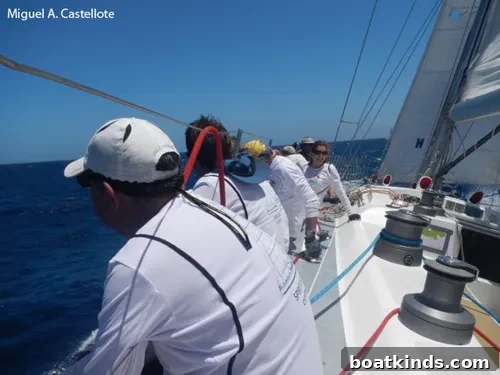
One of the clearest signs of our progress was what I call “high‑side etiquette.” When you sign on for a place on a performance racing boat, your role is not only to run winches or trim sheets but also to contribute ballast. On upwind legs, crew members who are not actively trimming must move quickly to the windward rail and hike out, leaning as far over as safely possible. That weight on the high side keeps the boat flatter, reduces leeway and lets the sails work more effectively — it’s a simple but vital part of fast sailing.
On board Juno, the eight or nine crew who weren’t manning a winch or handling a specific system embraced that responsibility. The captain’s reminders to move to windward became playful nudges rather than sharp commands. The whole boat rose and fell as one with each tack, and the rhythm of movement made the work of the helm, trimmers and pit crew easier and more consistent. That kind of teamwork is the backbone of good performance on any race day.
Day 3 delivered robust conditions: winds around 18 knots and a lively sea state. We were assigned a course that threaded through the smaller boat fleets — more than a hundred vessels of varying sizes and styles. Their spinnakers bloomed in every color, distant patches of pigment floating on the horizon like a pointillist painting come to life. It was one of those perfect sailing moments where the landscape, the wind and the crew’s energy all aligned and made you grateful to be on the water.
Not everything went according to plan. A spinnaker ripped during one of the downwind legs, a frustrating but common hazard when boats are pushed hard in steady breeze. We doused and stowed what we could and continued under jib alone. Sailing conservatively on the jibe and keeping clear of traffic, we stayed competitive and avoided compounding the problem. The way the crew handled the damage and settled into the new plan reinforced that we were learning not just to sail the boat fast but to manage setbacks calmly and effectively.
Back at the dock, the post‑race debrief was upbeat. Captain Tony praised how well we had melded as a crew: the faster tacks, cleaner sail changes, and the instinctive high‑side moves. Mistakes happened — and they will again — but the pattern of improvement was clear. That kind of incremental progress, race after race, is what builds confidence and speed over a regatta week.
Antigua Sailing Week offers conditions that test a team’s skills and patience in equal measure: strong trade winds, crowded racecourses and the visual spectacle of multiple classes on the same water. For a crew learning to operate a Farr 65 together, it’s an ideal proving ground. The combination of competition and camaraderie brings out the best in sailors, and for our group aboard Spirit of Juno, the experience strengthened both technique and trust.
Jonathan Russo has been sailing for more than 30 years. His home port is Shelter Island, N.Y., and he sails his Sabre 38, Sachem, extensively in New England waters.