
How Lithium Batteries Are Replacing Marine Generators: Inside the Fathom e-Power System
For many boat owners, an onboard generator is a necessary compromise: it provides 120-volt power for appliances and accessories when away from shore power, but brings noise, vibration, maintenance and exhaust risks such as carbon monoxide. Traditional alternatives—heavy AGM lead‑acid deep‑cycle batteries paired with inverters—offer limited energy and struggle to support high-draw systems like air conditioning and gyroscopic stabilizers. As marine electrification advances, lithium iron phosphate (LiFePO4) batteries are emerging as a realistic replacement for the conventional genset on production boats.
Large yachts have already adopted lithium battery banks to provide 120-volt power, often alongside a generator for charging when shore power isn’t available. Consumer-level LiFePO4 products from companies such as Battle Born Batteries and Victron Energy support DIY installations for boats and RVs. But Advanced Systems Group (ASG), part of Brunswick Marine, took the concept further. At CES in January 2020 ASG introduced Fathom e-Power, an integrated energy system that combines a high-capacity LiFePO4 battery bank with an intelligent power-management architecture designed to replace a traditional genset. The system’s intent is to make electric power onboard as seamless and invisible as an electric car’s powertrain.
“Most of the Fathom components are off the shelf from ASG brands Mastervolt and CZone,” explains Dr. John Reid, Brunswick Corporation vice president of enterprise technologies. “We built the engineering architecture to make these parts work together as an integrated, safe system. Components communicate on a common BUS network to synchronize load management, battery storage and charging. The boat monitors and manages the system—taking action or notifying the user about system states—so owners can trust the system’s operation.”
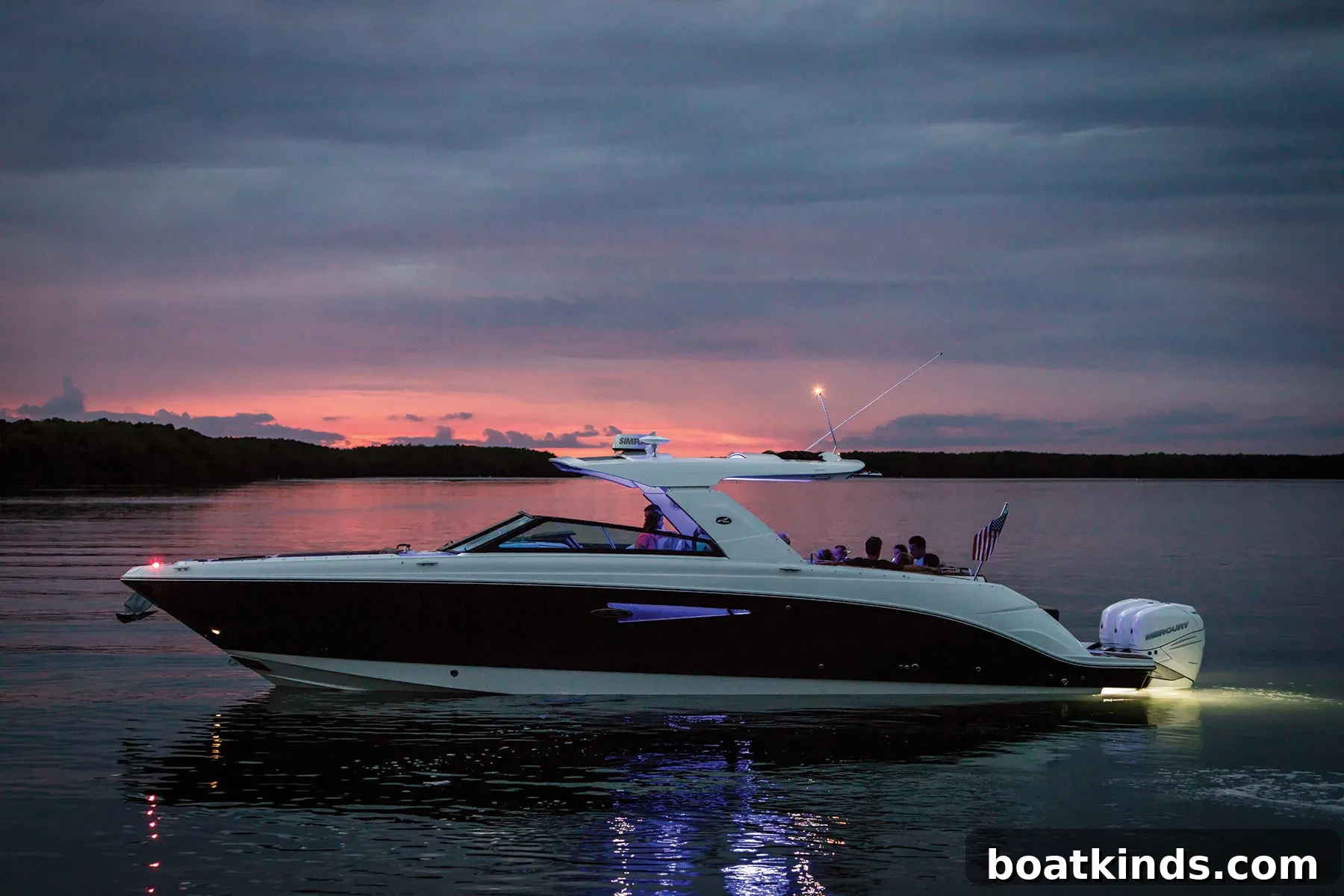
Fathom e-Power became an industry-first production option to replace the standard Westerbeke 7.5‑kW generator on the Sea Ray SLX 400 Outboard day cruiser. The factory-installed solution uses a bank of four Mastervolt LiFePO4 batteries sized to run accessory systems for roughly eight hours before requiring recharge from shore power or the outboard alternators. As an option, Fathom e-Power adds $24,385 to the SLX 400’s base retail price. With typical equipment and the Fathom option, a well-equipped 2022 Sea Ray SLX 400 Outboard approaches a million-dollar price point.
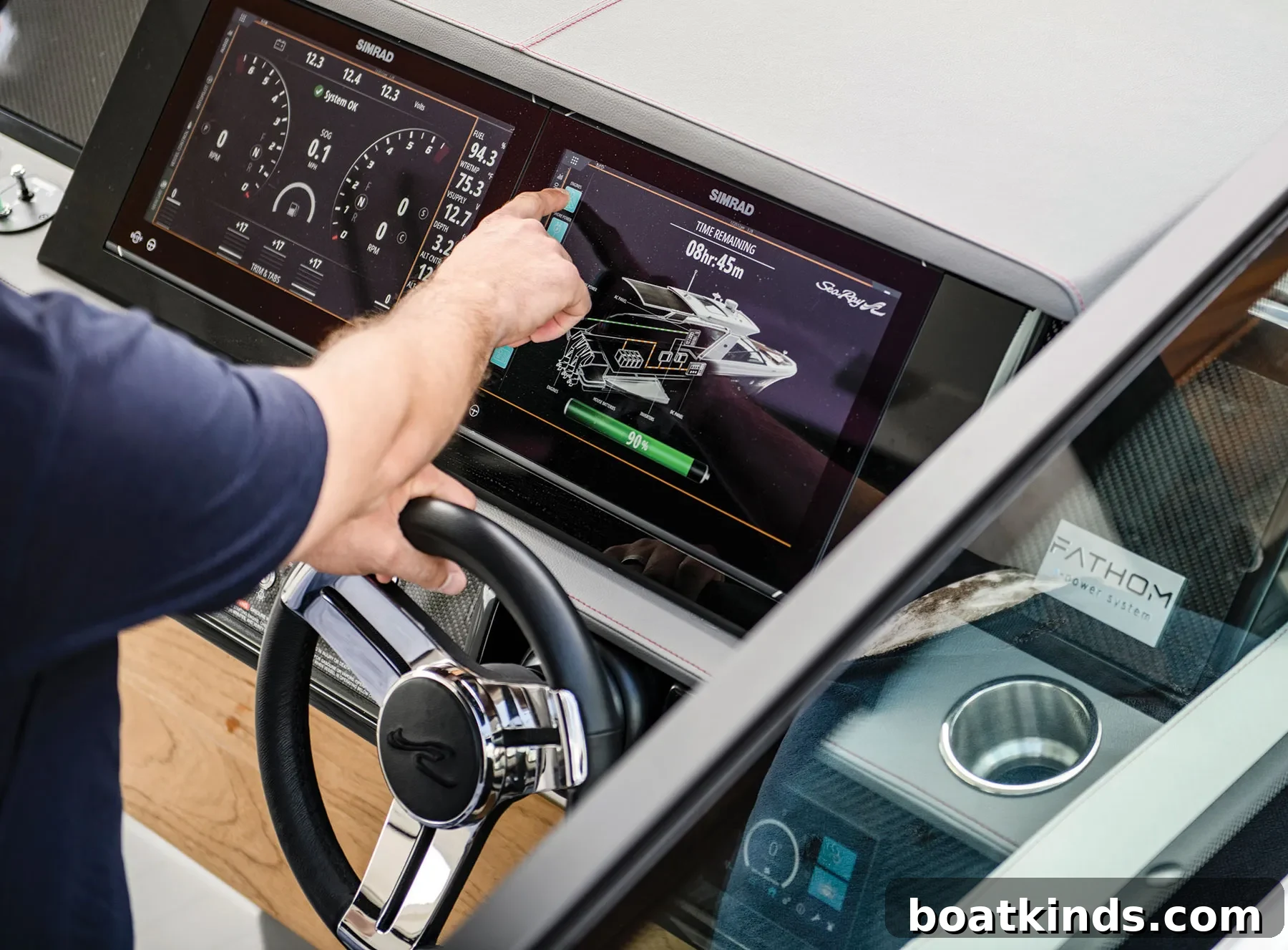
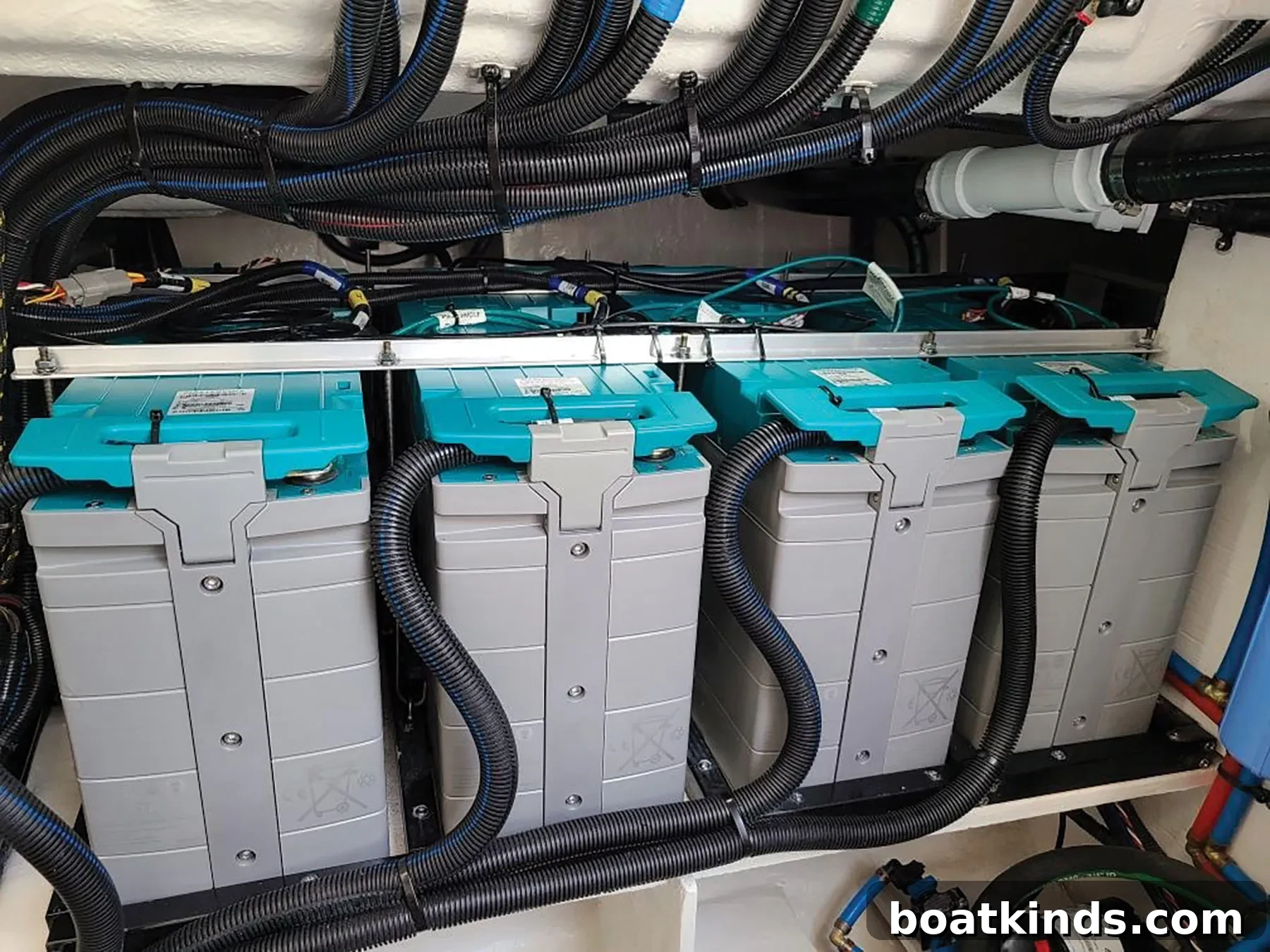
The heart of the Fathom system is a bank of four Mastervolt MLI Ultra 12/5500 LiFePO4 batteries (each listed as 5500-watt/400‑amp‑hour in the Fathom configuration), each equipped with a proprietary battery management system (BMS). The BMS communicates state of charge through CZone to the Simrad multi‑function display (MFD) at the helm, giving the operator clear, real-time information. According to Troy Kollman, director of advanced engineering at Brunswick Boat Group, each battery weighs roughly 125 pounds and the four units occupy about the same footprint as the standard generator. The LiFePO4 bank is about 70 percent lighter than an equivalent lead‑acid bank and is rated for up to 3,500 charge cycles—roughly seven times the life of lead acid batteries.
LiFePO4 chemistry also offers a higher usable depth of discharge (DOD): about 80 percent of stored energy is typically usable (in this system roughly 20 kWh of the total 22 kWh bank capacity). By contrast, AGM lead‑acid batteries commonly provide only 30 to 50 percent useful DOD and suffer shortened life when routinely discharged more deeply—an issue frequently encountered when AGMs are used with inverters to supply 120‑volt loads.
Charging and power conversion are handled by a pair of Mastervolt 6‑kW CombiMaster inverter/chargers that manage shore‑power charging and automatic transfer. With 120‑volt shore power available, a full recharge takes about five hours when onboard loads are inactive. A dedicated Mastervolt Chargemaster 12/25 supports the engine starting batteries, while a Mastervolt Charge Mate Pro smart combiner isolates the LiFePO4 bank from the starting batteries and optimizes charge transfer. When the boat is underway with triple Mercury Verado 300 or Mercury Racing 450 outboards, each engine’s 115‑amp alternator charges the starting batteries. Power is then managed so alternators never directly feed the lithium bank; instead, charge is routed safely from the starting batteries to the LiFePO4 pack. Using engine charging alone, a recharge from 20 percent state of charge takes roughly ten hours, so alternator charging is primarily intended to restore a useful state of charge rather than serve as a rapid recharge method.
The overall system is engineered for a “frictionless” boating experience: run the air conditioning, start the electric grill and operate the water heater or windlass without the generator turning over. The user interface integrated into the Simrad MFD displays percent remaining, time to empty and time-to-recharge based on present consumption and charging conditions, so owners always know their available energy and when to plan a recharge.
Kollman expects other builders will pursue similar integrated battery systems as lithium technology matures. “As we develop Fathom further, we’ll scale it for different boats and markets,” he says. “A vessel headed to the tropics will need more battery capacity for continuous air conditioning than one cruising in cooler climates. Fishing boats have different loads than a day cruiser like the Sea Ray. One attractive opportunity is retrofitting boats that can’t accommodate a genset due to space constraints—we can engineer Fathom to fit where a generator won’t.”
Marine power is clearly shifting toward lithium-based systems. While internal combustion gensets remain common today, integrated LiFePO4 solutions like Fathom e-Power illustrate a future in which quieter, cleaner, lower‑maintenance battery systems provide onboard 120‑volt power—potentially ushering in the gradual replacement of traditional generators on more production boats.
This article was originally published in the November 2021 issue.