
Graves Light: Boston Harbor’s Beacon on the Ledges
A steamer rides at anchor off the Graves ledges in Boston’s outer harbor in 1906. A busy scene unfolds on the landing at Graves Light as crew members unload supplies for the newest Massachusetts lighthouse. Once ashore, provisions and equipment had to be carried up roughly 30 feet to the open doorway—an exhausting and often dangerous task in poor weather.
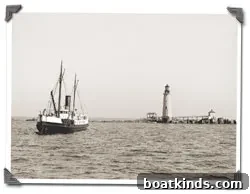
Although the photograph shows calm seas, the conditions around the ledges were frequently harsh. Waves could reach the windows set above the doorway, which opened into the keeper’s office and living quarters. One keeper recalled that opening a window during a storm might result in “three buckets of water in the face,” a vivid reminder of how exposed life was on the rock.
The Graves ledges had long been marked by buoys, but the expansion of the Broad Sound Channel to Boston Harbor for major shipping in 1902 created a clear need for a permanent, reliable light. Soon after the channel opened, a temporary shanty appeared on the rocks to house the work crews, complete with a blacksmith shop, cooking facilities, and basic living quarters. Roughly thirty workmen began the demanding job of transforming the ledges into a secure foundation for a lighthouse.
Construction required blasting a solid base out of the ledge and hauling heavy stone into place. A schooner delivered cut granite from Rockport, Massachusetts, and some of the individual blocks used in the massive base of the tower measured up to seven feet thick. Built on a 30-foot-diameter foundation, the lighthouse rose to a total height of 133 feet and was completed on Sept. 1, 1905. That day keeper Elliott Hadley lit its lantern, bringing a new measure of safety to the approaches to Boston Harbor.
Equipped with a first-order Fresnel lens standing 12 feet tall, Graves Light produced a powerful beam rated at 380,000 candlepower—at the time the most powerful light in Massachusetts. Its range and intensity made it a critical aid to navigation for vessels entering and leaving one of the nation’s busiest ports. Graves was widely regarded as “the most important light north of Cape Cod,” and its presence coincided with a notable decline in wrecks on the ledges—only two such incidents were recorded in its immediate vicinity.
The human side of the lighthouse is as compelling as its technical achievements. Keepers and their families who lived in the tower experienced the relentless assault of wind, spray, and cold. Supplies had to be ferried from anchored vessels and hoisted to the entrance; routine maintenance demanded careful attention to the lantern room, lens, and oil house. The small oil house visible at the right of the photograph served as a fuel store, separated from the living quarters for safety.
Graves Light also found a place in culture and memory. A poet praised the tower’s steady guidance: “Secure on thy rock, the light shines that saves, and guides to the haven, the welcoming Graves.” The lighthouse even appeared on the silver screen in the Hollywood production Portrait of Jennie (1948), starring Joseph Cotten and Jennifer Jones, where its distinctive profile contributed to the film’s maritime atmosphere.
Over the years, the tower has endured countless storms. While the main structure and the oil house remain standing, severe weather has taken its toll on the ancillary features: the original walkway and landing have been destroyed by waves and erosion, altering how supplies and visitors reach the light. Despite these losses, the lighthouse continues to symbolize navigation, resilience, and the long maritime history of Boston Harbor.
This account originally appeared in the July 2011 issue.