
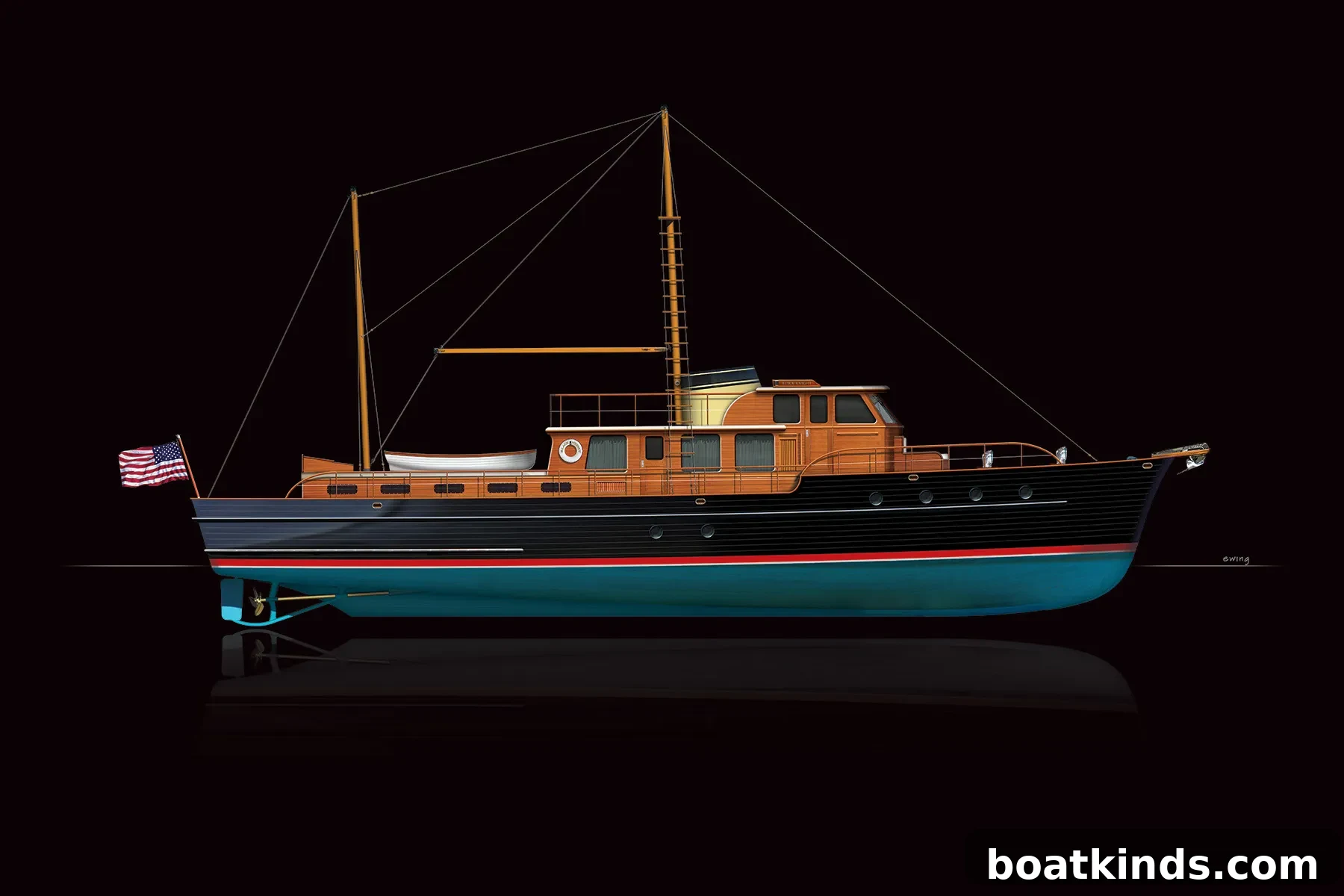
Black Knight: A Striking Race Committee Boat from the 1983 America’s Cup
At the opening of the 25th defense of the America’s Cup off Newport, Rhode Island, in 1983, the cannon was fired from the deck of Black Knight. Loaned by a member of the New York Yacht Club, this visually arresting vessel — with a glossy black hull, gleaming brightwork and classic lines — provided a dramatic and fitting presence for the storied international regatta.
Designer and Original Purpose
Black Knight began life in the 1960s as a purpose-built sportfishing yacht designed by Walter J. McInnis of Eldredge-McInnis, the Boston-based firm he co-founded with Albert Eldredge in 1926. Conceived as a comfortable, capable cruising and sportfishing platform, the yacht measures 82 feet overall with a 20-foot beam and a displacement of 108 gross tons. Twin GM Detroit Diesel engines were installed to provide reliable power and a reported top speed of about 16 knots.
Construction and Original Ownership
Built by the Goudy & Stevens Shipyard in East Boothbay, Maine, the boat was delivered in February 1968 to R. K. Mellon under her original name, Cassiar. The construction and lines reflect the era’s attention to traditional styling married to robust seafaring capability: wooden hull and superstructure work, polished metal brightwork and proportions that balance presence with seaworthiness.
Hull Form and Deck Layout
Original drawings reveal a hull with a flared bow, a rounded entry below the waterline and a deep draft that runs nearly the full length of the hull. The design places protected running gear and balanced rudders high enough to reduce the risk of damage if the boat runs aground. Above the waterline, a broad foredeck offers a spacious working platform at anchor — an advantage for race committee duties — while a Portuguese bridge and a raised pilothouse forward of amidships provide added safety and excellent sightlines.
Interior Arrangement and Crew Accommodations
Behind the pilothouse the yacht’s interior centers on a well-lit salon featuring large windows, some equipped with hand-crank mechanisms to lower them, and twin doors that open onto the side decks. Below the boat deck are three passenger cabins, including a generous owner’s stateroom aft with an ensuite head that includes a bathtub. The vessel was also outfitted with accommodations for a professional crew: quarters for three crew members plus a private cabin for the captain — a practical arrangement for a large wooden yacht that demands ongoing maintenance and attentive operation.
Later History and Legacy
Following the 1983 America’s Cup, which concluded with Australia’s victory, Jan Stenbeck — the multimillionaire backer of the Swedish challenger that year — purchased Black Knight. He used her as a cruiser and for transport to subsequent campaigns in Australia and New Zealand. The yacht has since passed through other owners but remained active and was sighted in Maine in 2022.
Black Knight’s distinctive black hull and elegant lines inspired a sistership: Yorel, now renamed Kizbel, was launched in the late 1980s with a white hull but shared many design cues. Both vessels are reminders of a period when high-quality craftsmanship, classic styling, and capable seagoing performance combined to produce yachts that served multiple roles — from luxury cruising to supporting high-profile sailing events.
Black Knight stands as an evocative example of mid-20th-century yacht design that crossed into the world of competitive sailing support, offering both functional utility as a race committee platform and the visual drama befitting one of yacht racing’s marquee events.
— John Wooldridge
This article was originally published in the December 2022 issue.