
Carleton Mitchell: A Portrait of a Bluewater Sailor
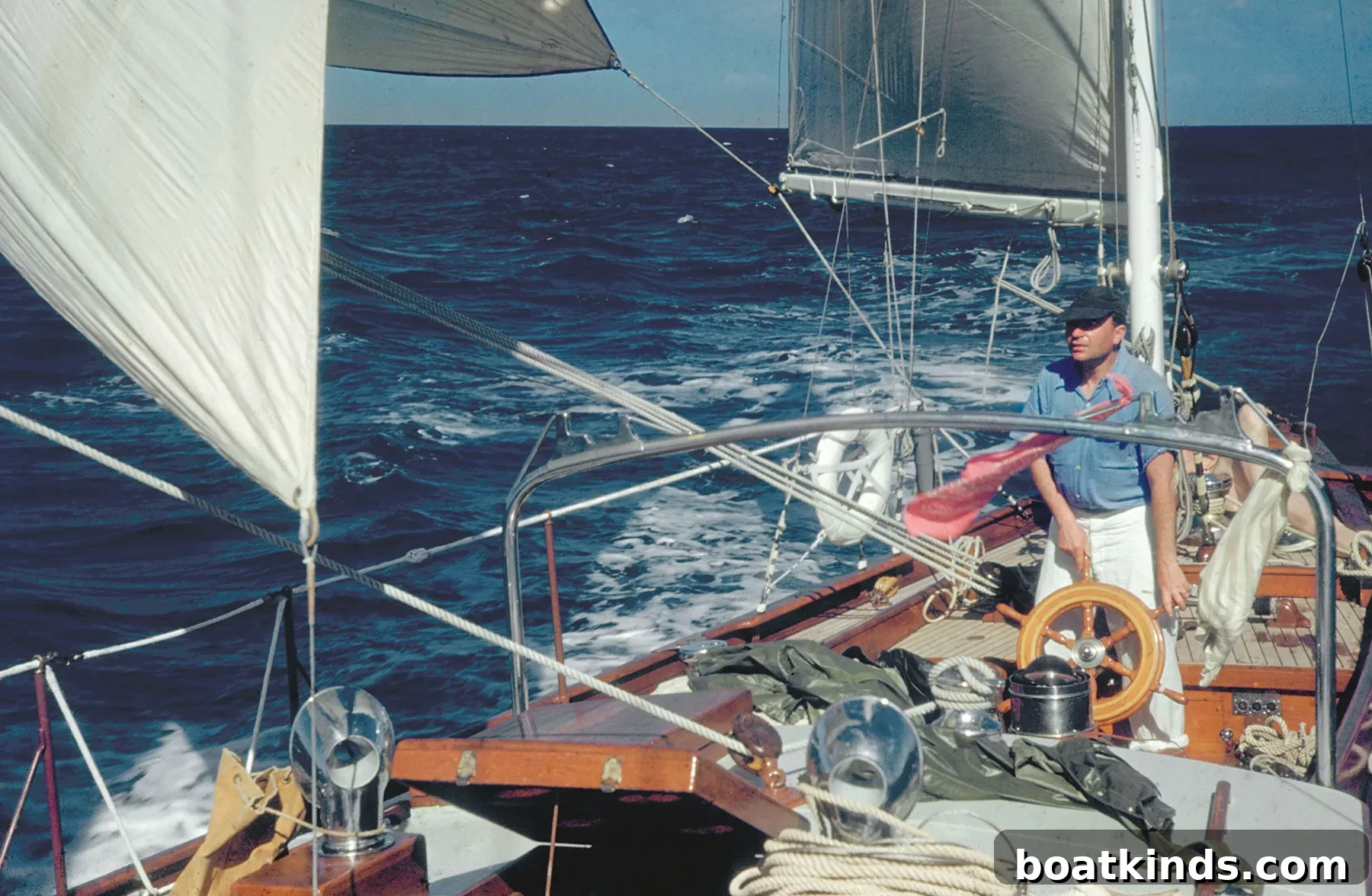
There was a time when sailboat racing captured national attention. Regattas were reported in major newspapers, and skippers and their boats regularly appeared on the covers of popular magazines. In that era Carleton Mitchell stood out: a yachtsman whose skill, temperament and writing helped bring the drama of ocean racing to a broad audience.
Mitchell became a household name among sailing enthusiasts when he earned repeated victories in one of the sport’s most demanding events, the Newport-to-Bermuda race. Sailing his 38-foot Sparkman & Stephens yawl Finisterre, he claimed three consecutive wins beginning in 1956 — a streak that underscored both tactical mastery and the ability to coax maximum performance from a modestly sized bluewater yacht. Those results cemented his reputation as one of the leading offshore racers of his time.
But Mitchell’s influence extended well beyond the racecourse. He was also an accomplished writer and photographer who translated the sensory realities of life at sea into vivid prose and striking images. His words and pictures invited readers aboard, conveying the weather, the weariness and the exhilaration that define long offshore passages. “No 20th-century man can really escape,” he wrote. “But a boat gives a man the opportunity to get away from the turmoil and into direct contact with nature.” This line captures the reflective, almost philosophical streak that runs through much of his work.
Mitchell’s background was unconventional for a man who became such a prominent figure in elite racing circles. A college dropout, a failed novelist and an ex-stevedore, he never fit the tidy stereotype of a yacht club impresario. Instead, he brought a gritty, observational voice to his stories and a hands-on practicality to his seamanship. His earliest exposure to boats came on Louisiana’s Lake Pontchartrain, and that lifelong relationship with the sea shaped his thinking and his craft.
Although best known for his bluewater exploits, Mitchell’s curiosity and appreciation of boats embraced powercraft as well. In 1960 he rode as a passenger on Dick Bertram’s winning entry in the Miami–Nassau race, an event notable for showcasing Ray Hunt’s deep-V hull design to a wider audience. That experience illustrates Mitchell’s broad interest in marine design and performance, and his willingness to study how different kinds of boats behaved in real conditions.
Mitchell was happiest when far from shore, battling the elements mid-ocean. In Passage East, he describes the eerie intimacy and residual isolation of a small crew working together through heavy weather: “Here we are, nine men, driving a fragile complex of wood, metal and cloth through driving rain and building sea. We are driven by our own compulsions, each personal and secret, so nebulous we probably could not express them to our mates if we tried.” That passage encapsulates his ability to portray sailors not simply as technicians but as human beings driven by private motives — yearning, stubbornness, courage and sometimes fear.
His photographs drew praise for their immediacy and sensitivity: one reviewer called them “among the most moving ever made of that beautiful object, a vessel under sail.” Whether capturing crew faces, the heave of waves, or the elegant geometry of spars and rigging, Mitchell’s imagery complemented his writing and enhanced his reputation as an interpreter of life at sea.
Carleton Mitchell died in 2007 at his home in Key Biscayne, Florida, at the age of 96. He left behind a legacy that reaches beyond race results: an enduring body of writing and photography that continues to inspire sailors, photographers and anyone who has felt the call of open water. Mitchell’s work remains relevant for those who seek a deeper, more nuanced sense of what it means to cross oceans under sail.
This article was originally published in the April 2021 issue.