
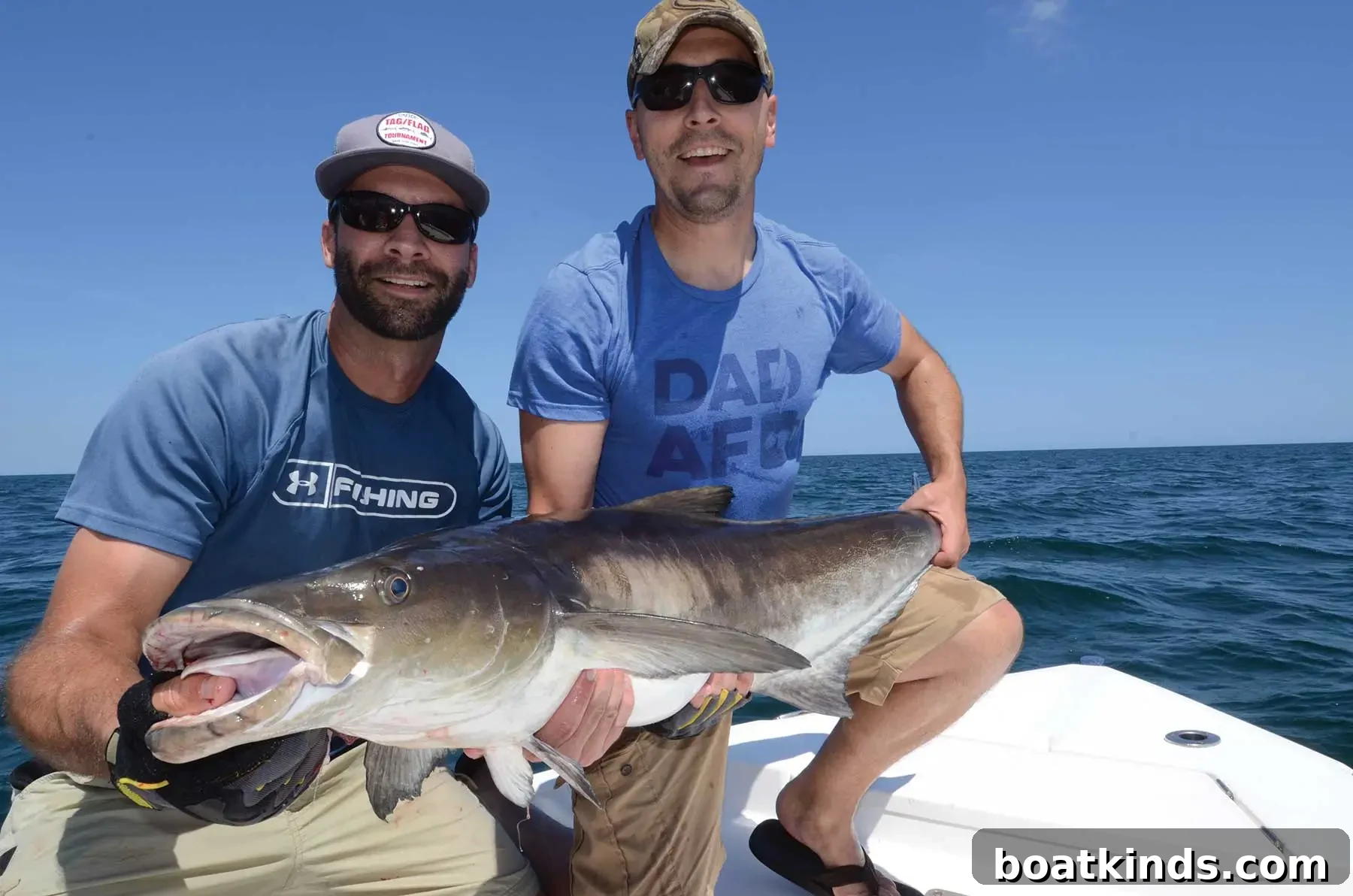
The first time I sight-cast to a cobia I was aboard a 25-foot center console in the Lower Chesapeake Bay with Capt. Ben Shepherd. He was a young captain then, and I was an aspiring outdoor writer discovering a relatively new fishery. We left Lynnhaven Inlet and ran to Thimble Shoal Channel, where Shepherd invited me up into the tower on the T-top.
It was a hot, bright mid-summer day and the clear green water looked lit from below. From the tower I could see a long way—easily a hundred yards—and Shepherd told me the fish would stand out. With the boat drifting along at about four knots, I scanned the water for long, brown shapes.
“There’s one,” he said, pointing. A long cobia eased into view. It wasn’t enormous, but seeing a wild animal unaware of being watched sent a thrill through me. Shepherd eased the boat closer and told me to cast. I loaded a heavy spinning rod and threw a two-ounce bucktail. My first cast landed a little behind the fish. Before I could regroup, Shepherd pitched his bucktail a few feet ahead of the cobia and cranked it into view. The fish struck with sudden aggression, twisted, and the reel screamed as its heavy drag took line.
That moment hooked me. Since then I’ve spent many summer days searching the lower Chesapeake and the mid-Atlantic coast for cobia, joining a growing number of anglers who plan their summers around sight-casting for these migratory fish. Over the last decade tighter regulations and apparent population growth have improved the fishery, and an enthusiastic community of cobia anglers—often called cobia cowboys—now chases these fish up and down the coast. Tournaments pay out substantial prizes, sight-casting towers have proliferated, and sightings have pushed farther north in recent years.
Cobia on the Chesapeake
Capt. Zach Hoffman of Salt Treated Fishing is one of those dedicated cobia captains. Raised fishing for bass, Hoffman switched focus after catching his first cobia and went straight into the charter business after high school. His 30-foot Privateer, Clockwork, is outfitted specifically for sight-casting: three control stations let him run the boat from the wheelhouse, the cockpit or an elevated tower, while a single diesel engine allows the boat to cover long distances efficiently. “Sometimes we run up to 80 miles in a day in search of cobia,” he told me.
We ran the middle bay off Seaford, Virginia, navigating shoals and shipping channels between Hampton and Cape Charles. Hoffman explained the seasonal pattern: the first cobia typically show off Hatteras in mid-May, arrive off Sandbridge and Virginia Beach by June, then move into the Chesapeake in July and peak through midsummer from the mid-bay channels to the Chesapeake Bay Bridge-Tunnel. By late summer many fish can be found near the mouth of the bay, and in recent years cobia have been seen as far north as Maryland and Delaware; a Delaware state record was set in 2018.
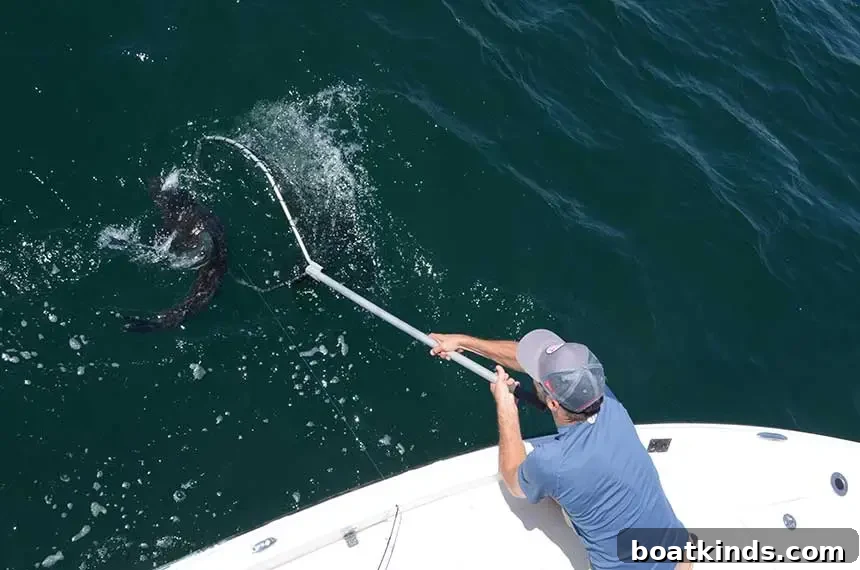
On a mid-August Saturday in the Lower Bay we found ourselves among a couple dozen boats. Hoffman prefers searching with the sun at his back; a bit of chop actually helps to see the fish, while clouds make them disappear. From his tower Hoffman can spot cobia as far as 100 yards away. He works tide lines, bait schools and even turtles, because cobia are curious and often hang around structure.
When we located fish Hoffman would angle the boat toward them but keep a respectful distance—often the fish will approach the boat on their own. There’s no simple rule for why cobia surface or where they’ll appear next; patterns can be inconsistent and the fish can show up in different spots day to day. Still, sight-casting doesn’t require fancy gear or a tower: anglers can stand on a cooler or the bow and pick out cobia when conditions allow. Hoffman advises newcomers to follow the seasonal movements and avoid crowding the fleet.
Tackle As Art
Sighting cobia is only half the challenge. Rigging for the cast and winning the fight are equally important. For most anglers a couple of rods, several jigs and a bucket of live eels will suffice, but attention to detail makes the difference on big fish.
Capt. Aaron Kelly, who has guided from Oregon Inlet, North Carolina, for more than two decades, helped pioneer the modern approach. Early on he learned from Florida guides, where sight-casting to cobia has a long tradition. Florida bucktails tended to be heavier, with large, stout hooks and skirts made from deer hair, feathers and flashy materials designed to provoke an aggressive strike. Kelly embraced that style and began building his own cobia jigs, eventually marketing them under the Meathog label.
Today’s cobia jigs are craftsmanship: lead heads in several shapes, deep glossy finishes and swirls of color built to withstand a cobia’s rough bite. They hide large, heavy-gauge hooks—sometimes up to a 10/0 gap—behind dense skirts of deer hair, feathers and flash to create enticing movement.
Kelly recommends starting with two medium-heavy spinning rods. A longer rod—around eight feet—helps with casting distance and accuracy. Pair the rod with a high-capacity, high-drag spinning reel. Spinning rigs perform well in windy, open-water conditions because the line passes smoothly. Spool several hundred yards of line with 50-pound braided line and attach a three-foot length of 80-pound fluorocarbon leader. Braid casts farther and has less stretch, which helps you set the hook cleanly when a cobia hits.
Many cobia guides carry a second rod rigged with a live eel on an 8/0 hook as a fail-safe. Kelly keeps eels in a bucket with a few inches of water and will switch baits if a fish ignores the bucktail.
After decades on the water, veterans like Kelly say the fishery is thriving. “Even with all the anglers, we’re seeing more fish than the old timers,” he told me. For anglers new to cobia, his advice is simple: start looking. When conditions are right and you train your eyes to the water, cobia will reveal themselves.
This article originally appeared in the July 2020 issue.