
Brothers Complete 8,312-Mile Atlantic Crossing in 21-Foot Open Catamaran
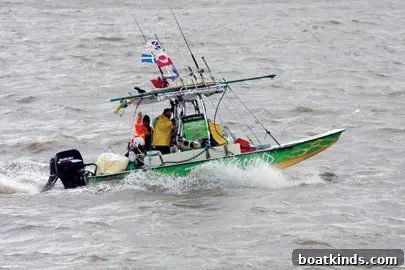
Two Florida brothers, Ralph and Robert Brown, completed an 8,312-mile ocean voyage that took them from Tampa, Florida, across the Atlantic to Germany in a 21-foot open catamaran. The journey, carried out to raise funds for charities supporting wounded service members, tested their seamanship, endurance and the seaworthiness of a small, center-console flats boat engineered for shallow-water work but pressed into a long ocean passage.
Route, Timing and Purpose
The brothers set out from Tampa on June 27 and completed the crossing on September 10, a voyage that took 76 days in a series of legs. Their itinerary followed the U.S. East Coast northward into Canadian waters before heading across the North Atlantic toward Europe. The trip was organized as a fundraiser for groups assisting wounded soldiers, and it also served as a personal tribute: the voyage commemorated three of Ralph Brown’s Marine Corps comrades who lost their lives during a 1980 operation connected to an attempted hostage-rescue mission.
The Boat and Equipment
The boat is a 21-foot center-console catamaran flats boat designed by Ralph Brown, who runs Dream Boats in Hudson, Florida. Foam was injected into the hulls to ensure buoyancy and an unsinkable structure, a key safety feature for such an ambitious crossing in a small open craft. Propulsion came from a single 140-horsepower Suzuki four-stroke outboard, with an auxiliary 9.9-horsepower Suzuki kicker for lower-speed, fuel-efficient cruising when needed.
Onboard safety and communications equipment included an emergency position-indicating radio beacon (EPIRB), two satellite phones, a VHF radio, life jackets and survival suits. Those systems, combined with the boat’s buoyant construction, were central to managing risk during long stretches of open water and severe weather.
Major Challenges and Conditions
Even in a well-prepared small craft, the North Atlantic presented severe conditions. The team reported that their practical handling limit was roughly 12-foot seas. Between the Shetland Islands and the Orkney Islands off Scotland’s north coast, they encountered breaking waves of 12 to 15 feet accompanied by gale-force northerly winds while they were making a southwestward course. On at least three occasions the boat nearly capsized; the brothers debated whether to deploy a sea anchor but chose to continue powering through the conditions.
The single longest leg of the passage was the 593-mile crossing from Canada to Greenland, where they encountered persistent 7- to 9-foot waves and faced a fuel shortage that forced them to deploy the sea anchor and wait for the winds to change. For the final stretch of approximately 180 miles on that leg, they relied mainly on the kicker motor for its better fuel efficiency.
Seamanship, Preparation and Outcome
The voyage required careful planning, conservative seamanship and a clear focus on safety. The Browns’ experience highlights how preparation—boat design, redundant communication systems, and safety gear—can make long-distance passages feasible even in small open boats. Their decision-making under pressure, such as when to use the sea anchor and when to change engines to conserve fuel, demonstrates the practical choices bluewater small-boat sailors must face.
Beyond the technical achievement, the crossing was driven by purpose. The mission aimed to raise money for charities that support wounded soldiers and to honor fallen comrades from Ralph Brown’s Marine Corps unit. The brothers completed their voyage after 76 days at sea, arriving in Germany on September 10 and closing a passage that combined adventure, commemoration and charitable intent.
Further Information
For background information about the boat design and the crossing, the brothers referenced Dream Boats (www.dreamboats.net) and maintained information about the voyage at www.crosstheatlantic.com. This account originally appeared in the November 2009 issue.