
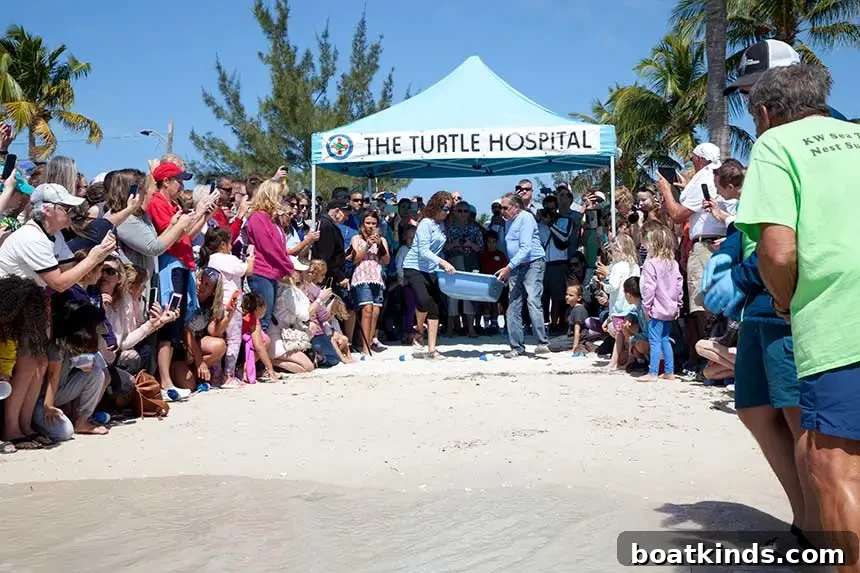
At first glance, Richie Moretti doesn’t look like a celebrity of sea turtle conservation. Short in stature and wearing blue jeans, his dark hair tied in a thin ponytail, he could blend into any crowd—except the one gathered on a bright, breezy Saturday at Higgs Beach in Key West, Florida. Locals and visitors have come for a noon release: The Turtle Hospital in Marathon is returning a rehabilitated sea turtle to the Gulf waters.
“Richard, how ya doin’?” calls a man in a key-lime-green T-shirt labeled Key West Sea Turtle Club Beach Patrol. “We’re here to help!”
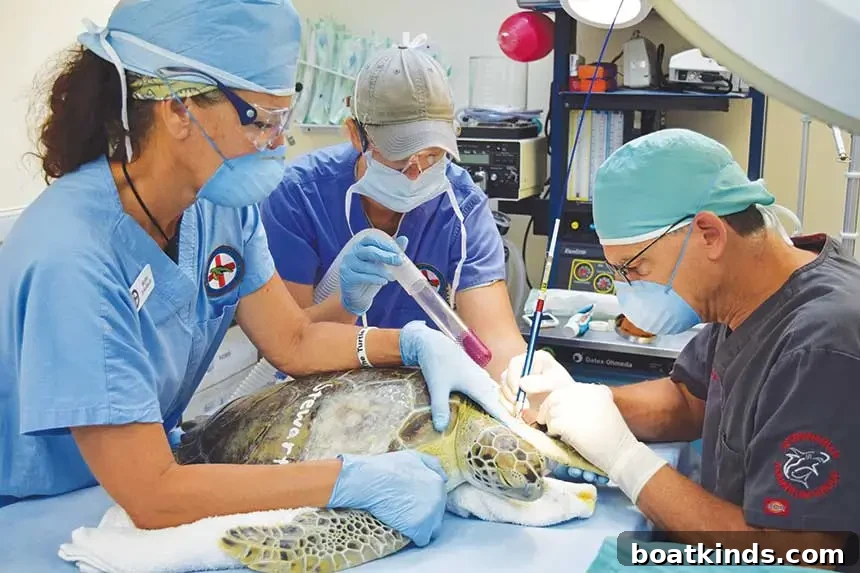
Moretti smiles, thanks him, and together with hospital manager Bette Zirkelbach they lift a plastic tub from the turtle ambulance—a white Chevy van with bright orange stripes—and carry the patient under a shaded tent. The star of the day is Tommy, an eight-year-old green sea turtle weighing about 40 pounds. Found floating in Tavernier Creek ten months earlier, Tommy’s eyes and mouth had been obscured by tumors caused by a herpes-type virus known as fibropapilloma. After four surgeries, including work by a veterinary ophthalmologist, he is healthy and ready to return to the ocean.
People learned about the release through local radio and social media; now dozens of children press forward, asking Moretti questions about Tommy’s treatment and recovery. The scene highlights the public-facing side of the nonprofit: education and conservation outreach are as central to the hospital’s work as veterinary care and research.
The Turtle Hospital in Marathon is unique in the United States for combining sea turtle rescue, rehabilitation, research and public education under one roof. The facility has led national research into fibropapilloma, a potentially fatal disease that can immobilize turtles by overtaking soft tissue and impairing sight and feeding. Hospital veterinarians also treat more familiar injuries—entanglement in fishing gear, ingestion of plastic and balloon debris, and boat-propeller strikes—using advanced surgical techniques to remove growths and restore mobility and vision.
Alongside clinical work, The Turtle Hospital offers popular tours guided by a team of 21 full-time and five part-time educators. Visitors receive briefings on sea turtle species, biology, human-caused threats, and conservation best practices; they may witness veterinary procedures and always visit the rehabilitation pools. One pool houses approximately 18 turtles that cannot be released due to permanent injuries, while others undergo treatment and recovery before being returned to the wild. To date, the hospital has successfully released more than 2,000 sea turtles back into their natural habitat.
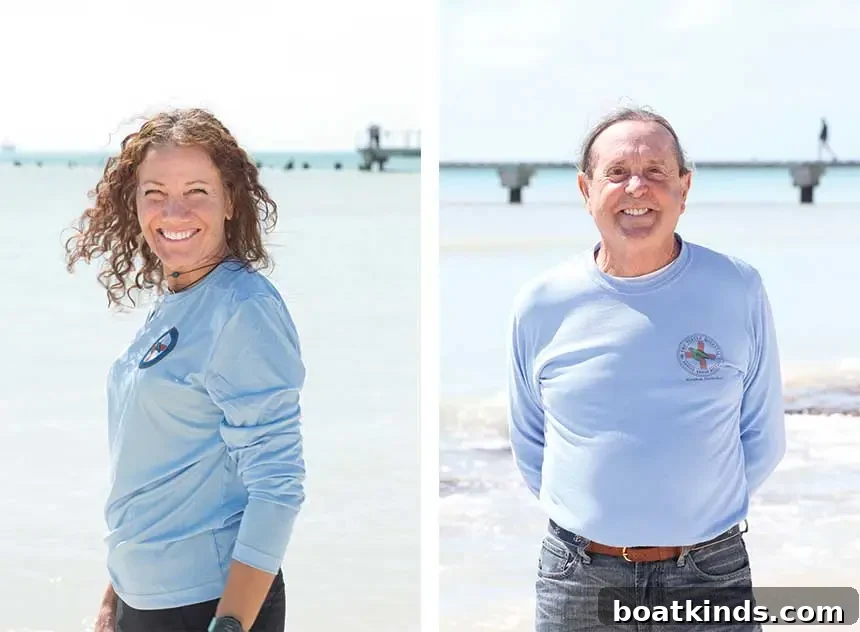
“Last year we had 85,000 visitors,” Zirkelbach says, emphasizing the role of public engagement in sea turtle conservation. “Six out of ten of our rescue calls come from people who visited here. They’re out fishing or boating, they see a sick or injured turtle, and they call it in. Educating people on the water is our best hope for protecting marine life.”
Moretti traces his path to sea turtle work back to boats. In 1980, during the Mariel boatlift, he trailered his 27-foot Glastron from New Jersey to Florida intending to help. Although the Coast Guard declined his assistance, he discovered another opportunity: dozens of struggling motels in the Florida Keys. An ambitious young man, he successfully bid on one property that included a 100,000-gallon saltwater pool directly fed by Florida Bay.
He later sold a Volkswagen repair business and moved to the Keys to run the motel with Tina Brown. After buying a 48-foot sportfishing boat and competing in local tournaments, they began keeping fish in the motel’s pool simply to observe them. The pool soon hosted permit, snook, jewfish and other species; schools began bringing students to touch starfish and conchs and learn about marine life firsthand.
When the Teenage Mutant Ninja Turtles craze inspired children to ask for turtles in the late 1980s, state wildlife officials refused—sea turtles are protected—but they offered a different proposition: the state needed someone to rehabilitate injured sea turtles. Moretti accepted the challenge. Early cases often involved turtles entangled in fishing line or rope; simple rehabilitation and, when necessary, amputation by local vets could return many animals to health.
Over time, Moretti encountered turtles covered in tumor-like growths he did not know how to treat. He added observation tanks, isolated affected animals, and invited scientists and veterinarians from across Florida and the country to study the lesions and potential treatments. In a 2014 podcast called Talking Animals, he recounted those early learning experiences and the community effort that helped The Turtle Hospital evolve into a center for sea turtle medicine.
Moretti met Zirkelbach while both volunteered as aerial wildlife observers during Key West powerboat races. Zirkelbach, a former marine biology student who traded a corporate life near Philadelphia for nonprofit work, joined the hospital in 2012 to help turn it into a self-sustaining nonprofit. Since then she has driven major growth in outreach, fundraising, and scientific collaboration.
Under their leadership, The Turtle Hospital has pursued ambitious projects: creating a turtle blood bank, supporting peer-reviewed research into fibropapilloma, and organizing the first comprehensive health survey of green turtles in the Keys. The organization now occupies an adjacent building Moretti bought—and converted from its former life as a nightclub—housing animal care staff, visiting veterinarians, retail and maintenance, and two research labs. Moretti transferred the entire property to The Turtle Hospital with legal restrictions to ensure it remains dedicated to rescue, research, and rehabilitation.
Today, Moretti also uses a 34-foot Fountain to escort newly hatched or disoriented sea turtles offshore and release them into protective Sargassum mats that offer shelter and food for young hatchlings. His fast boat and three large engines attract attention when rescuers arrive to help an injured turtle—an image he admits is atypical but effective.
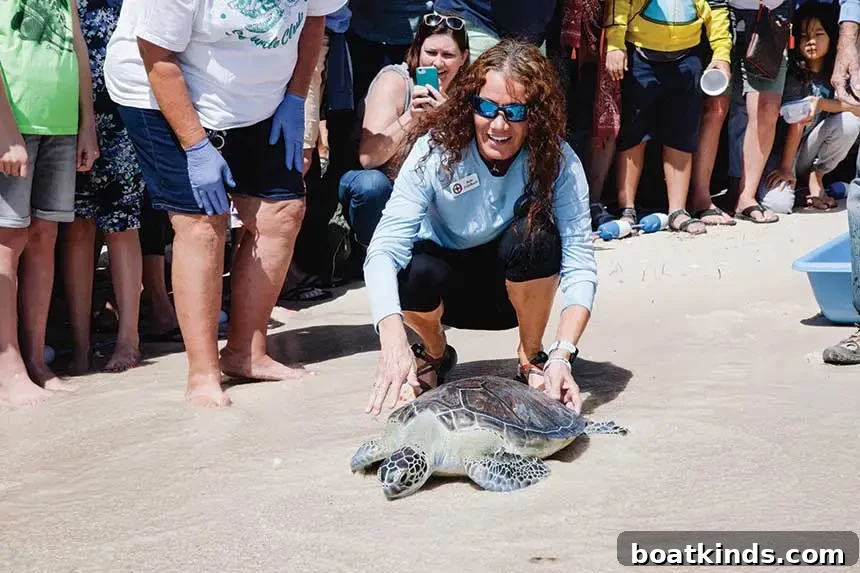
Back at Higgs Beach, Zirkelbach finishes her talk: slow down when you see a turtle, keep fishing line and plastic out of the water, and report injured animals promptly. Then she and Moretti walk Tommy down a sandy aisle lined with cheering onlookers. At the water’s edge they set him on the sand; he pauses only a moment before a small wave carries him away.
“You can see what I’m talking about,” Moretti says, hand over his heart. “That turtle was almost gone. Now he’s in the ocean. There is nothing like the feeling of fixing these dinosaurs and helping them live.”
This article originally appeared in the May 2020 issue.