
The ship’s wheel Bob Fuller shows off is a thing of beauty.
Curved, carefully shaped pieces of teak are joined and highlighted with holly and ebony inlays that radiate from a tooled, polished and engraved bronze hub. It’s the kind of wheel that suggests a boat could cross any sea and still look timeless.
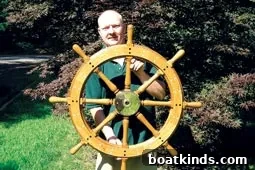
Fuller, who made the wheel, sits in his Halifax, Mass., boat shop and talks about the influence of his grandfather, Charles Fuller, who taught him the craft. The wheel is both a practical instrument and a testament to three generations of hands-on boatbuilding and pattern-making.
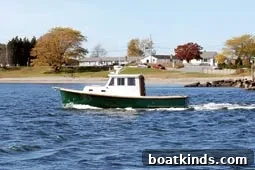
Bob Fuller, now 48 and owner of South Shore Boatworks in Halifax, grew up around boats. He began as an apprentice at Industrial Patterns, where his grandfather and father, Robert, worked. The local shop combined boatbuilding, repair and pattern-making for hardware; those combined skills and a strict work ethic are evident in the pieces Fuller produces today, including Sandpiper III—the first South Shore Boatworks Gurnet Point 25 powerboat launched last August.
Fuller still works close to home—his shop sits across the street from where he grew up—and he reflects on how rare it is today for a young person to learn a trade from both their grandfather and father. “They were perfectionists,” he says. “That’s how I look at things: it’s not right until it’s right.”
Today his younger brother, Charles, runs Industrial Patterns, and the brothers collaborate when a job calls for it. That overlap of experience and exacting standards shows up in every custom wheel, bronze fitting and teak detail that leaves Fuller’s shop.
Creating a lobster yacht
Fuller opened South Shore Boatworks in 1990. The shop produces ship’s wheels—some made for other manufacturers and some built as one-off customs—restores and repairs wooden and fiberglass boats, constructs Grand Banks dories and makes patterns for custom bronze hardware. Fuller’s team includes long-term employees such as Joel Clemons, who brings extensive woodworking and drafting skills, and Andrew Campbell, who handles carpentry and fiberglass work. Together they handle most aspects of a build or restoration in-house.
Those combined skills came together in Sandpiper III, the first inboard Gurnet Point 25. The hull was designed by Jamie Lowell of Lowell Brothers, a firm with deep roots in lobster-boat design. Sea Glass Technologies in Bristol, R.I., laid up the hull, and Fuller’s shop completed the custom fit-out.
Fuller’s original idea was a simple, trailerable, inboard-powered lobster-style boat about 25 feet long—an easy-to-own, efficient platform that could serve as anything from a pocket lobster yacht for a cruising couple to a rugged center-console fishing boat. After years of sketches and mockups, Fuller laid the keel in November 2008 for owners who were downsizing from a 44-foot passage trawler and wanted a comfortable dayboat with overnight accommodations.
The owners found South Shore Boatworks and the Gurnet Point 25 online, visited the shop, and worked with Fuller to define cabin layout and amenities. Their experience and clear preferences made the custom build a collaborative process from the start. Sandpiper III was launched from Standish Boat Yard in Tiverton, R.I., at the same yard where the boatbuilder Will Frost worked in the 1940s—a small nod to local boatbuilding history.
Sandpiper III
Sandpiper III is the lobster-yacht variant of the Gurnet Point 25. Other configurations include bass-boat, center-console with trunk cabin, and open center-console versions. This particular build features an extended hardtop, a V-berth, and a cruising cabin fitted with an enclosed head, a single-burner stove and a traditional ice box. Even the cabin sink uses a brass hand pump, reinforcing the boat’s timeless feel. To ensure the owners were satisfied with space and ergonomics, Fuller’s team mocked up the interior in plywood so the owners could experience the cabin’s scale before finalizing details—something Fuller says a computer drawing can’t replicate.
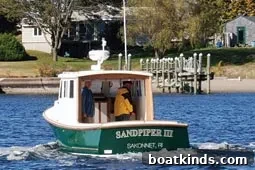
The hull and deck are molded using vinylester resin and gelcoat with Divinycell closed-cell foam coring. Stringers are made of dense Penske Board—now branded Airex PXC—and are glassed over to create a stiff, lightweight structure. “Out of the mold the hull weighs maybe 1,000 pounds,” Fuller explains. “So it doesn’t take much to drive this boat through the water.”
The hull follows a semidisplacement profile with a full keel, a protected prop and a skeg rudder—traditional elements of a built-down lobster-boat form. A long, even sheer runs from the tall spoon bow to the curved, tumblehome stern, helping the boat handle follows and quartering seas. Power is provided by a single diesel: Sandpiper III carries a 180-hp Yanmar mounted in a custom cockpit engine box that doubles as seating. During sea trials the boat reached 21–23 mph at top speed and cruised at 17–19 mph while burning about 3.5 gallons per hour.
Timeless and easy
The Gurnet Point 25 was conceived primarily as an inboard model, though it can be adapted for outboard power. Fuller says most buyers prefer the inboard layout because placing the engine deep amidships complements the hull’s design and performance. Sandpiper III showcases custom details throughout: the cockpit sole, gunwales and cabin sole are teak; a teak-and-bronze anchor platform was crafted for the plow anchor; and the helm is fitted with a six-spoke, 22-inch teak ship’s wheel, trimmed with holly and finished with a polished bronze hub engraved “Sandpiper III.”
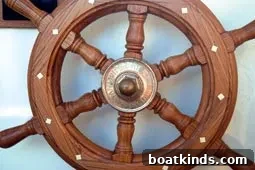
Fuller calls the wheel “an eye-catcher,” but the build’s value is more than cosmetic. The Gurnet Point 25 inboard lineup—typically powered by a 160-hp Volvo or a 180-hp Yanmar—ranges from about $80,000 for basic center-console versions to just over $110,000 for cabin-equipped bass and lobster-boat models. Outboard configurations are less expensive, generally $60,000 to $90,000, though those prices do not include engines.
Fuller believes the design offers long-term value: it’s efficient to power, economical to run, and versatile enough to be finished to an owner’s preferences. He already has a second hull molded and continues to see renewed interest in the timeless style and practical performance of the Gurnet Point 25.
Contact South Shore Boatworks for more information.
This article originally appeared in the New England Home Waters section of the June 2010 issue.