
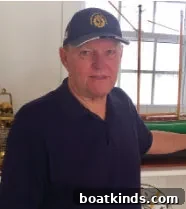
At 17 I joined the schooner Bluenose II as a deckhand while she was anchored off St. Lucia in the West Indies. My father was a close friend of Captain Ellsworth Coggins, master of the original Canadian racing schooner Bluenose. In the early 1960s the Oland family of Nova Scotia commissioned a replica at the Lunenburg shipyard and named her Bluenose II. She called on Marigot Bay many times when I was young, and we would watch her long black hull slip slowly into the inner harbor. The crew often dropped the anchor to windward before running stern lines to the coconut trees on the sand spit.
My father, who ran a small fleet of schooners out of Marigot Bay, had spoken to Coggins on my behalf. As part of an agreement with my parents about not returning to school, I promised to gain sea experience on vessels other than my father’s. They felt it would do me good to leave the bay and learn to fend for myself. I loved the islands, but I agreed.
By circumstance and with my father’s support I secured a place on Bluenose II. There was a long waiting list of Canadian lads hoping for the same chance, so I knew I was fortunate. I signed the ship’s book in the chart room with Captain Coggins and went on deck to learn the routine. When I asked seaman Dave Rawding what O.D. stood for, he grinned and said, “Ordinary seaman — mush for brains.” It was all in good humor.
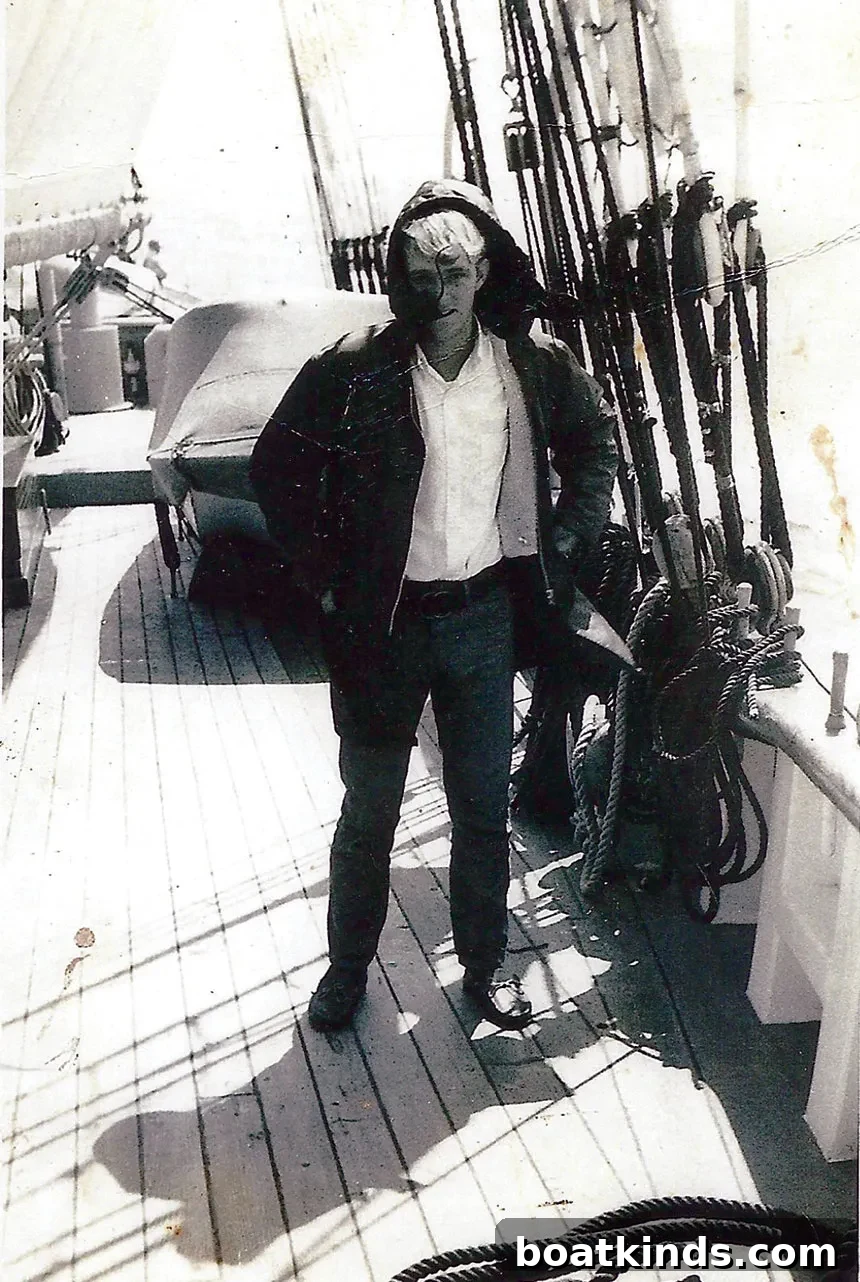
The crew included Rodney Himmelman, the engineer from Lunenburg; the mate, Oddmund Skodje, a capable Norwegian seaman; and bosun Neil Dalkier from Denmark, along with several other hardworking men. I settled into the ship’s rhythm and found I could hold my own despite my age. My previous experience ashore had given me a solid foundation, and I was grateful. The Bluenose II was a fine vessel and the crew was a steady, good-natured bunch.
We ran charter cruises through the southern Caribbean, the Leeward Islands, and the Virgins, and the schooner ate up the trade winds. The open channels between islands brought steady, stiff breezes, and nothing thrilled me more than taking the helm. With a 4,000-square-foot mainsail and an 84-foot main boom, she heeled into the blue Caribbean and moved with an effortless grace. At 12 knots she seemed hardly to notice the speed. At first the mate watched me at the wheel, but the boat steered easily and I quickly learned her manners. Soon the mate and skipper left me to keep her on course with confidence.
On one trip the Oland family sailed with us for a few weeks. We went to the Tobago Cays, and I remember taking them to World’s End Reef for snorkeling after a morning in the tender spearing a dozen or so lobsters for their dinner. There was also a plentiful cargo stowed in the hold: hundreds of cases of Schooner lager produced by the Oland Brewery. The Bluenose II had been built, in part, as a promotional vessel, and the cans carried the phrase “You can’t beat a good schooner,” a nod to the original Bluenose and her racing fame. In the fo’c’sle the drinking age was not enforced, and I quickly gained an appreciation for that golden brew.
All too soon the island charter season ended and we sailed north to Nova Scotia, home for most of the crew and a place to reunite with families. After a stop in Bermuda we arrived at Halifax to a warm welcome. The streets and wharves were full of family and friends, and before long only a few of us remained on board while the others took shore leave. A few weeks later the captain announced we would be running day trips out of Halifax Harbor.
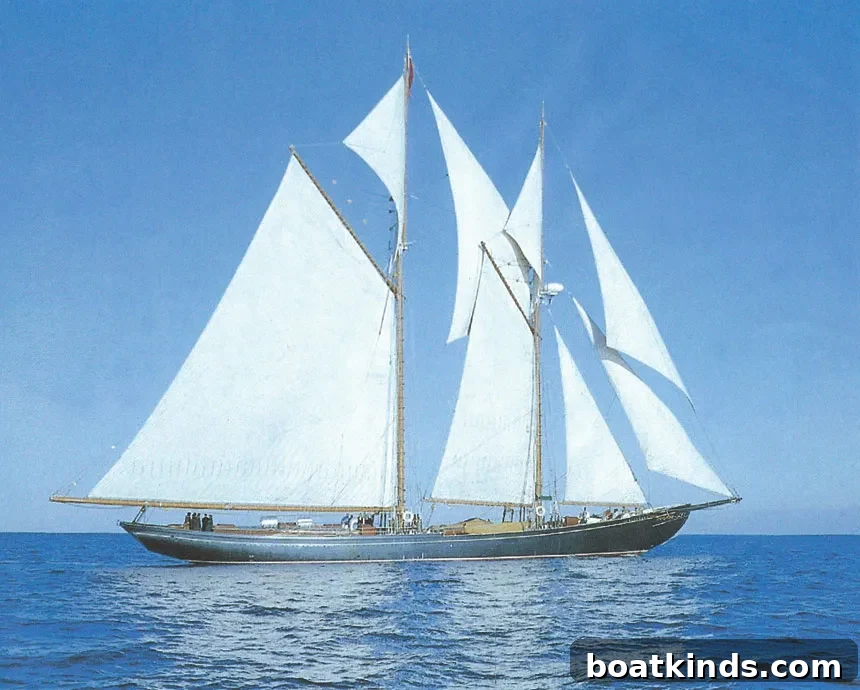
We were issued new uniforms — baggier navy-style trousers and shirts embroidered with Bluenose II on the front. Mine were a bit large and the cuffs bunched over my shoes. The decks filled quickly with day-trippers and the summer sails were simple pleasure trips: set every sail in the morning, drift out past McNabs Island toward Chebucto Head, then tack back into the harbor.
Those warm days also brought a steady parade of local young people, and the crew’s youngest were eager to impress. I noticed a pretty blonde on one sail who seemed to watch my every move. I smiled when I could, hoping to work up the courage to speak with her after the trip. As we neared the berth the mate ordered the mainsail lowered. Lowering that huge sail required timing: the throat and peak halyards must be eased together over the belaying pins and into the large wooden blocks on deck. I made a show of my role but kept glancing back at the blond woman. Suddenly I felt a tug at my leg — the cuff of my trousers had been caught in one of the pulley blocks.
I looked down in horror as my trousers were drawn over my waist. The woman’s smile froze and then melted into a giggle as she covered her mouth. The mate called, “Hey! Lower away!” and I frantically tried to maintain the rhythm to save face. As the heavy manila rope fed through the block the rear seam of my trousers began to split. My pants slid down, one leg was hauled up against the block, and I was stuck. The mate came over, scowling at first, then grinning. “Showing off for the girls, eh?” he said, and with his knife he cut the tattered cloth away.
With most of my trousers gone, my embarrassment was complete. The crew and the passengers laughed; the young woman laughed too. We finished lowering the sail and made fast the halyards. Skodje nodded for me to go below. I ran forward, changed into fresh trousers in the fo’c’sle, and returned to help with dock lines and to see the passengers ashore. At the gangway the young woman stepped aside and said kindly, “Don’t worry. It was funny, but it could happen to anyone.” I thanked her, asked if she lived in Halifax, and she replied with a smile that she was visiting from Ontario. She thanked me for a nice trip and walked up the gangway. I never saw her again, but her small kindness eased my shame.
For a few days the shipmates ribbed me, and I never again took my eyes off the main halyard blocks when lowering sail.
Jambalaya
Ingredients
- 3 large boneless chicken breasts, diced
- ½ pound ham, diced
- 3 large sausages, sliced
- 1 pound large peeled shrimp
- 1 large can stewed tomatoes
- 1 green pepper, chopped
- 1 large onion, chopped
- 1 teaspoon crushed garlic
- 2 cups rice
- 1 teaspoon oregano
- Olive oil
- ¼ cup red cooking wine
- Tabasco sauce, to taste
- Salt and pepper
- 2 bay leaves
Method
Heat olive oil in a saucepan and sauté the chicken, sausage, ham, and shrimp until lightly browned. Season with salt, pepper, and crushed garlic while cooking. Add the chopped green pepper, onion, oregano, bay leaves, red wine, and the stewed tomatoes. Reduce the heat and simmer gently for about 20 minutes.
Meanwhile, cook the rice according to package directions but substitute 2 cups of tomato juice for 2 cups of water. When the rice is nearly done, lower the heat and combine it with the simmered meat and vegetable mixture. Add Tabasco to taste and fold gently with a spoon just before serving to keep the textures intact.
This article originally appeared in the December 2017 issue. More stories by Capt. Boudreau can be found in publications such as Soundings and the collection Where The Tradewinds Blow.