
North America offers two iconic cruising adventures that capture the imagination of seasoned boaters and newcomers alike: the Inside Passage of the Pacific Northwest and the Great Loop that circles much of the eastern United States and southeastern Canada. The Inside Passage stretches from Washington State through British Columbia and on to Alaska, offering nearly 1,000 miles of mostly sheltered waters running through largely undeveloped coastal wilderness. The Great Loop is a seasonal, roughly 6,000-mile circuit that links the Great Lakes, the inland rivers and canals, the Gulf Coast, and the Eastern Seaboard—a diverse voyage through varied climates, cultures, and waterways.
These two routes come up constantly in conversations at marinas, boat shows, and design studios. For many baby boomers, they represent long-delayed dreams finally attainable after years of work and careful saving. The decision to go cruising often begins with one boat show conversation, and it grows into a detailed plan as ideas and experiences are shared.
After a recent run of boat shows I started thinking about alternatives to the usual approach of buying or commissioning a single boat for long-distance cruising. Friends and shared adventures have been central to many of my best cruises. Some of the most memorable trips began with a friend nudging me onto the water. That camaraderie suggests another model: cruising in company—several independent platforms traveling together—rather than cramming multiple people onto one vessel.
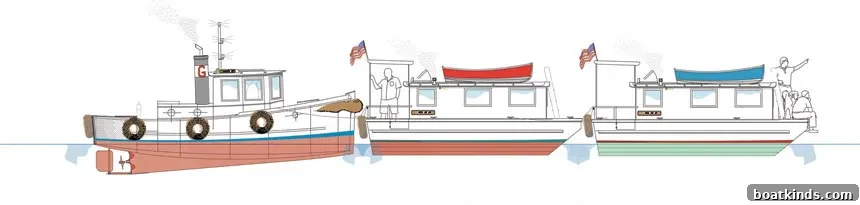
Godzilla 25
LOD: 24 feet, 8 inches
BEAM: 9 feet
DRAFT: 33 inches
DISPLACEMENT: 5,800 pounds (light)

Millie Hill 20
LOD: 20 feet, 4 inches
BEAM: 8 feet, 2 inches
DRAFT: 12 inches (outboard up)
DISPLACEMENT: 2,800 pounds (light)
Over the years my wife and I came to a consistent realization: cruising in company—where each couple or individual has their own small boat, and the group travels together—almost always beats crowding several people onto one vessel. I’ve enjoyed trips with people aboard the same boat, but the freedom and comfort of having your own space while still sharing the voyage with friends creates a richer, more relaxed experience.
This month’s design concept begins with that idea. Picture a flotilla made up of modest liveaboard shanties or small houseboats paired with a single, proper tugboat to provide reliable propulsion and maneuverability for the group. The shanties offer private cabins, basic galleys and heads, and comfortable living spaces, while the tug supplies the muscle for longer legs or when weather or currents demand a stronger, more seaworthy drive system.
I’ve built several of these compact houseboats: flat-bottomed, voluminous, and surprisingly comfortable. They typically use small, high-thrust outboards, which are fine for short moves between marinas or quiet stretches. But for extended cruising, a tiller-steered outboard becomes tiring and makes it tempting to stay anchored rather than push on. A dependable tug in the flotilla removes that friction and keeps the group moving when plans call for distance or deadlines.
The tug becomes the logical leader of the expedition: a robust engine, a large propeller and rudder, and enough displacement and stability to tow or push several shanties comfortably. Navigation and watch duties can be shared by a couple of people aboard the tug, while the floating homes follow or raft up at night. When privacy is wanted, each shanty can cast off and anchor independently, but the tug’s presence provides security, range, and the ability to handle adverse conditions.
Ownership models are flexible. A shanty association could jointly own the tug and rotate responsibilities and operating costs, or one member could own the tug while others own their shanties and contribute to fuel and maintenance during shared cruises. This cooperative approach spreads cost, reduces the complexity of boat ownership for individuals, and fosters a close-knit cruising community.
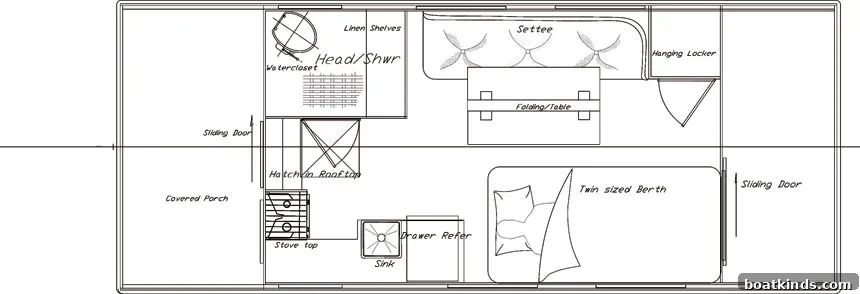
The Godzilla 25 is designed to be just under the 26-foot regulatory limit that would require a licensed skipper, making it accessible to many owners. Her accommodations are planned for two people, with a compact head aft near the engine room and a simple, efficient galley. Walk-up side decks and sliding doors to both port and starboard provide easy access to the helm and excellent ventilation in warm weather.
The Millie Hill 20 serves as an ideal shanty platform. Her roof can carry a small dinghy or a couple of kayaks, and the interior 13-by-8-foot cabin fits an enclosed head, a galley, a dinette that converts to a double berth, and modest seating. A small forward deck and a larger aft deck extend the living space, and an elevated sunshade over the cockpit creates a pleasant evening hangout for the group.
Imagine a flotilla pulled along by a dependable tug, the shanties tied alongside for a late-afternoon raft-up, steaks on a grill, friends mingling, and a sunset over calm water. This model keeps the benefits of companionship while preserving personal space and simplifying navigation and propulsion for longer trips. It’s an accessible, social, and practical way to explore the Inside Passage, the Great Loop, or any extended cruising route.
This article originally appeared in the April 2018 issue.