
A mother’s lament after one of the most common accidents at sea: a man falls overboard and loses his life
The sea is unforgiving, indifferent to skill or experience, and quick to turn a momentary mistake into a tragedy. Even the most seasoned boaters can be vulnerable to simple, avoidable accidents.
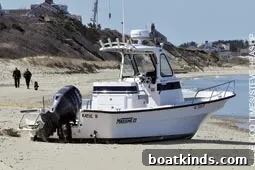
One Nantucket family learned that lesson in the worst possible way. Thirty-six-year-old Jonathan Hemingway, a man who loved and respected the ocean, disappeared after apparently falling overboard from the family’s 23-foot Maritime Patriot, Katie B. His mother, Nancy Rappaport, reconstructs the likely sequence of events with painful clarity: a sudden pitch of the boat, a lost grip, and then nothing.
Hemingway, who ran a landscaping business in Nantucket with his wife Katherine, captained the vessel alone while Katherine and their two young daughters slept below in the cabin berth. Investigators believe he may have been relieving himself at the rail when the vessel pitched and he fell into the cold water. The night of March 17, while making the roughly 30-mile trip from Hyannis to Nantucket, the unmanned Katie B continued on and eventually ran aground on Cliff Beach on Nantucket’s north shore.
Analysis of the boat’s GPS supports the overboard theory: around nine miles off Nantucket, the GPS track shows the boat veer off course and begin tightening circles before grounding. Detective Lt. Jerry Adams of the Nantucket Police Department explains that a running prop can steer a rudderless, unpiloted boat in a circle—in this case, turning the craft clockwise until it reached the beach. Unless new evidence emerges, investigators believe Hemingway fell from the boat nine miles out and the vessel then made its way to shore unmanned.
A spring-like night
It was a clear, mild night for March with seas of 1 to 3 feet and winds around 10 mph. Rappaport remembers the evening as one that felt like the first hint of spring—peepers were singing on shore and the temperature hovered in the low 40s. Jonathan had offered his mother a ride, but she declined because of the chill. He was comfortable on the water and a lifelong boater who had grown up on Nantucket’s waters; he sometimes took long runs offshore and had made the Hyannis–Nantucket trip many times.
Katherine had met Jonathan in Hyannis, bringing dinner and a 12-pack of beer to the boat. They ate and each had a beer; Katherine later found Jonathan’s can half full. They departed about 9 p.m., the two girls bundled into the cabin with a DVD and snacks. As the seas built a little chop, Jonathan slowed the boat. His mother believes that, while he was at the rail, the vessel’s motion made him more vulnerable, he lost his footing and went into the 38-degree water while Katie B continued toward Nantucket under power.
A ‘bump’ and a turn
Katherine awoke shortly after 1 a.m. to the sensation of the boat bumping and turning. The engine alarm sounded as the props dug into sand. Accustomed to running aground on Nantucket shoals and confident in her husband’s seamanship—he had always waded off and pushed the boat free—she did not immediately raise the alarm. With the children asleep and sprawled across her, and with the companionway latch malfunctioning, she stayed quiet and, believing Jonathan would handle the situation, went back to sleep.
Hours later, at about 5 a.m., Katherine again heard the alarm and saw Nantucket lights. She assumed Jonathan had gone to fetch help or the truck and remained reluctant to rouse the children. It was not until around 7:45 a.m., when daylight brought fuller concern, that she forced the companionway and called a friend. Initial confusion over alleged phone calls and timing delayed notification of authorities; when the friend later recanted a story that Jonathan had called, police escalated the response.
No trace found
By 1:30 p.m., police had notified the U.S. Coast Guard that a person was missing and possibly lost at sea. The Coast Guard mounted an extensive search, deploying four boats, two cutters, a helicopter and a fixed-wing aircraft. Over 21 hours, teams covered 767 square miles from Chatham to Great Neck to Martha’s Vineyard and east of Nantucket—essentially the coastal corridor of the Hyannis–Nantucket run. Despite the large-scale effort, no sign of Jonathan Hemingway was found. The Barnstable district attorney’s office continues to list the disappearance as under investigation.
Falling overboard is a leading cause of recreational boating drownings. In 2008 the Coast Guard reported that 157 of 510 recreational boating drowning deaths resulted from people going overboard. Safety advocates emphasize prevention measures such as wearing a life jacket and using an engine cut-off switch (a kill-switch lanyard) that stops the motor if the operator is ejected from the helm—measures that can make a difference in moments of unexpected risk.
Rappaport describes the aftermath as overwhelming. “I’m stunned. I can’t take it in,” she says. The Nantucket community responded with support: hundreds attended a memorial for Jonathan at Brant Point lighthouse on March 26. As a longtime island resident and behavioral therapist, Rappaport reflects on the island’s maritime heritage and the generations of families who have faced similar losses. For now, the family grieves a loved one taken by a commonplace hazard of boating, and the community remembers a man who knew and loved the sea.
Related articles (titles only)
– Safety takes a proactive approach
– Crash highlights perils of night boating
This article originally appeared in the June 2010 issue.