
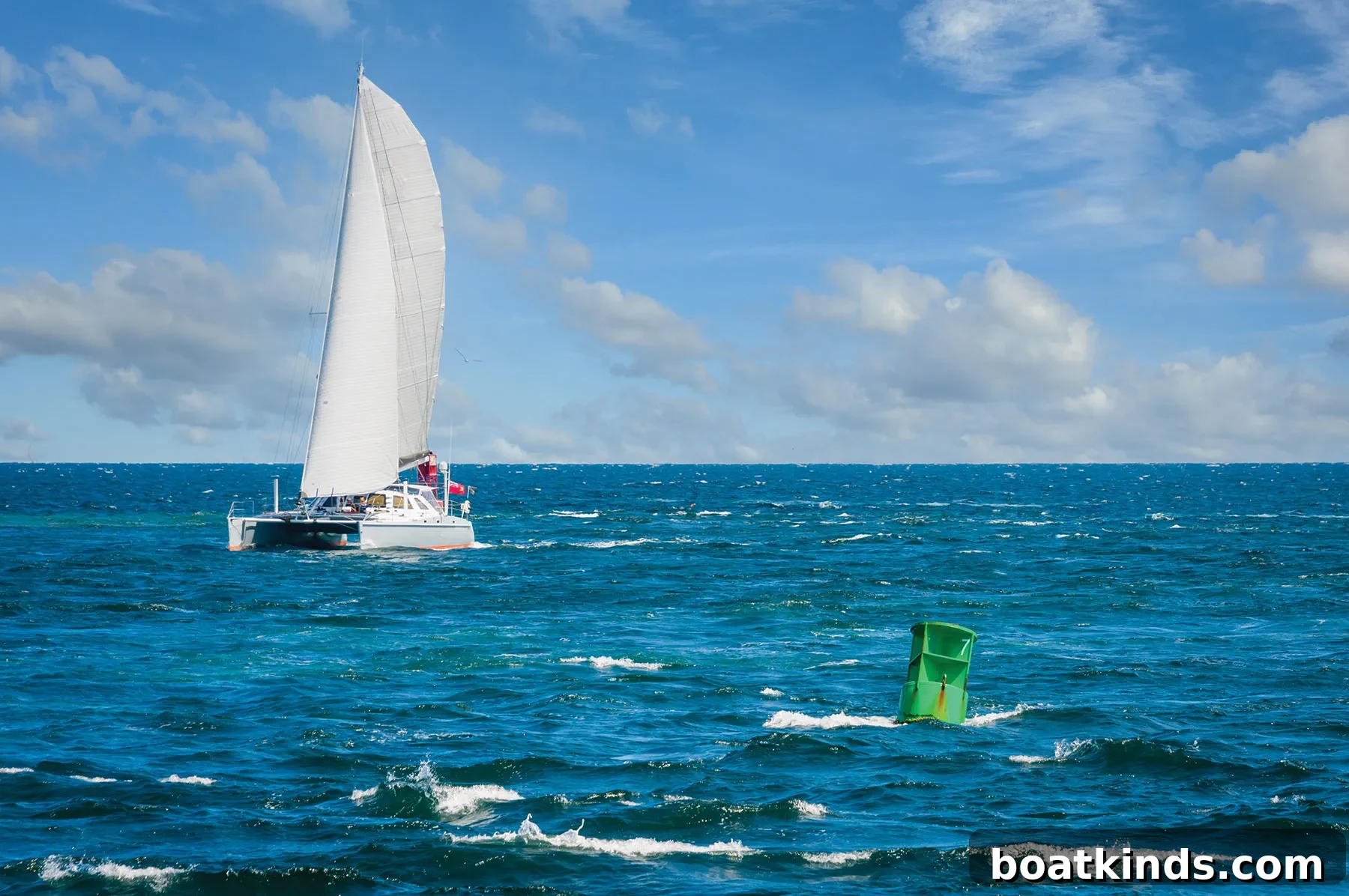
Once, mariners relied on paper charts and a magnetic compass to find their way. Today, GPS and electronic chartplotters dominate navigation, and many boaters rarely consult paper charts. But electronics can fail, and when they do, old rules like “red, right, returning” remain vital. Keeping red buoys to starboard while returning to harbor will usually keep you in the channel—unless you miss one. A skipped marker can easily lead to prop damage, grounding, or worse.
I once spoke with a cruiser owner at a boatyard who had bent propellers hanging from his shafts. He told me he’d been keeping red to starboard, as he always did, yet somehow ended up on a shallow bottom. The problem: he was in unfamiliar waters. After coming in from the ocean, he missed the turn onto the Intracoastal Waterway near Stuart, Florida, and followed buoys into the St. Lucie River instead. There the waterway split into several routes—some markers indicated the main channel, others marked secondary cuts. Although he had red to starboard, he missed a small red nun buoy and steered for a more distant red dayboard. A brief departure from the channel at 15 knots was enough to find the bottom.
He was fortunate no one was hurt, but he blamed the buoy placement rather than acknowledging he hadn’t verified his position. No electronics substitute for basic seamanship: reading aids to navigation and consulting a chart are essential. When I asked if he had a paper chart aboard, he admitted he relied solely on his plotter. Nautical charts are more than road maps; they show where you can safely travel and where you must not go—shoals, submerged hazards, and shallow flats that can tear up running gear. Had he checked buoy numbers against a chart, he would likely have realized he was off course.
Understanding buoy types and daymarks is a core skill. You might recall that green daymarks were once black; the change was completed in the 1980s to improve visibility. Floating aids include red nuns—conical tops, even numbers, red lights—and green cans—flat tops, odd numbers, green lights. These buoys are typically anchored with heavy chain and can shift slightly with tides, wind, and current, so give them room. Slow speeds and adverse currents can push you into a buoy, so avoid close passes.
Permanent beacons use dayboards mounted on poles: square boards usually indicate green aids, and triangular boards indicate red aids. Support poles can be metal or wood; they can scratch a hull or hide a snagged fishing line that could foul a prop. Range boards, two aligned markers that define a straight channel line, are another common stationary aid. Specialty buoys—white with orange bands—communicate restrictions or hazards: swimming areas, exclusion zones, speed limits, or other instructions. Pay attention to these distinctive markings and obey their messages.
At junctions, additional markings show the preferred route. Horizontal bands of red over green mean the preferred channel lies to port; green over red means the preferred channel is to starboard. Numbers on buoys are also crucial: follow and verify them against your chart to confirm you are on the intended route. If you don’t have time to match a buoy number to your chart before the next marker appears, you are probably going too fast for safe navigation in that area.
Buoys can be temporary or missing. On a delivery through Bogue Sound, North Carolina, I found a green can labeled 3T; the “T” indicated a temporary aid placed because the permanent number 3 buoy was absent. Charts might show an aid that isn’t actually in place, and lights on buoys can fail—charts and aids are complementary tools, not interchangeable guarantees.
Aids to navigation define channel boundaries. Even a slight excursion beyond those limits can lead to grounding at low tide. When transiting unfamiliar waters I often glance astern: if my wake breaks on the channel edge, the area outside the marked channel is shallow and I’m too close to the boundary. Also watch for signs your boat is “crabbing” instead of tracking straight—strong side currents or wind can push the stern out of the channel so that, at a bend or turn, you swing outside the safe water.
Shoaling is always a threat, but most groundings are avoidable with careful observation and situational awareness. Learn to read buoy shapes, colors, lights and numbers; check those numbers against a chart; maintain a speed that gives you time to process each marker; and respect temporary or missing aids. In short: pay attention to the buoys. It’s your boat—navigate it with care.
This article was originally published in the March 2022 issue.