
Blue skies, verdant meadows and sunlit water set the scene in Marstal on the Danish island of Ærø. This story isn’t about pronunciation but about salt-stained schooners, the craftsmen who built them and the crews who sailed them across the globe.
In the late 19th and early 20th centuries Marstal was widely known for its cargo schooners. More than a hundred from this small port worked the Newfoundland trade, bringing cod to Europe and salt back to the New World.
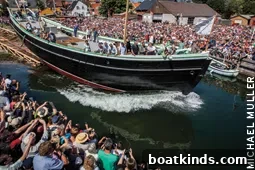
On May 26, an estimated crowd of 5,000 to 10,000 people gathered in town to celebrate a rare maritime revival: the relaunch of Bonavista, one of Marstal’s historic schooners, restored as closely as possible to her original 1914 condition. She was sliding down the ways at Eriksens Plads—the very spot where she first entered the water 98 years earlier.
The harbor was crowded with some 90 traditional schooners and cutters that had sailed to Ærø to serve as a festive backdrop for the stabelafløbning, the ceremonial launch. Danish flags fluttered among the masts, locals and visitors sported sunburned noses and bright smiles, and the air rang with laughter, singing saws and the steady clink of maritime conversation. Brewing for the event was Bonavista Ale, tapped from carts from about 9 a.m. Denmark’s affection for wooden ships and strong øl was on full display.
A big job that grew bigger
Restoring Bonavista’s hull—its broad bow and elegant sheer—was a massive undertaking that broke conventional cost expectations. Master shipwright Ebbe Andersen of Ebbes Bådebyggeri, a specialist in traditional shipbuilding, led the project. What began as a restoration rapidly revealed itself to be closer to a reconstruction. When Bonavista was hauled ashore with a broken keel in 2008, most of her structure below decks was beyond salvage. “We saved one knee forward, one aft, a couple of floor timbers and the manual anchor windlass,” Andersen recalls dryly.
Over months of painstaking work, Andersen and his team dismantled and reshaped the hull: hydraulic stands jacked the frames into position, chains pulled the shell into alignment, and the keel, frames and planking were replaced. Nearly all the timber came from Danish forests planted centuries ago; only the decking used Norwegian pine. The dedication to traditional materials and methods made the restoration costly—at least twenty percent more expensive than building a new vessel of similar size—and the ship still needed a rudder, internal bulkheads, an engine and ballast before she could sail properly.
When Bonavista was built in 1914 she was already outpaced by motorized ships, yet she served in the Newfoundland trade, survived World War I, and later was fitted with a 50-hp engine to work local Baltic and North Sea routes. In 2000 the Danish Ministry of Culture prevented her sale to the United States by acquiring the schooner and placing her under the care of the National Museum of Denmark, which sought bids for restoration—bringing Ebbes Bådebyggeri into the project. The job became more than restoring an old hull; it became a statement of cultural preservation.
More than just a schooner
During the multi-year restoration Bonavista drew crowds. “More than 60,000 people came each year to see the work,” says Erik Kromann, director of the local maritime museum and custodian of Marstal’s seafaring legacy. For a tiny town, Marstal’s fleet made it internationally known: its ships were early agents of global trade and cultural exchange.
Author Carsten Jensen, born in Marstal and known for his novel We, the Drowned, emphasizes the project’s wider importance. Traditional boatbuilding skills are vanishing as older craftsmen retire and few young people learn the trade. Restoring Bonavista preserved not just timber and nails but living know-how and national memory. The project appealed to a broad community of locals, sailors and international visitors who wanted to reconnect with a tangible piece of maritime history.

Among the sea of Danish flags a lone American banner flew from Wiki Wiki, a pristine Hinckley Sou’wester 51 owned by John and Mary Treanor of Houston and Southwest Harbor, Maine. Members of the Cruising Club of America, the Treanors had sailed widely—across the Atlantic and around northern Europe—stopping in Marstal during a tour that included Scotland, the Hebrides, Orkney, Norway’s fjords and Sweden’s skerries. They chose Ebbe’s yard partly for practical reasons: unlike some countries, Denmark didn’t demand a large storage bond, only the regular yard charges for maintenance.
They built it, now what?
Although Bonavista’s hull was restored and she was launched with great fanfare, concerns remain about her future. The schooner was intended to sail as a regional ambassador for Marstal and Danish shipbuilding, but final completion depends on a stable plan for operating costs. She isn’t intended to join the crowded charter market; instead, stakeholders hope she can serve as a museum ship and a traveling representative of local maritime culture.
Ebbe Holmboe, recently retired from the National Museum’s board, supports public stewardship: “I’m positive for Bonavista’s future as a museum ship. If Denmark can’t cover this, who can? Danes must accept responsibility for their own heritage.”
At the launch, steely workmen loosened the cradle at mid-morning. Shortly before 11:30 a.m. a slight shudder ran through the hull and the crowd erupted. Bonavista slipped down greased wooden ways—lubricated in time-honored fashion with ox grease and soap—then gathered speed and eased into the harbor. She cut through the water with the same composure she showed a century earlier. Horns blared, people cheered, and for a moment everyone felt the shared pride of keeping a maritime tradition alive.
For Marstal and Denmark the moment was more than nostalgia: it was affirmation that craftsmanship, community and history can be revived and celebrated. As Bonavista floated free, the town’s smiles said it all—this piece of the past had been welcomed into the present.
Dieter Loibner is sailing editor for Soundings.
This article originally appeared in the August 2012 issue.