
Historic Lifesaving Boats: The Craft That Braved Surf, Storm and Sea
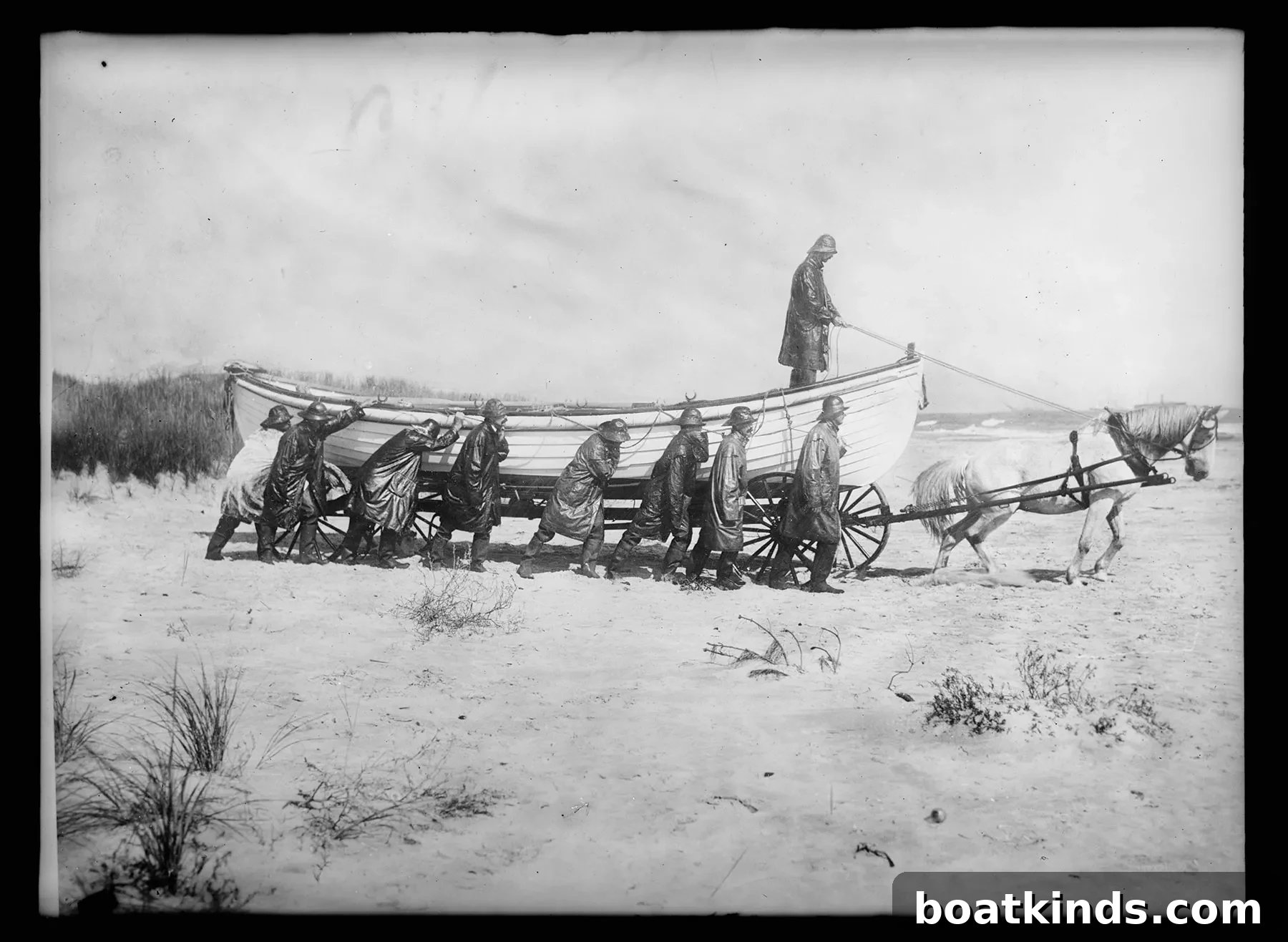
This early twentieth-century illustration from Red Cross magazine captures a dramatic moment in lifesaving history. The exact location in the image is unclear, but the courage and endurance of lifesaving crews during the age of sail are well documented. Equally fascinating are the boats these crews relied on—small, sturdy vessels designed to face surf, wind and breaking seas in order to reach those in peril.
Organized lifesaving at the U.S. coastline began regionally, driven by volunteers who used whatever local craft were available. One of the earliest organized efforts was the Massachusetts Humane Society, founded in 1786, which established a station on Nantasket Beach. Volunteers from that group rescued five crewmembers from the sinking ship Emeline and later pulled a dozen survivors from the wreck of the Mohawk—early examples of community-based sea rescue before federal standardization.
Formal standardization of lifesaving craft and techniques followed the creation of the United States Life-Saving Service (USLSS) in 1871. The USLSS developed and promoted specific designs intended to perform reliably in surf and storm. Among these standardized rescue craft was the Jersey pulling surfboat. Built typically 25 to 27 feet long, with a square stern, the Jersey surfboat offered room for multiple thwarts and a system of oars often used in a double-banked (side-by-side) arrangement. Construction typically combined cedar planking over oak frames to balance lightness and strength, enabling the boats to be rowed hard into breakers and to survive repeated impacts with surf and sand.
The boat shown above closely resembles the Monomoy pulling surfboat, named for Monomoy Island off the tip of Cape Cod. The Monomoy was a double-ended 26-foot craft, usually rigged with a mast and sail in addition to oars. Configured with multiple thwarts to seat rowers in a double-banked layout, the Monomoy and similar pulling surfboats relied on human power and seamanship to reach wrecked vessels through surf zones that would have swamped ordinary boats.
Early pulling surfboats like these were not equipped with many of the safety features we expect today. They were neither self-righting nor self-bailing, so crews had to rely on boat handling and timing to avoid catastrophic swamping. That began to change with innovations introduced later in the 19th century. The Dobbins pulling lifeboat, introduced in 1878 in the USLSS’s Lake Erie and Lake Ontario district, brought important advances. Built up to 32 feet long, with five thwarts and room for multiple double-banked oarsmen, the Dobbins design incorporated self-righting and self-bailing characteristics, as well as a sailing rig—features that greatly improved survivability in heavy conditions.
An even larger example was the Merryman pulling and sailing lifeboat, which drew on British design principles. At about 34 feet and displacing roughly four tons, the Merryman carried a two-masted rig and offered increased capacity and seaworthiness for the most demanding rescues. These larger, purpose-built lifeboats reflected lessons learned from years of surf and storm operations and represented a major step forward in lifesaving technology.
Throughout this era, lifesaving crews pushed their boats and themselves to the limits. One dramatic example occurred during the Great Storm of November 1888. Volunteers of the Massachusetts Humane Society, under the leadership of Capt. Joshua James, rowed out to six separate wrecks over the course of two brutal days, rescuing 29 people. For that extraordinary effort the United States Life-Saving Service awarded the volunteers multiple honors, including 11 gold and four silver lifesaving medals—testimony to both the danger of the work and the skill of the crews.
These historic surfboats and lifeboats, from the compact Jersey pulling surfboat to the larger Dobbins and Merryman designs, embody an era when human courage and specialized craft combined to save lives in some of the harshest coastal conditions. Their legacy lives on in modern rescue boats and in the tradition of volunteer and professional lifesavers who still answer the call when the sea endangers lives.
This article was originally published in the July 2021 issue.