
Carl Eichenlaub — Shipwright, Boatbuilder, and Unflappable Olympic Fixture
The sailing world mourned the loss of Carl Eichenlaub, a master boatbuilder and longtime shipwright for the U.S. Olympic sailing team. Beyond crafting boats for prominent sailors such as Malin Burnham and Lowell North, Carl was famed for his ability to repair almost anything—an aptitude he demonstrated consistently throughout his life and especially during his tenure with the Olympic team from 1976 to 2004.
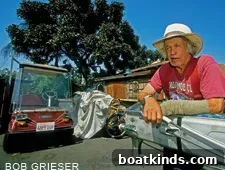
Eichenlaub, who died at 83 in November, will be remembered as much for his technical skill as for his humanity. He was a goodwill ambassador with a toolbox, known for helping competitors in need while still supporting his own team. Those gestures occasionally stirred controversy, but Carl balanced loyalty and generosity with a rare practicality that made him indispensable—and part of his lasting legacy.
Born July 30, 1930, in San Diego, Carl Martin Eichenlaub Jr. was the only child of Carl Eichenlaub and Wilhelmina Pennybaker. He learned to sail on Mission Bay in a 16-foot plywood sloop he built from a how-to book. Hands-on, curious and competitive, he began building boats on Shelter Island in the early 1950s after graduating from San Diego State. His early work included Sabots, Snipes and Lightnings, and he quickly earned a reputation as an exceptional craftsman.
An accomplished sailor, he won the Lightning Internationals in Michigan in 1960 sailing a Lightning he had built. To hone his skills he practiced in an 8-foot Sabot on Mission Bay, taking the Adult Championship in 1959. His oft-quoted belief—“If you can sail a Sabot well, you can sail anything well”—became a hallmark of his practical approach to maritime skill.
In the 1960s Carl collaborated with Lowell North, the dominant Star-class sailor and sailmaker of the era. North asked Eichenlaub to build him a new Star, and Eichenlaub-built Stars soon became sought after. When fiberglass was introduced to the Star class, Carl was skeptical, warning that a hull made from “a roll of cloth and a barrel of resin” could flex and be difficult to correct compared to wood. History proved fiberglass robust, but Carl adapted and learned to work with it.
One defining moment came at the 1984 Los Angeles Olympics, when Bill Buchan’s Star did not meet measurement requirements and its entry hung in the balance. The boat was too narrow at the stern, and Carl made four careful cuts along the chines and deck, inserted wedges and re-glassed the hull. The repair was performed under intense scrutiny—and it held. Buchan went on to win the gold medal.
“Carl was in all my Olympic campaigns,” said Mark Reynolds, a two-time Olympic gold medalist in the Star. “He’s the best when it comes to fixing something quickly and in ingenious ways.” Examples of that ingenuity abound: in 1976 Carl famously sealed a Finn mast by pouring radiator stop-leak fluid down the inside, solving an urgent buoyancy requirement with a pragmatic, unconventional fix.
Helping others for the good of it
Carl’s generosity extended beyond formal obligations. In the mid-1970s he partnered with a young designer, Doug Peterson, to build a One-Tonner called Ganbare on a shoestring budget. The boat looked unconventional—shorter and lighter with a long waterline—but it represented a leap in design. Despite being towed to the start with halyards still being rigged, Ganbare won the North American Championships and launched Peterson’s career while cementing Carl’s reputation as someone who could make miracles happen under pressure.
His willingness to help sometimes smoothed tense situations. At one Pan American Games, after a protest left relations with a Brazilian team bitter, the Brazilians later returned asking Carl to repair a mangled bow pulpit on their J/24 so they could race. With his welding equipment he straightened, rewelded and refitted the pulpit, turning antagonism into gratitude—and a couple of cases of beer on his doorstep the next day.
Renaissance man with humor
Carl combined practical skill with a sharp wit. He enjoyed pranks and knew how to use humor to defuse tension. At the 1992 Olympics opening, he famously slipped into the crowd to stroll beside members of the U.S. basketball “Dream Team” and Olympic star Carl Lewis on live television. On another occasion he pulled his Wanderlodge into a Las Vegas gas station towing a trailer labeled “Eichenlaub Farms,” convincing an attendant to care for his non-existent horses while his mobile workshop sat in the shade.
He also loved music. A former flute and piccolo player, Carl later took up the bassoon and played with several orchestras. He called his travels to join fellow musicians “bassoon regattas,” combining two lifelong passions—music and the open road.
Family moments were proud achievements. In 2006 his daughter Betty Sue Sherman became the first female commodore of the San Diego Yacht Club. Carl built her a Pacific Class 32 in varnished mahogany as a flagship—a rare project and the first Pacific Class built from scratch since 1956. “When it’s done I have to figure out what’s next because for my father, boats are the best therapy,” Sherman said at the time.
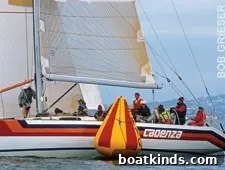
Carl’s own boat, Cadenza, reflected his dual loves of craftsmanship and performance. A cadenza in music is a solo passage that showcases a musician’s virtuosity—an apt name for a boat owned and sailed by a man who was a virtuoso of wood, resin and practical problem-solving. Whether fixing a compromised hull, stitching together a new design, or playing a bassoon solo, Carl Eichenlaub approached life with skill, wit and decency.
Dieter Loibner is sailing editor for Soundings.
March 2014 issue
Editor’s note: The original version of this story contained an error regarding Dennis Conner’s crew at the 1976 Olympic regatta, which was Conn Findlay, not Jim Reynolds.