
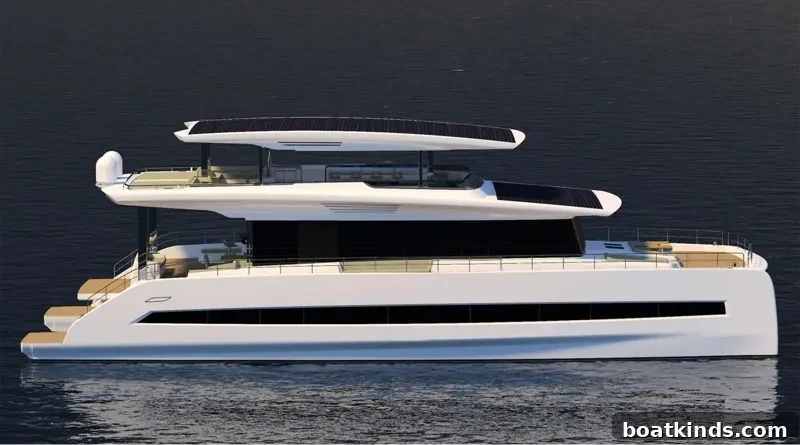
Silent-Yachts Scales Up Production of Solar-Powered Electric Catamarans
Silent-Yachts, the Austrian pioneer in solar-powered catamaran design, has moved from early adopter status to a rapidly scaling production business. After selling its first solar catamaran in 2018, the company now reports 11 of its electric yachts afloat and has committed to a substantial production run for the coming year. With two new shipyards established in Thailand and Italy, Silent-Yachts is preparing to build an additional 20 electric catamarans in 2021.
The planned production includes 15 units of the Silent 60, one Silent 55 and four examples of the newer Silent 80 model. To support these builds, the company has placed an order for 500 lithium-ion battery packs, a sizeable investment that highlights the importance of energy storage in today’s electric-boat market. These battery systems will provide propulsion energy and support onboard systems, enabling extended quiet-running periods and greater operational flexibility for owners.
Innovation extends beyond batteries. Silent-Yachts is also introducing new hybrid propulsion aids: in January the company will deliver the first Silent 60 equipped with an automatic kite-sail system designed to assist propulsion. When not deployed, the kite stows neatly in a dedicated compartment beneath the forward deck. The kite system is intended to complement the boat’s electric drive and solar array, offering an additional renewable push when wind conditions are favorable and helping to conserve battery charge.
Silent-Yachts’ expansion comes as a broader trend toward electric and solar-assisted vessels gains traction. Builders from several countries are developing electric powerboats and catamarans, including Soel Yachts in the Netherlands, Hovercraft of Slovenia, and Azura Marine in Singapore. These companies share a focus on reducing fossil-fuel consumption, noise and local emissions, and on providing owners with a more sustainable cruising experience.
Solar catamarans combine well-suited technologies for quiet, low-impact cruising. Large deck and roof areas on modern catamarans allow for significant photovoltaic array capacity, which can continually recharge batteries during daylight hours. When paired with efficient electric drivetrains and intelligent battery management systems, solar arrays reduce reliance on generators and shore power, making longer passages under electric power more feasible—especially in calm, sunny cruising grounds. Lithium-ion batteries, while requiring careful thermal and charging management, offer relatively high energy density and reliable cycle life for marine applications.
The benefits of solar-electric catamarans extend beyond energy savings. Electric propulsion systems are inherently quieter and produce less vibration than combustion engines, enhancing the onboard comfort for owners and guests. Lower mechanical complexity can reduce routine maintenance needs over time, and the absence of diesel exhaust improves onboard air quality and reduces environmental impact in sensitive coastal areas and anchorages.
Challenges remain for widespread adoption: charging infrastructure in some regions is limited, and energy availability is still subject to weather and operational demands. Manufacturers are addressing these limits through a combination of larger battery banks, smarter energy management software, auxiliary renewable systems such as kite sails, and flexible hybrid arrangements that include backup generators when necessary. For many buyers, the trade-offs are acceptable in return for the quieter, cleaner and more sustainable boating experience.
Silent-Yachts’ decision to open shipyards in Thailand and Italy reflects both supply-chain and strategic considerations, placing manufacturing closer to key markets and skilled labor pools while enabling faster delivery timelines. The order for 500 lithium-ion packs also suggests growing volume in the sector and the need for reliable battery supply chains to support scaling production.
As more builders enter the electric-boat space and technology matures, customers can expect a wider range of solar-assisted and fully electric yachts. These designs are likely to continue evolving with improved battery chemistry, smarter control systems and auxiliary renewable options like kite sails and wind-assist technologies, all aimed at extending range and reducing fossil fuel dependence.
Source: Plugboats.com