
John H. Snow’s “Schooner On the Ways” and the Legacy of Carver Shipyard
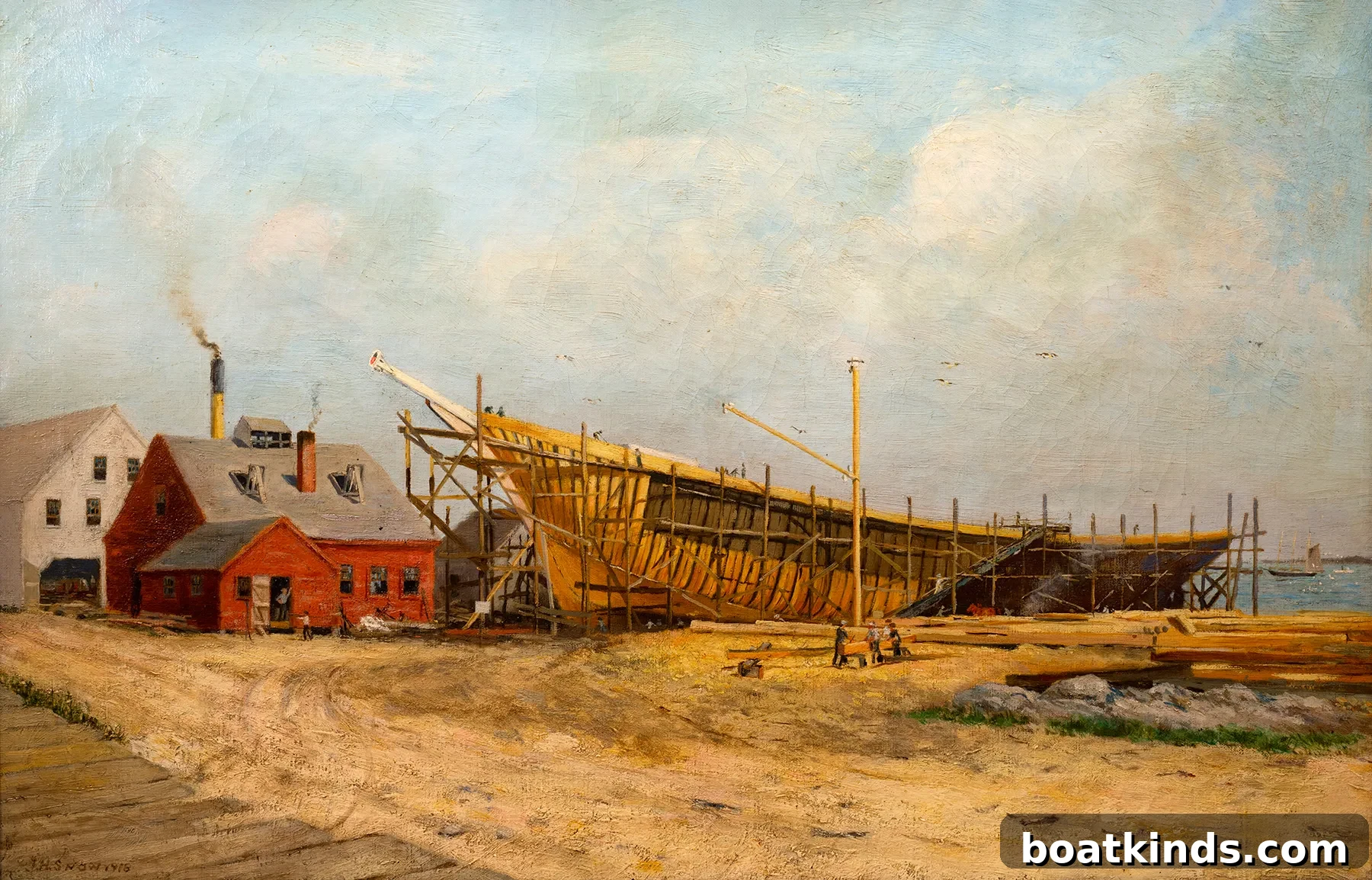
John H. Snow’s 1918 painting Schooner On the Ways captures the ribs of a partially built schooner resting on the sands of Carver Shipyard in Searsport, Maine. Against a clear blue sky with only a few thin clouds, the composition places the unfinished hull in the foreground while a steam shed, an oakum shop and low storage buildings form a calm, working backdrop. The artist’s choice of perspective and restraint in color emphasizes both the scale of the vessel and the practical character of the shipyard.
Carver Shipyard takes its name from John Carver, a master shipbuilder who established the yard in 1824. The shipyard’s early output included a succession of schooners and other sailing vessels; the first craft built there was the schooner Boston, on which Carver himself worked. Over the following decades the yard was productive, producing multiple schooners, brigs and barks and sustaining a local maritime economy. The operation later passed to Carver’s son, George, who continued the family craft after his father’s death. As Frederick Frasier Black observed in Searsport Sea Captains, John Carver stood out among the many early shipbuilders in the region.
By the time Snow painted Schooner On the Ways in 1918, large-scale wooden shipbuilding in Searsport—and in much of coastal Maine—had declined. The last schooner built in the town, The Conner, was launched in 1890, marking an end to the era of routine vessel construction there. Snow’s depiction of shipbuilding on the ways, therefore, is not a straightforward documentary record of a contemporary scene but a creative reimagining: the artist relied on historical knowledge, memory and imagination to reconstruct a moment in the life of a shipyard whose heyday had passed.
Snow’s own background helps explain his facility for painting maritime and coastal subjects. Born in 1875 in Newton, Massachusetts, to Caroline and Henry Snow, he trained and worked as a draftsman in the Boston area. In the 1880s he learned technical drawing and aspects of construction in Cambridge and later at Waltham Public Works, developing an understanding of engineering and structure that would translate naturally into his art. His career included periods spent in Waltham and other New England towns, and his paintings mainly depict outdoor scenes and coastal townscapes—places like Ipswich, Massachusetts, and the harbors of Maine.
Despite his technical skill and the clear sensitivity to form and space evident in works such as Schooner On the Ways, John H. Snow remains a relatively obscure figure in American art history. Details of his life are sparse: he was married twice and had no children, and he died in 1939 of unknown causes. The commissioning circumstances for this particular painting are still unclear. Yet Snow’s work retains value for another reason: it preserves visual testimony to a distinctive regional industry and way of life that shaped coastal New England communities for much of the nineteenth century.
Today Schooner On the Ways is part of the permanent collection at the Penobscot Marine Museum in Searsport. The painting functions both as an artistic composition and as a cultural document, offering viewers a measured, thoughtful glimpse of shipbuilding traditions that once defined the town. The careful depiction of workshop buildings—the steam shed and oakum shop, for example—adds texture and authenticity to the scene, even if it is reconceived through the artist’s memory and historical awareness.
Viewed now, Snow’s painting invites reflection on craft, industry and change. It stands as a visual record of the tools, spaces and human labor that supported wooden vessel construction in coastal Maine. More broadly, it reminds modern audiences of the ways in which small shipyards like Carver’s contributed to maritime commerce, community identity and regional history.
—Lidia Goldberg
This article was originally published in the February 2023 issue.