
Florida Launches Mooring-Field Pilot to Improve Cruising and Protect Waters
Florida has selected four regions for a three-year pilot program to establish managed mooring fields. Officials expect these moorings to make cruising more enjoyable for transient boaters while encouraging more communities to offer secure, environmentally sensitive alternatives to anchoring.
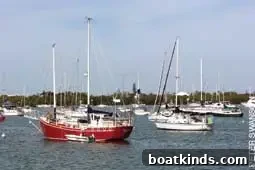
The state’s approach responds to longstanding conflicts over anchoring and mooring. Many counties and municipalities have restricted both practices because of concerns that visiting vessels could damage seagrass, pollute local waters or contribute to the accumulation of derelict boats. The Florida Fish and Wildlife Conservation Commission believes that properly managed mooring fields can reduce those risks by concentrating vessels in defined areas with oversight and services.
Capt. Thomas Shipp, who oversees boating and waterways for the commission, says the purpose of the pilot is to test regulatory options and find practical solutions. “We want to develop and test policies and regulatory options that come out of it and see what works and what doesn’t work,” he said.
Under the pilot program the commission approved, Sarasota, St. Petersburg, St. Augustine and parts of the Florida Keys (specifically Marathon and Key West) were chosen as sites where local authorities can create mooring fields and adopt management rules. Those local rules — including any restrictions on vessels anchored outside mooring fields — must undergo public hearings and receive commission approval.
Florida law distinguishes between liveaboard vessels and cruising boats. A legislative change two years prior redefined “liveaboard” as “any vessel used solely as a residence and not for navigation,” preventing cruisers from being treated the same as permanent liveaboards. Local governments can regulate or prohibit mooring or anchoring of liveaboard vessels and floating structures such as houseboats, but they are barred from regulating the anchoring of cruising boats except within permitted mooring fields. The pilot program allows participating localities limited authority to regulate non-liveaboard vessels outside their managed mooring fields, subject to the public-review and commission-approval process.
Proponents say properly installed moorings not only protect sensitive habitats like seagrass beds but also provide conveniences that reduce negative impacts from transient visitors. Claiborne Young, publisher of the Salty Southeast Cruisers’ Net, acknowledges the benefits but warns the program must be monitored closely. “The concern is that cities and counties — the less ethical ones — might try to use [the program] to prevent anyone from anchoring anywhere near a city’s waters,” he said. Young urged cruisers to attend public hearings and stay engaged while rules are developed.
Several communities already have or are installing moorings as part of the pilot effort. Sarasota is placing 130 moorings near the city-owned Marina Jack on Sarasota Bay, with a dinghy dock, pumpout station and showers. St. Augustine has installed 163 moorings across three fields: two off its seawall on the Intracoastal Waterway and one on Salt Run. St. Petersburg is adding 26 moorings in the Vinoy Yacht Basin with an anticipated October opening. The Florida Keys already operate established fields: 226 moorings at Boot Key in Marathon and 126 at Garrison Bight in Key West.
The commission briefly approved a joint proposal from Stuart and Martin counties for additional moorings — 51 planned for the Indian River Lagoon south of the Jensen Beach Causeway and 69 already in place at Stuart’s Southpoint Anchorage — but a permit issue led to withdrawal of the approval. If permitting is resolved, the proposal could be reconsidered.
Derelict vessels remain a major driver behind local interest in stricter anchoring controls. A 2010 commission study counted more than 1,800 derelict boats in Florida, creating hazards to navigation, environmental damage and community blight. Some waterfront communities have sought to limit anchoring to reduce the number of abandoned or derelict vessels, even though state law assigns primary responsibility for regulating non-liveaboard anchoring to the state rather than to local governments.
“Derelicts are a problem, and anyone who doesn’t see this has his head in the sand,” Young said, stressing the need for practical responses.
David Morehead, guest services director at the St. Augustine Municipal Marina, echoed that priority. “I think what we’re really looking for is a way to take care of the derelict vessels,” he said of his city’s participation in the program. “That’s what we hope to find out with this.”
This pilot will be evaluated by the legislature and the commission in 2014; any local mooring and anchoring ordinances adopted under the pilot will expire unless the legislature affirmatively re-enacts them following the evaluation.
‘This article originally appeared in the July 2011 issue.