
The Flying Dutchman: The Fast, Tunable Two-Person Racing Dinghy
The legendary Vliegende Hollander, better known in English as the Flying Dutchman, carries a dual legacy: an old maritime myth about a ghost ship doomed to sail forever, and a modern legacy as one of the most thrilling and technically advanced racing dinghies ever developed. Unlike the supernatural tale, the sailing Flying Dutchman is very much a real, high-performance two-person monohull that has earned a reputation among competitive sailors as one of the fastest dinghies in the world.
Conceived in the Netherlands in the early 1950s by designers Uus Van Essen and Conrad Gulcher, the Flying Dutchman stands out for its blend of raw speed and tunability. Its design was a departure from the norms of the era: a lightweight, planing hull matched with a powerful Bermuda rig allows the boat to accelerate quickly and slice through waves. On the racecourse the class is known to reach speeds up to 20 knots in the right conditions, making it a spectacular sight at regattas.
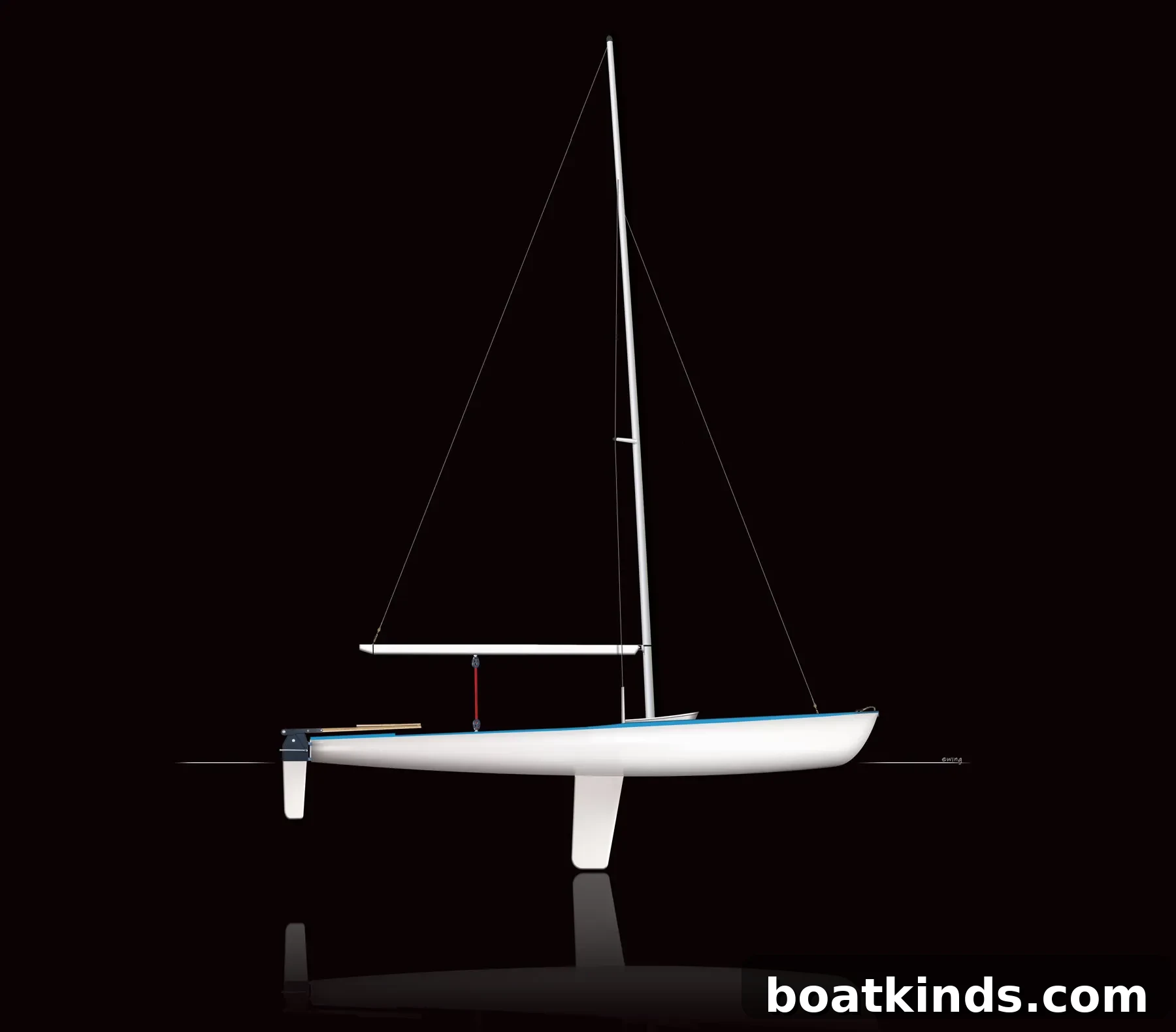
As a racing design, the Flying Dutchman pairs a 110-square-foot main sail and a 90-square-foot jib with a very large spinnaker—about 230 square feet—giving the boat a sail plan that produces huge power downwind. The centerboard sloop layout, combined with the class’s emphasis on adjustability, gives crews precise control over sail shape and balance. The rig features controls that can be adjusted on the fly: genoa halyard tension, shroud settings and mast rake are all controllable while racing, a level of in-competition tuning that puts emphasis on both sailor skill and engineering setup.
The class introduced and normalized equipment and techniques previously reserved for larger boats. Because Van Essen and Gulcher established the design as an open class—allowing innovation within the basic rules—racing teams were encouraged to experiment. That environment helped bring roller furling, windward sheet travelers, spinnaker chutes and pole-launching systems into dinghy racing. These innovations increased safety, efficiency and the tactical options available to crews during races.
Construction of Flying Dutchman boats has evolved considerably. Early boats used cold-molded wood, while later examples incorporated modern composites such as fiberglass, carbon fiber and Kevlar to reduce weight and improve stiffness. The hull weight—around 290 pounds—combined with the boat’s planing characteristics makes hiking, trapezing and weight placement crucial to boat speed. To counteract the large sail area when sailing upwind, crews use a trapeze and hiking straps, a setup that demands athleticism and coordination from both skipper and crew.
Class historian Henry Clay Ericsson aptly described the boat’s rig as “a tuner’s mecca, being chock-full with ropes and pulleys.” That level of complexity rewards crews who can read wind and water, then translate those readings into precise adjustments. Ericsson also highlighted the physical and skill demands of the boat, noting that “pure boat speed is the key ingredient for success. The ideal crewman should be tall, heavy, nimble and smart.” In practice, success in the class depends on a combination of raw speed, tactical savvy and teamwork.
For more than three decades the Flying Dutchman held a prominent place in international competition as an Olympic class, drawing elite sailors from around the world. Although it is no longer part of the Olympic program, the class remains active: more than 10,000 Flying Dutchman hulls have been built, and fleets continue to race internationally. The class is supported by dedicated organizations such as the International Flying Dutchman Class Association and national affiliates like Flying Dutchman USA, which help maintain class rules, organize regattas and preserve the boat’s competitive heritage.
Today the Flying Dutchman continues to appeal to sailors who prize speed, technical challenge and the satisfaction of tuning a finely balanced racing machine. Its combination of high sail area, adjustable rigging and lightweight construction makes it a timeless test of skill for skipper and crew alike, and its history of innovation has left a lasting mark on dinghy racing as a whole.
This article was originally published in the October 2020 issue.