
To many anglers—especially those who fish along the coast—the U.S. Coast Guard feels a lot like the local police: they’re there to protect you, and you appreciate that presence. But they also enforce safety regulations, which can sometimes result in expensive citations. Still, most boaters would agree it’s better to comply than to be on the receiving end of a ticket.
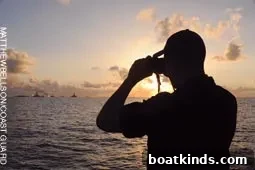
When you see a Coast Guard vessel on the water, a quick mental checklist kicks in: do I have the required PFDs, working fire extinguishers, correct navigation lights, and all other safety equipment? You might give a wave, but many of us instinctively avoid making eye contact—nobody wants an inspection that reveals a deficiency.
I used to be that wary boater. Not anymore. The crew of the Coast Guard station at Port Aransas, Texas, are some of my closest allies now. I joined the ranks of those who have had to call for help at sea. I became the person in the water who needed to be rescued.
It happened about six miles off the Port Aransas jetties. Conditions were manageable but choppy—rough enough to complicate tasks but still common for offshore fishing. I was on a 24-foot Grady-White equipped with a single 225-hp outboard mounted on a bracket. We were trolling when my line fouled the propeller and the engine safety feature immediately shut the motor down, as designed. I trimmed the engine up and realized I was in a precarious situation.
In hindsight I should have used the VHF to call the local tower and requested the towing service covered by my insurance. A tow back to Port Aransas would have allowed me to clear the prop in calm conditions and get back to fishing. Instead I made a decision many experienced anglers make: I overestimated my own ability to fix the problem at sea.
I’ve cleared props by hand before and felt confident I could do it again. The difference this time was the offshore environment. A steady 15-mph southeast wind coupled with three-foot seas created surface chop, while a strong subsurface current flowed in a different direction and an outgoing tide added a third vector. The water felt like a running washing machine.
I put on a life jacket, tied a line around my waist, lowered the swim ladder and entered the water. I reached the prop but couldn’t clear the lines by hand. I planned to return to the boat for tools, confident I could climb back up the ladder. That’s where things went wrong.
The handrail and ladder were wet and slick. Each time I tried to pull myself aboard, my hand slipped, and as the boat rose with a wave the motion pushed me back. My attempts to haul myself up failed repeatedly. My wife was at the helm but she lives with a disability that limits her mobility; she couldn’t move around the boat to help, and her visibility of me was poor. I couldn’t see her clearly, and she couldn’t see me well enough to understand how much trouble I was in.
My next mistake was pride. I should have instructed her to radio for assistance immediately. I was wearing a life jacket and tethered to the boat, and waiting for help would have been the prudent, safer choice. Instead, I kept trying to climb back aboard, unwilling to rely on others. That decision cost me energy and composure.
Eventually I reached the point of total exhaustion. Holding onto the ladder was all I could manage. That’s when my wife radioed the Coast Guard. Their response was immediate. Two nearby fishing boats also headed toward us and when the first arrived, several men put on life jackets and entered the water to assist. They reached me and helped me back aboard my vessel just as the Coast Guard cutter pulled alongside.
I was beyond embarrassed—I was relieved, exhausted, nauseated from saltwater ingestion and deeply grateful. Those fishermen were remarkable: experienced offshore anglers who understood the risks of the sea and who intervened without hesitation. There is a strong culture among offshore fishermen of helping one another, and their quick action likely prevented a more serious outcome.
The Coast Guard personnel were equally outstanding. On discovering that our contracted tow would take an hour to reach us, the crew offered to tow our boat back to port themselves. They were concerned about dehydration and exhaustion; after nearly 45 minutes in rough water I was close to hypothermic and could have been at risk for shock. They didn’t leave anything to chance. Once back at Port Aransas they put us in an air-conditioned room and stayed with us until the tow service arrived and cleared the prop.
The crew was young—the average age seemed around 20—with several teenagers and a few slightly older members. Their professionalism, compassion and calm competence were striking. They performed beyond the basic requirements of the job, showing both technical skill in search and rescue and human kindness in their care for us afterward.
This experience taught me several important lessons about boat safety and humility. Never underestimate the sea or overestimate your personal ability to handle a difficult offshore situation. Use proper safety gear, keep communication equipment at hand, and don’t hesitate to ask for assistance when conditions become risky. When you see another boat in need, stop and help if you safely can—those who aided me epitomized the best of the boating community.
I’m grateful to those who came to our aid—the good Samaritans and the Coast Guard crew. Next time I see them on the water, I’ll do more than wave; I’ll make eye contact and offer a heartfelt thank you. They earned it.
This story is from the July 6 edition of the Fort Worth, Texas-based Star-Telegram.
This article originally appeared in the September 2010 issue.