
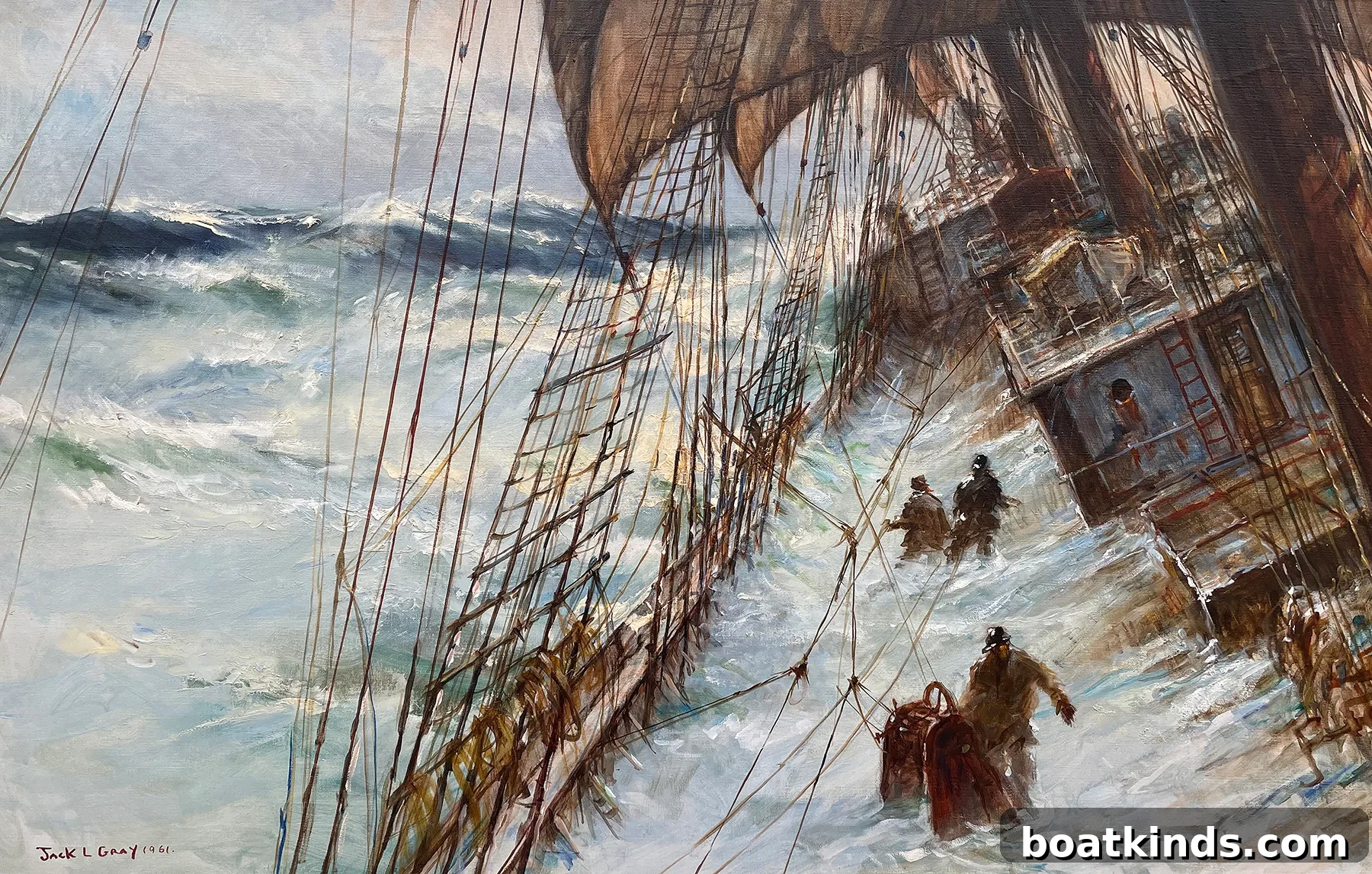
Jack L. Gray: “In the Roaring Forties on the Deck of a Four-Masted Bark”
Water cascades over the rail and drenches the deck in Jack L. Gray’s dramatic oil painting, “In the Roaring Forties on the Deck of a Four-Masted Bark.” The canvas captures a moment of raw sea power: whitecapped waves and gale-driven spray dominate the scene while the crew cling to the rigging and rails, fighting to keep the ship under control. The work is an intense study of man confronting nature, rendered with an immediacy that pulls the viewer into the tumult.
Early Life and Maritime Roots
Born in Halifax, Nova Scotia, in 1927, Gray grew up as an only child with a lifelong fascination for ships and the sea. He honed his drawing skills early, winning entrance to the Nova Scotia College of Art and Design and studying further at the Montreal Museum of Fine Arts. Between formal training and studio work, Gray spent several seasons aboard dory-fishing schooners out of Lunenburg, Nova Scotia. Those years at sea produced a substantial body of sketches, notes, and photographs that would inform his mature marine paintings.
Artistic Career and Notable Works
Gray’s first solo exhibit took place in Chester, Nova Scotia, in 1948 and led to multiple commissions. In the mid-1950s he relocated to New York City, where his time afloat continued—famously using a flat-bottomed skiff he referred to as the S.O.B. His reputation grew as his oil-on-canvas paintings began to circulate. Gray’s canvases often include extensive inscriptions on the reverse that detail location and subject matter, offering viewers contextual anchors even though the works themselves are rarely dated.
One of Gray’s paintings, “Dressing Down, the Gully,” was presented to President John F. Kennedy in 1962, an event that raised wider interest in his art. Gray later settled in West Palm Beach, Florida, living aboard a boat and frequently sailing to the Bahamas. He remained in Florida for the rest of his life.
Technique, Themes, and Legacy
Gray’s marine paintings are distinguished by their vivid portrayal of the ocean’s energy. He conveyed wind, spray, and motion with confident brushwork and a keen observation of how light interacts with water. The emotional core of many works, including “In the Roaring Forties,” is the relationship between sailors and the elements—a study in endurance, seamanship, and the smallness of human effort against an immense natural world.
Marine art dealer Russell Jinishian has described Gray as someone who “lived a true artist life,” a reference to both his commitment to craft and his immersion in maritime culture. Jinishian notes that the strength of paintings such as “In the Roaring Forties” lies in their depiction of man versus nature: the painting emphasizes the resourcefulness and leadership required to survive at sea, and the tense reliance on the captain’s decisions and the crew’s resolve.
Afterlife of the Work
Jack L. Gray died in September 1981; his ashes were scattered at sea, a final return to the environment that shaped his life and work. Interest in his approach to marine painting revived in the early 2000s, prompting renewed attention from museums and collectors and a corresponding rise in the market for his paintings. Today his canvases are appreciated both for their technical skill and for their evocative storytelling about life at sea.
This article was originally published in the May 2023 issue.