
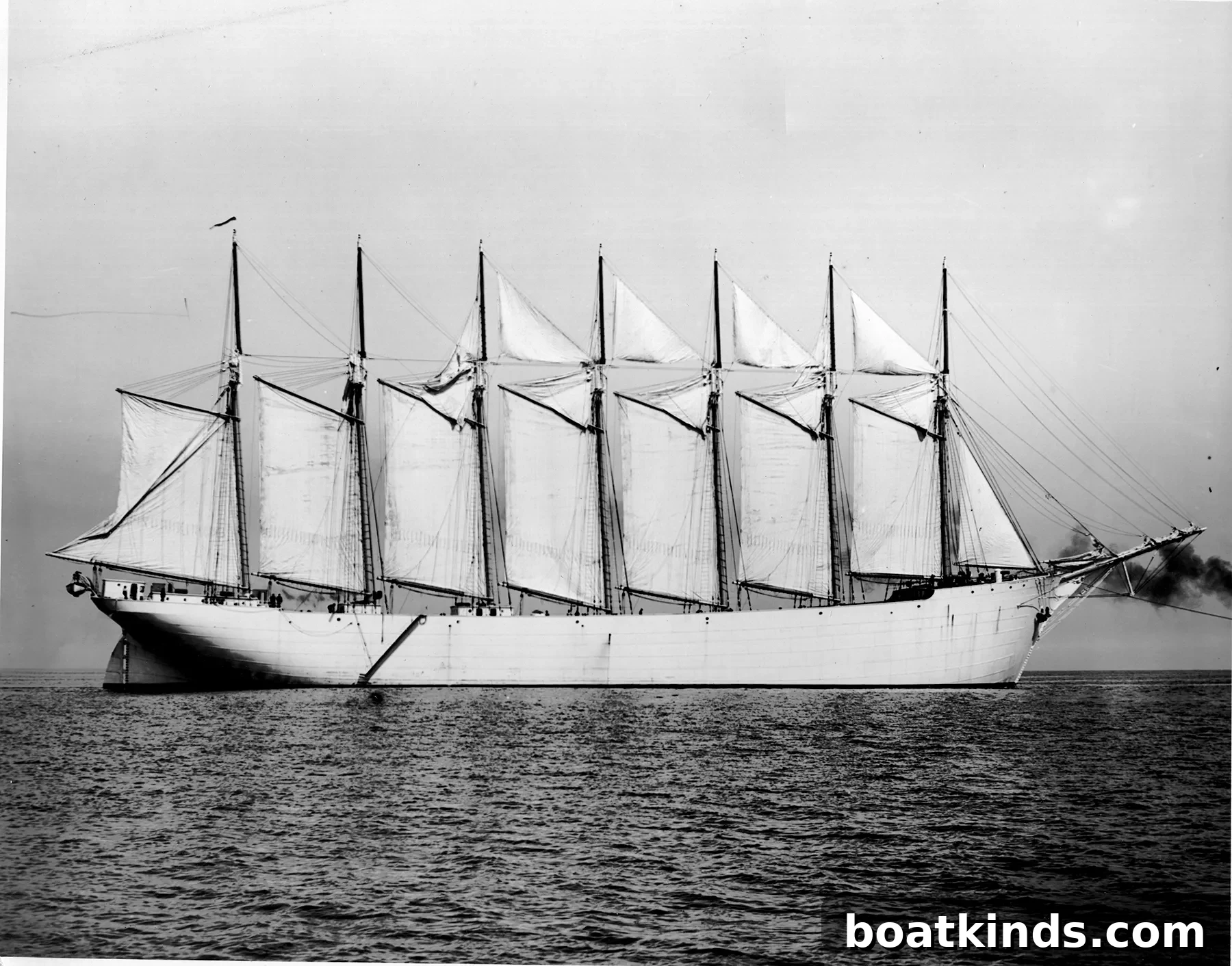
The Thomas W. Lawson: The Only Seven-Masted Steel-Hulled Schooner
At the turn of the 20th century, when steam was already reshaping maritime commerce, a handful of large sailing vessels still plied the world’s trade routes. Among them, the Thomas W. Lawson stood out as an extraordinary experiment: the only seven-masted, steel-hulled schooner ever built. Launched in 1902, she embodied both the ambition of her designers and the limitations of a fading age of sail.
The Thomas W. Lawson was commissioned in June 1901 by the Fore River Ship and Engine Company in Quincy, Massachusetts. Naval architect Bowdoin B. Crowninshield produced a design intended to maximize cargo capacity and operating efficiency for long coastal and transoceanic runs. The finished ship measured 475 feet in length, with seven masts towering 193 feet each and a sail plan that included 25 individual sails. For her size and pure reliance on wind power, she was regarded as the largest schooner and the largest pure sailing vessel of her era.
Inside the lofty hull, the Thomas W. Lawson was outfitted for serious commercial service and extended voyages. She featured two continuous decks, a poop and a forecastle, and interior spaces designed to support a professional crew: the captain’s cabin, officers’ mess and berthing rooms, a card room, and a separate rudder house away from the living quarters. These accommodations reflected the needs of a large crew and the long hauls she was meant to perform, whether carrying bulk cargo along coastlines or crossing oceans under sail.
Despite the ambitious concept and impressive scale, Crowninshield’s design suffered from operational shortcomings. The vessel’s hull and loading characteristics required a shallower working draft in many ports, forcing her to carry less cargo than planned to avoid running aground in shallow harbors. That reduced earning capacity undercut the economic case for such a specialized sailing freighter at a time when steamships offered greater regularity and easier handling in confined waters.
In practice, Thomas W. Lawson often hauled coal and oil along the Eastern Seaboard of the United States, though she was built with the Pacific trade in mind. One of her final and most notable voyages was a trans-Atlantic run in November 1907 to London, laden with 58,000 barrels of light paraffin oil. The voyage showcased both her cargo capability and the hazards faced by large sailing vessels navigating busy, weather-prone waters.
The tragedy unfolded in the English Channel. On December 13, 1907, while anchored between the Nundeeps shallows and Gunner’s Rock to ride out an approaching storm, both of her anchor chains broke during the night. The storm drove the great schooner onto Shag Rock, where she was battered until all seven masts were lost. The disaster claimed 16 of the 18 men on board, a grim reminder of how unforgiving the sea can be, even to the most imposing of ships.
Today the wreck of the Thomas W. Lawson rests with her bow in approximately 56 feet of water off the northeast side of Shag Rock. The remains have become a site of interest for maritime historians and recreational scuba divers alike. As a wreck, she preserves a rare example of an ambitious late-era sailing freighter and continues to draw attention to the unique story of the only seven-masted steel-hulled schooner.
The Thomas W. Lawson’s short, dramatic career highlights a transitional period in maritime history: the end of large commercial sail and the full ascendancy of steam-powered ships. Her construction represented the peak of sailing-ship scale and ambition, but her operational limitations and ultimate loss underscore the practical and economic forces that shaped early 20th-century shipping. For modern visitors and divers, the wreck provides a tangible link to that period—a reminder of innovative design, bold commercial hopes, and the ever-present risks of life at sea.