
“You show this to anybody, and I’ll kill you,” Jon Lyons jokes as he presses a green Sharpie into a crowded page of my notebook. He’s marking chines, deadrise angles, running surfaces and hull steps, comparing a dozen production skiffs as he explains the engineering strengths of the Regulator 26—one of those classic deep-vee center consoles he has sold and repowered repeatedly over the years.

For the better part of two hours Lyons has been sketching and talking, shifting through drawings and real-world examples to make a simple point about boat repower and performance: balance matters more than brute horsepower. “My dad’s the engineer. I do this stuff by feel,” he says, tracing the 26’s steep, unadorned vee while emphasizing weight distribution and the correct amount of power for a hull designed to plane and cut through Atlantic slop.
Lyons grew up at Ocean House Marina tucked into the backwaters of Ninigret Pond in Charlestown, Rhode Island, a complicated network of shoals, bars and narrow channels that empty into Block Island Sound through the notoriously fickle Charlestown Breachway. It’s a place that forces you to learn close-quarters handling, tide-reading and how different hulls behave in real seaway. Lyons sells and outfits boats that can handle those conditions—deep-vees built to carry fishermen long distances in sometimes harsh water.
Interest in used Regulator 26s has surged since the manufacturer phased that model out in favor of a new Regulator 25, a trend Lyons has watched closely. The 26’s reputation among anglers—especially north of the Mason-Dixon Line—has kept demand high for well-sorted used hulls, and that demand has driven a lively repower market. In Lyons’s view, repowering isn’t merely about installing bigger motors: it’s about achieving the right balance of weight, horsepower and prop selection so the boat performs as intended.
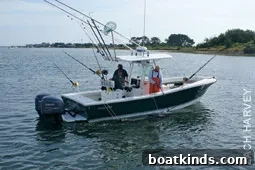
“With heavier-displacement boats—diesel Down Easters, Carolina sportfishers, working lobstermen’s hulls—you worry less about juggling the power end,” Lyons explains. “It’s in the lighter, sharp deep-vee planing hulls—Grady-White, Regulator, SeaCraft, old Hydra-Sports—where balance becomes critical. These boats are engineered to get on plane quickly and stay efficient at cruise rpm. Too much or too little weight aft, or too much horsepower, changes everything.”
Lyons recounts an industry lesson: when newer, heavier V-6 four-strokes hit the market, buyers often equated more horsepower with better performance. But engine weight changes acceleration, hole shot and cruising efficiency. For example, a four-cylinder 150 can weigh around 450 pounds while an F200 V-6 might weigh 600 pounds. On a small, light hull that difference can make the lighter engine quicker out of the hole and easier on the boat’s intended geometry.
He offers a practical rule of thumb for planing hulls: when a boat jumps on plane and comfortably holds that attitude around 3,000–3,800 rpm, you’ve likely found a well-balanced combination of weight and power. If you’re straining past 4,000 rpm to get onto plane, you’re probably underpowered or carrying too much weight aft. If the boat squats and requires constant trimming or tab correction to level, you may have too much weight on the transom or be dealing with an inappropriate prop or engine placement.
Lyons rejects the simplistic notion of “overpowering” as a virtue. It’s not merely brute horsepower; it’s how the entire system—hull, engines, props and load—works together. An overpowered, overweighted setup can ruin the acceleration profile, stress engines unnecessarily and lead to inefficient cruising that burns more fuel for less speed.
That balance has become easier to achieve as manufacturers address the historical weight penalties of four-stroke technology. Yamaha’s newer 200-horse 4-stroke, for instance, uses lighter, stronger materials that narrow the weight gap between modern four-strokes and older two-strokes. Lyons notes that on a Regulator 26, a pair of modern 200s often offers the sweet spot: enough thrust, lighter weight and a better ride than larger, heavier V-6 options such as F250s, often at a lower overall cost.
Ultimately, Lyons says repowering is about stewardship—getting owners the ride and efficiency their boats were designed for while protecting powerplants from unnecessary strain. “We often have to advocate for our customers, even when they come in wanting the biggest motor on the market,” he says. “The right choice delivers speed without hammering the engines and gives anglers the confidence to run where the fish are and come home safely.”
Zach Harvey is fishing editor for Soundings.
June 2014 issue