
Beached to Rot: A Row of Early 1800s Wooden Vessels in New York City
A single black-and-white photograph from the Detroit Photographic Co. captures a haunting scene: a fleet of wooden vessels from the early 1800s left stranded on a New York City shoreline. The caption—“beached to rot away, New York City”—frames what at first glance seems a melancholy loss. Yet the image also offers a rich, detailed catalogue of boat types and the era they represent: pleasure craft, workboats, harbor ferries and a grand steamer, all resting together like the pages of a maritime history book turned to an ending chapter.
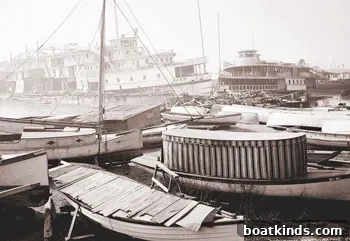
The variety of wooden vessels in the photograph speaks to a time when sail, steam and skilled craftsmanship coexisted. A graceful catboat, with its characteristic broad beam and single mast, draws the eye. Its diamond-shaped ports and stout, slightly blunt mast are unmistakable. The long sprit and a plumb bow that drops to the cutwater give the boat a compact, purposeful silhouette. One can imagine a solitary sailor perched in the cockpit, leaning against the coaming with a lively tiller in hand, watching wind and water with a practiced calm.
Nearby, a launch with a striped-canvas surrey top suggests a different kind of life: short river and harbor trips, genteel outings and summer afternoons. The launch bears the name Ki-Ki on her bow, painted in a manner that hints at affection and pride. Scenes of women with parasols and men in blazers and white trousers—Sunday yacht races, family excursions, small celebrations—come readily to mind when looking at this little boat. These small pleasure craft served as social stages as much as they did as modes of transport.
Dominating the composition in the distance is the steamer Drew, a large passenger vessel built in a style popular in the late 1800s. Named after Daniel Drew, a figure associated with the Bristol Line of steamers, this ship is described as more than 300 feet in length—a substantial vessel designed to carry passengers between New York and Albany. For many, such steamers offered a rare taste of comfort and luxury, transporting travelers for business, vacations and family trips in conditions beyond what most experienced ashore.
The photograph functions as both an archive and an elegy. It records an exact moment when the ordinary technology of a prior age—wooden hulls, wooden masts, sails and early steam propulsion—had already been overtaken by rapid innovation. New forms of transportation and power, including railroads, automobiles, gasoline inboard engines and outboards, steadily displaced older vessels and the industries that supported them. Shipbuilding itself moved toward iron and steel construction, while new engines changed how people and goods moved over water. The boats in the photograph were not merely abandoned; they were casualties of a broader technological and economic transformation.
Yet to view them only as obsolete objects is to miss their cultural value. Each craft in that tidy jumble once carried stories—of crew and passengers, daily labor and weekend leisure, of river and harbor life shaped by tides and weather. The steamer Drew, for example, speaks to an era of long-distance river travel that connected cities and communities. The catboat and the surrey-topped launch recall the texture of coastal recreation and the rhythms of small-boat handling. Together, they provide a cross-section of maritime heritage that matters to collectors, historians and anyone interested in the evolution of working waterfronts.
Today these wooden vessels would likely be candidates for restoration, preservation or museum display, treasured as artifacts of an era when wood and canvas met water in ways that combined utility and artistry. Instead, in the photograph they await decay, a stark reminder that material culture can be fragile in the face of progress. The image invites reflection about what societies choose to conserve, what they let go, and the ways in which technological change reshapes both landscapes and memories.
This article originally appeared in the December 2015 issue.