
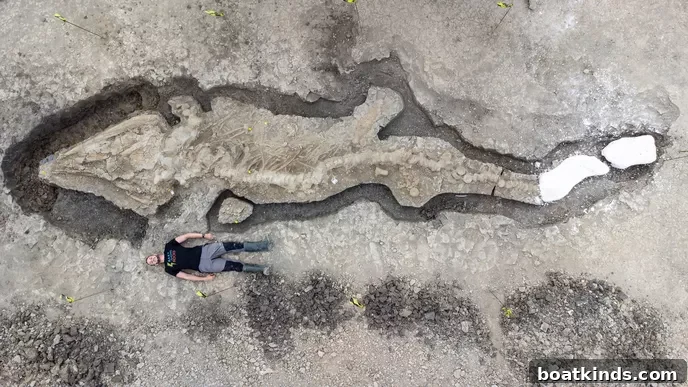
33-Foot “Sea Dragon” Fossil Unearthed at Rutland Water
A 33-foot-long marine reptile fossil, described in the press as a “sea dragon,” was discovered in a drained lagoon in Britain. Scientists have identified the specimen as Temnodontosaurus trigonodont, a species that lived roughly 180 million years ago during the early Jurassic, at a time when dinosaurs dominated the land.
This find represents the largest and most complete ichthyosaur fossil uncovered to date in the U.K. While ichthyosaur remains have been recorded across Britain before, none matched the size or level of preservation of this specimen, and it is reportedly the first time this particular species has been found in the country.
How the Fossil Was Found
The fossil was initially spotted in January 2021 at the Rutland Water Nature Reserve. Joe Davis, a conservation team leader with the Leicestershire and Rutland Wildlife Trust, and a colleague made the discovery while inspecting a drained section of the lagoon. Davis later recounted that he noticed what looked like clay pipes protruding from the mud — an appearance that reminded him of whale and dolphin vertebrae he had encountered previously on the Hebrides.
Following the discovery, professional archaeologists and palaeontologists carried out a controlled excavation in August and September 2021 to recover the remains. The excavation process required careful removal of surrounding sediments to document the fossil’s position and preserve fragile bones for study and conservation.
Scientific and Public Interest
Temnodontosaurus belongs to a group of marine reptiles known as ichthyosaurs. These animals were highly adapted to life in the sea and are often compared in form to modern dolphins and whales, though they are not related to those mammals. The exceptional size and completeness of the Rutland specimen make it an important discovery for British palaeontology: it provides rare insight into the diversity and distribution of early Jurassic marine life in this region.
The find has attracted both scientific and public attention. The specimen was featured on the BBC television series Digging for Britain, where its discovery and excavation were presented to a broader audience. Coverage on the program helped highlight the significance of the find and the collaborative work between conservation staff, volunteer finders, and professional researchers.
Local Context and Conservation
Rutland Water Nature Reserve, the site of the discovery, is a managed landscape with reservoirs and wetland habitats. Draining parts of a lagoon for maintenance or conservation work can sometimes expose buried deposits, and in this instance it allowed an exceptional fossil to be revealed. Local conservation teams played a key role in identifying the bones and coordinating with specialists to ensure the fossil was excavated and conserved properly.
Recovered fossils of this scale typically undergo detailed cleaning, consolidation, and study before they are catalogued and, in many cases, prepared for museum display or further scientific analysis. Each specimen contributes to a growing picture of prehistoric marine ecosystems and helps refine what scientists know about creature size, anatomy, and distribution during the Jurassic.
Why the Discovery Matters
Large, well-preserved ichthyosaur fossils are globally important because they preserve anatomical details that fragmentary remains cannot. This Temnodontosaurus trigonodont find will help researchers compare British specimens with others found in different regions, improving understanding of species variation and palaeogeography — how ancient species were distributed across the seas of the past.
Beyond its scientific value, the discovery is a reminder of the potential for significant finds in managed landscapes and reserves, and of the role that local guardians, volunteers, and reserve staff can play in uncovering and protecting important palaeontological resources.
As analysis and conservation work continues, the Rutland ichthyosaur promises to remain a focal point for researchers and the public interested in Britain’s deep past and the incredible marine reptiles that once patrolled the ancient oceans.