
When I first walked into the waterfront offices on North Cove in Essex, Connecticut, so many years ago, Soundings truly lived up to its old tagline: “The Nation’s Boating Newspaper.” The newsroom was a different world — reporters tapping out copy on typewriters, cigarette packs on desks, and a slower, more deliberate rhythm to the news cycle. In those pre-Web days, a monthly magazine could still “break” a story. We produced five regional editions and turned out pages of reporting to complement the steady stream of advertisements that arrived with each tide.
Back then Soundings was a tabloid printed on inexpensive black-and-white newsprint with a color cover. It wasn’t glamorous, but it was full of news, character and purpose. When an issue went to press, founder Jack Turner would blow a conch shell, we’d stand around the long paste-up tables, and we’d celebrate with beer, rum and wine. It was a lively, sometimes raucous group of quirky reporters and editors who worked hard and had fun doing it. Jack wanted Soundings to be the “flying tigers” of marine publishing, and that spirit guided us.
Jack passed on about a decade ago, and the last traces of our newsprint era and tabloid format have vanished. I can’t recall who now keeps the conch, but it’s been silent for some time. Most of the colleagues who were with me when I first arrived have moved on to new harbors, and change continues to arrive like tides on the shoreline.
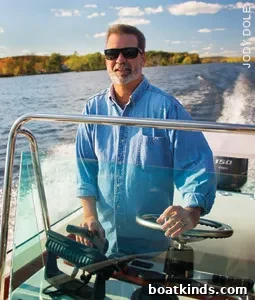
It is with gratitude and a touch of wistfulness that I announce a change of course. After 18 years as chief editor, I’m handing the helm of Soundings to Mary South. I won’t be leaving the waterfront — I’ll remain in my cluttered, artifact-filled office in Essex, where I’ll continue writing and editing a new fishing magazine, and I’ll also contribute to Soundings as editor-at-large when time allows. That role fits me well and keeps me connected to the boating community.
Mary South brings 25 years in publishing and a lifelong love of boating. A former editor of Yachting magazine, she understands the nuances of our field — she knows, for example, the difference between a built-down and a skeg-built lobster hull, which speaks volumes about her experience. Over the past year she has served as deputy editor of Soundings, helping launch our new fishing title and proving to be an indispensable colleague and friend. Mary is a skilled writer and editor with high standards and strong journalistic integrity; I’m confident Soundings will remain in excellent hands with her leadership and our veteran team at the wheel.
My primary focus going forward is a new quarterly, Anglers Journal, which our company launched about a year ago. The publication was recently named one of the “30 hottest” magazine startups of 2014 and picked up a couple of Folio awards last December — notable recognition for a title so young. I’ll be deeply involved there as editor, wearing many hats, and I’ll also continue as editor-in-chief of Soundings Trade Only, our monthly dedicated to the boating industry.
When I became editor of Soundings, my aim was to shape a magazine that honored a wide swath of the waterfront — one that appreciated both classic and contemporary boats. I wanted coverage that looked closely at trends in design, propulsion and electronics while also respecting tradition, seamanship and proven practices of the past. If, at times, a story, painting or photograph allowed readers to glimpse the sea’s grandeur — what the old Cape Horner Rex Clements called “the windswept fields of infinity” — then I feel we achieved something meaningful.
Reflecting on more than three decades in maritime journalism, it’s been an extraordinary voyage — through calms and squalls, highs and lows, always returning to fair winds and a favorable tide. Soundings has been a seaworthy and fortunate ship, and I’ve been privileged to be part of its crew.
To our readers — the sharpest, saltiest audience any reporter or editor could hope to have — thank you. Your loyalty, feedback and passion for the water have kept me on my toes all these years. I look forward to seeing you on the water and to continuing to write about the boats, the people and the craft we all love.
“He picked up the ball of twine and put it to his nose and drew in the smell of boats, caulking smell, rope-locker smell – the smell which, savored in deepest gloom of wintertime, had the power of evoking faraway sunlit wavetops, a canted mist, a warm summer breeze on the helmsman’s cheek.” — John Hersey
February 2015 issue