
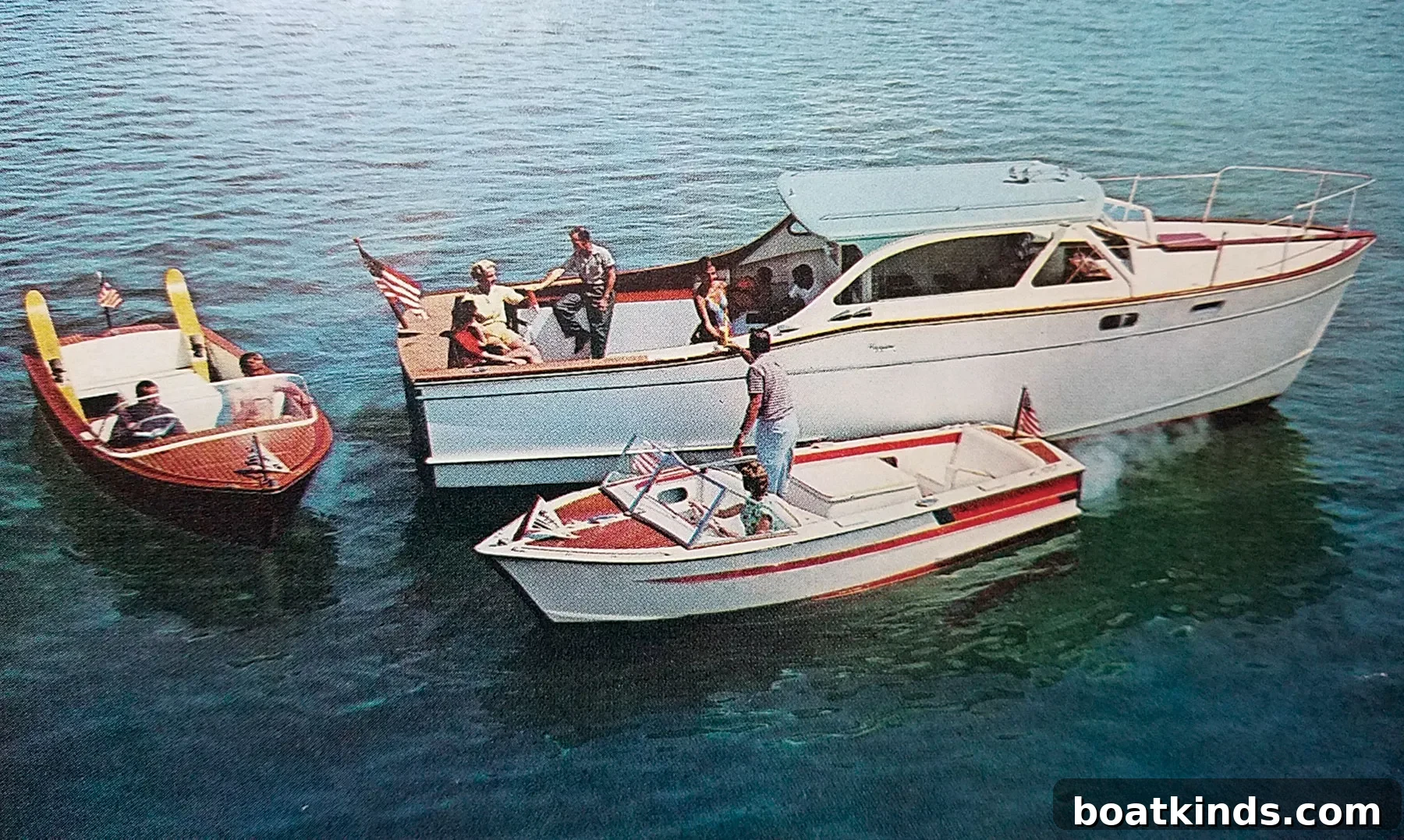
A 1960s advertisement described this trio of Higgins Seafarers as a “rendezvous with happy boating,” a fitting phrase for what many consider America’s first family of pleasure boats. The image captures the variety in the Higgins lineup—sporty, luxurious and spacious—illustrating why these classic wooden boats still draw attention from collectors and enthusiasts.
On the left sits the 17-foot Port Royal sport runabout, a nimble hull designed for tow sports like waterskiing. In the foreground is the two-tone, 18-foot Mandalay, marketed as a “luxury” runabout with styling intended to appeal to owners who wanted a more refined day-boat. Dominating the scene is the 33-foot Chandleur Sports Cruiser, the largest of the Higgins pleasure-boat models (a Sports Fisherman version was also offered). Together, these models represent the range of designs produced by the Louisiana builder.
Constructed in wood, Higgins boats combined varnished timberwork with two-tone painted surfaces and clean, classic lines. Distinctive features of the Higgins brand included left-side steering, a floor-mounted accelerator pedal, and an automobile-style dashboard and wheel with the gear shift on the steering column. These design choices created a driving feel that many owners still praise for its familiarity and ergonomic layout.
Performance was a clear priority for the builder. The Port Royal, powered by a 109-horsepower Gray Marine inboard, could reach nearly 40 mph—fast enough for exhilarating waterskiing sessions. The Chandleur cruisers employed twin engines producing a combined 550 horsepower, enabling speeds in excess of 35 mph for a large wooden cruiser, impressive for their size and era.
Speed and seaworthiness were hallmarks of Andrew J. Higgins’s career long before he produced leisure craft. Born in Columbus, Nebraska, in 1886, Higgins began building boats as a child and later ran a New Orleans shipyard in the late 1930s. There he developed shallow-draft, tunnel-stern workboats capable of operating in shallow water and even being driven up onto shore—designs originally intended for loggers and oil-field operations that later proved critical for military use.
During World War II, those shallow-draft landing craft became essential to amphibious operations. Higgins’s shipyard produced a very large number of these craft for the U.S. military, and the effort involved a diverse workforce that included women and minorities. For their contribution to the war effort, Higgins and his workers received Congressional recognition. In addition to landing craft, the yard produced nearly 200 PT boats, including high-performance 78-foot models known for capability in challenging sea conditions.
The technology and naval experience behind those military vessels translated into the handling and layout of Higgins’s pleasure boats. Owners and restorers often remark that the pleasure craft “drive different” and “look different,” reflecting a blend of thoughtful engineering and distinctive styling not commonly found in mass-produced boats of the period.
Today, Higgins pleasure craft are rare. The Higgins Classic Boat Association, an active owners’ group committed to preserving these wooden boats, estimates there are about 200 Higgins pleasure craft remaining. That scarcity, combined with the boats’ craftsmanship and historical connection, keeps them in demand among collectors, restorers and maritime historians.
Preservation efforts focus on maintaining original features—varnished mahogany, two-tone paint schemes, and the unique helm layout—while addressing the practical challenges of caring for wooden hulls and aging mechanical systems. Owners often balance restoration that honors authenticity with upgrades that improve safety and usability, such as modern electrical systems or refreshed propulsion components, always mindful of keeping the boats’ character intact.
Whether admired for their vintage looks, their performance pedigree inherited from wartime shipbuilding, or the story of Andrew Higgins himself, these boats remain a tactile link to a formative era in American boatbuilding. For enthusiasts of classic wooden boats, a Higgins is recognizable not only by its lines but by the sense of history and craftsmanship it carries.
This article originally appeared in the September 2020 issue.