
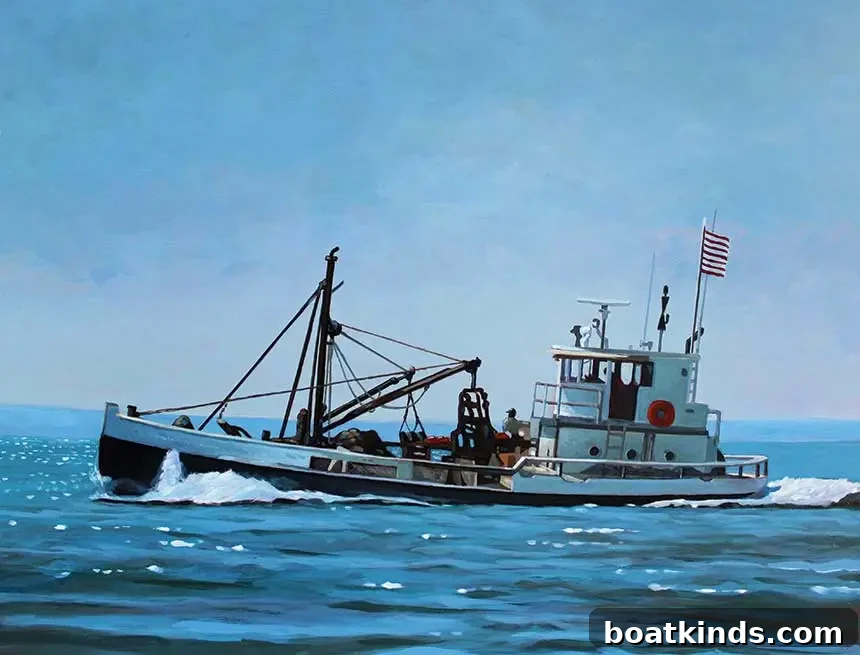
Brechin Morgan’s Suzanne: A Wooden-Hull Oyster Boat on Long Island Sound
In this evocative oil painting, Brechin Morgan captures the wooden-hull oyster boat Suzanne as she works the waters of Long Island Sound out of Bridgeport, Connecticut. At first glance the scene reads as calm and almost photographic: a quiet sea, steady light, and the familiar silhouette of a working boat. Look more closely, though, and the painting reveals layers of texture, weather, and labor—what Morgan calls the grit and beauty, the raw physicality of life on the water.
“I have an emotional connection to these hardy wooden vessels,” Morgan explains from his Bridgeport home. That connection goes back decades and is rooted in lived experience. His first job after art school was as a deckhand on the oyster boat Eban Thatcher, a vessel much like the one he depicts in the painting. The boat was run by the Tallmadge Oyster Co. in South Norwalk, Connecticut, and Morgan still recalls how the work felt: the cold of early April, seawater and sand in his boots, a hot thermos of coffee, and the captain’s constant shouts. Those sensory memories—the fatigue, the routine, the brief camaraderie—inform his work and give it emotional authenticity.
Morgan’s respect for these boats and for the people who work them is apparent in every brushstroke. He describes dredging young oysters and moving them to new beds as physical, repetitive, and elemental work. At the end of a long day there was always “exhaustion and dreamless sleep,” he says, a stark and honest note that helps explain why his paintings feel so grounded. The vessels are not romanticized; they are respected for their durability and the tough maritime lives they support.
Beyond his early days as a deckhand, Morgan is also an accomplished mariner and world traveler. In 1998 he left Ballard’s Wharf on Block Island, Rhode Island, in his 27-foot cutter, the Otter, and sailed westward around the globe. That 32,000-mile voyage, during which he sketched and painted constantly, earned him the Joshua Slocum Society Golden Circle Award. The journey did more than add an accolade to his career—it honed his eye, sharpened his sense of composition, and deepened his relationship with light and weather at sea.
Morgan speaks about painting as a medium that can intensify perception. “I love the connection between realism and painting,” he says. Up close, his canvases are composed of paint—layers, brushstrokes, and color choices. Step back, and those same strokes resolve into an oyster boat set in a particular atmosphere: the chill of a spring morning on Long Island Sound, the grain of the wooden hull, the tension of lines and nets. He contrasts that richness with photography, noting that photos can feel flat because of printing and ink limitations. Painting allows him to deepen the sense of space, color, and atmosphere and to shape an emotionally engaging, personal experience for the viewer.
His working process is both intuitive and disciplined. Morgan admits he can’t always explain exactly how certain effects emerge. He keeps an emotion in mind, and he keeps the brush moving—layering, wiping, refining—until the composition “settles out and looks right.” That combination of memory, feeling, and technique is what gives his maritime paintings their potency: they are anchored in real experience but translated through a painter’s sensibility.
The subject of Suzanne is a fitting example of Morgan’s approach. The boat itself is central, but the painting is also about the environment that shapes the work—the light on the water, the salt air, the weathered surfaces, and the rhythms of labor. By balancing precise observation with painterly interpretation, Morgan invites viewers to imagine not only how the boat looks, but how it feels to be aboard: the movement, the chill, and the steady focus required by a day’s work on the sound.
For those who value maritime history and realist painting, Morgan’s work offers a bridge between memory and craft. His paintings honor the vessels and the people who depend on them while also demonstrating how oil painting can expand our emotional understanding of a familiar scene. The result is artwork that feels both true and alive—rooted in specific experience, yet open to the viewer’s own associations and memories of sea and work.
This article originally appeared in the July 2020 issue.