
Kids quickly learn that putting weight high up makes an object less stable—think of a pogo stick, stilts or a unicycle. Likewise, weight kept low makes an object more stable: Weebles wobble but don’t fall down. Less obvious to both children and adults is how the free surface effect (FSE)—the tendency of liquids to slosh from side to side inside a boat—acts like an invisible force that can push a vessel closer to capsizing than you might expect.
Weights and Measures
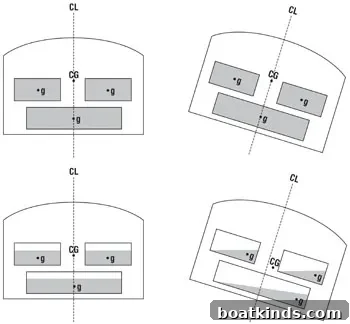
Every item aboard a vessel has its own center of gravity—engines, batteries, anchors, coolers, cruising guides and, importantly, any liquids in tanks. Each of these contributes to the vessel’s overall center of gravity (CG) based on its weight and location. Heavy objects move the CG more than light ones. Low-placed weight lowers the CG; high-placed weight raises it. Off-center weights shift the CG away from the centerline and can cause the vessel to list. Ideally, the combined weights aboard produce a CG that sits on the centerline and is low enough for safe operation in expected conditions.
In a perfect world a vessel’s stability would be fixed, but in reality it changes for many reasons—one of the most important being free surface effect. Picture a small boat: when several people move to one side, their individual centers of gravity move too and pull the boat’s overall CG off the centerline, causing a list. If those people moved repeatedly from side to side, the boat’s roll would grow more intense and could lead to capsize. FSE works similarly, except you usually cannot see it; liquid inside tanks or on deck shifts and amplifies roll in ways that aren’t immediately obvious.
Living With Free Surface
Common sources of free surface effect include water tanks, fuel tanks, holding tanks and bilges. Larger vessels may also have lube oil, waste oil or ballast tanks that contribute. Bilge water is a frequent culprit—removing it is a standard heavy-weather precaution. Water on deck from breaking seas not only adds momentary weight and raises the CG, it also creates a free surface as it drains. While some vessels resist capsizing better than others, FSE reduces stability across the board.
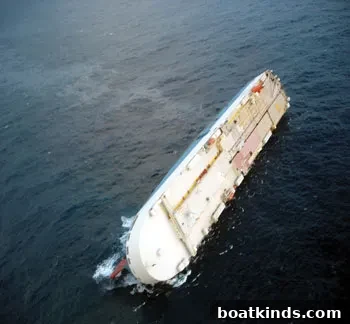
FSE is rarely the single cause of a capsize; usually other factors play a role. Still, it can convert a manageable situation into a dangerous one. There are documented cases where firefighting introduced so much water into a ship that it lost stability—the SS Normandie, during World War II conversions, famously rolled at dock after firefighting efforts flooded her decks and tanks. Elevated CG from many passengers on an upper deck combined with a beam sea and free-surface liquids can also push a vessel past its point of no return.
Heavy weather is another common scenario where FSE becomes critical. In large seas and strong winds, partially filled tanks can exaggerate rolling, reduce rudder effectiveness and lead to broaching. Deep rolling can affect oil levels and cooling intakes, risking machinery failure at the worst time. Add a couple of green seas on deck and a sudden gust, and a vessel can go from stable to unrecoverable very quickly. When that starts to happen, options are limited.
Countermeasures
Understanding how FSE works allows you to manage it. A full tank behaves like a fixed weight and does not create a free surface; an empty tank likewise has no slosh. Therefore, before heading into heavy weather or any situation where FSE might matter, consider consolidating or topping off tanks to reduce the number of partially filled (slack) tanks. Aim to balance full and empty tanks so the vessel remains on an even keel. Perform these transfers in port or calm conditions—moving liquids during rough seas can make matters worse.
On vessels with bulwarks, make sure waterways, freeing ports and scuppers are unobstructed. These openings are sized and located to drain water quickly from deck; blocked scuppers trap water, raise the CG and create additional free-surface area. Avoid leaving coolers, deck boxes or jerry jugs in places that impede drainage. If heavy weather can’t be avoided, keep topside weight low and steer to reduce rolling and water on deck.
Hydrostatic Balancing
Many larger yachts have paired tanks—port and starboard fuel or water tanks—with a cross-connection valve between them. Owners sometimes leave these cross connections open so tanks draw down evenly, avoiding a list. That practice can be dangerous: if the vessel heels for an extended period, liquid will flow from the high side to the low side until levels equalize, worsening the list. This slow transfer is called hydrostatic balancing. Isolating tank pairs prevents uncontrolled transfers and limits the number of slack tanks at any one time, helping to maintain stability.
Completely eliminating free surface effect is impossible—you can’t always keep every tank fully filled or empty, and you can’t avoid all bad weather. But by recognizing FSE and hydrostatic balancing, and by taking simple precautions—topping off or consolidating tanks, keeping scuppers clear, isolating tanks when appropriate, and minimizing topside weight—you reduce one significant source of risk and improve your vessel’s overall stability.
Capt. Daniel Parrott grew up in Connecticut and spent 20 years voyaging worldwide on traditional sailing ships. In 2003 he joined the faculty of Maine Maritime Academy, where he teaches navigation, seamanship and bridge resource management. Parrott holds a USCG license, Master of Oceans, 1,600 tons and second mate unlimited, and is the author of Tall Ships Down and Bridge Resource Management for Small Ships.
This article originally appeared in the March 2017 issue.