
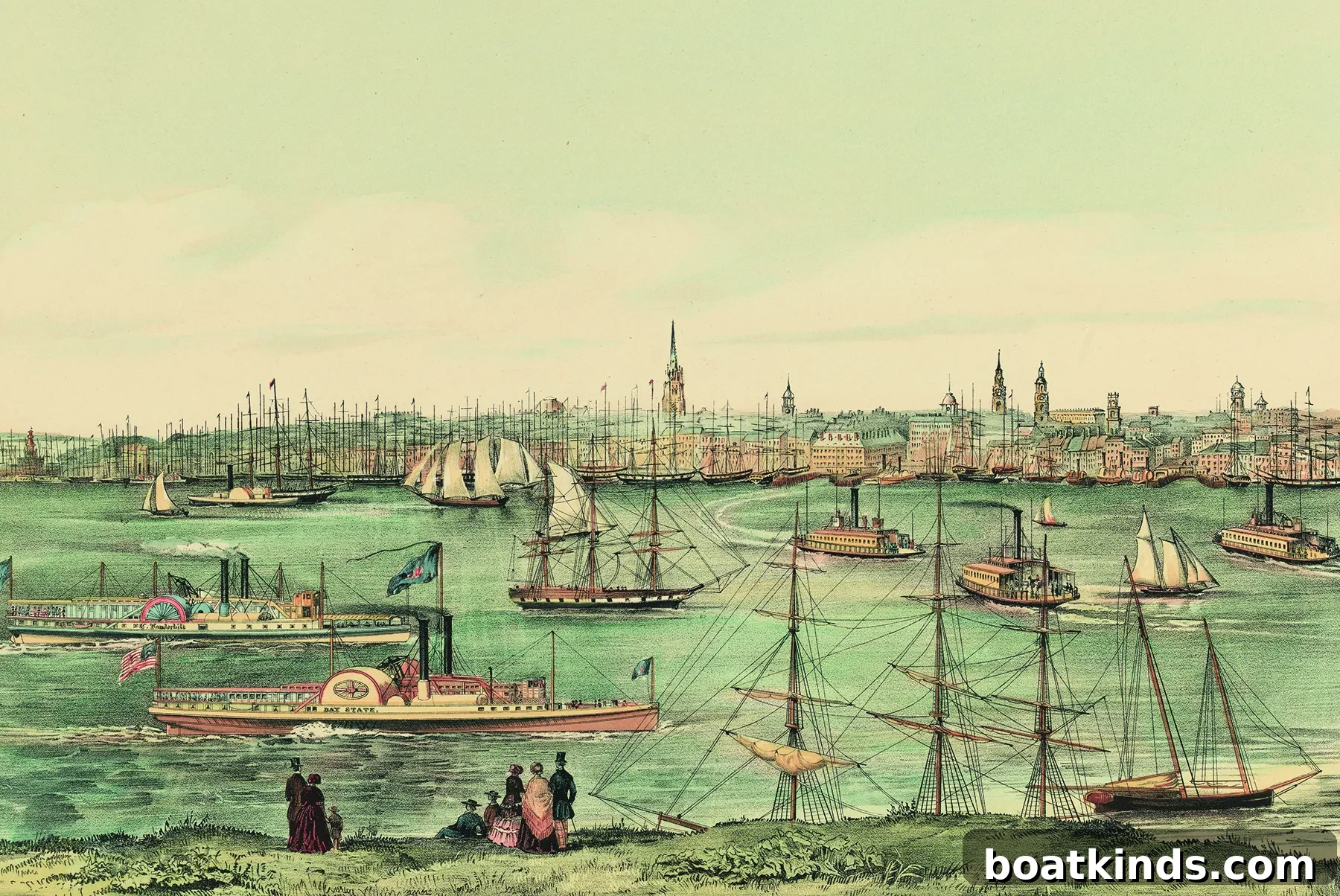
“View of New York from Brooklyn Heights” (1849): Frances Flora Bond Palmer’s East River Scene
The 1849 lithograph “View of New York from Brooklyn Heights” by Frances Flora Bond Palmer captures a bustling, ship-filled East River at midcentury. Schooners, clippers, sloops and paddle steamers crowd the water while people on the Brooklyn Heights shore look across to Manhattan. The clear weather and animated waterfront convey a city in motion—one shaped by trade, travel and daily life on the river.
In the mid-19th century, the East River was a vital artery for New York’s economy and social life. Cargo ships delivered goods, passenger vessels carried immigrants and visitors, and ferries provided the only regular connection between Brooklyn and Manhattan before the Brooklyn Bridge opened in 1883. Time spent on and beside the river—commuting, trading, working and recreating—was a central part of life for many residents of the growing metropolis.
Palmer’s lithograph serves both as an artistic impression and a historical document. Lithographs and panoramas produced during this era often recorded current events, changing cityscapes and scenes of everyday activity. Publishers and businesses alike commissioned prints to document news, advertise locations, or celebrate civic growth. This image fits within that tradition, offering viewers a window into urban life at the end of the Civil War and amid the height of the Industrial Revolution.
One notable publisher of the period, Currier and Ives, included works by Palmer in its output. Such printmaking firms helped shape popular visual culture by distributing images that were accessible to a broad audience. Palmer’s work, reproduced and sold through commercial channels, reached people who wanted visual records of the city and its maritime life.
Frances Flora Bond Palmer was born in Leicester, England, in 1812 and received early artistic training at Miss Linwood’s School for Young Ladies. She emigrated to New York City in 1841 with her husband, Edmund Seymour Palmer, and established herself as an illustrator of landscapes and panoramic views. Over the course of her career she produced more than 200 lithographs for Currier and Ives and other clients, contributing a significant body of work that documented American scenes during a transformative period.
Despite her productivity and the popularity of the prints she produced, Palmer did not receive the recognition often afforded to male contemporaries. As Martina Caruso, director of collections at the South Street Seaport Museum, has observed, women artists in the mid to late 19th century frequently went unrecognized by the institutional art world, and Palmer’s career reflects that broader historical pattern. Her contributions to commercial printmaking were influential in shaping public images of American cities, even as her personal reputation remained limited.
Today, the South Street Seaport Museum in Manhattan’s South Street Seaport Historic District preserves twelve of Palmer’s works, including this lithograph. The museum features the piece in its permanent exhibition, “South Street and the Rise of New York,” where it helps narrate the city’s maritime and commercial development. Displayed alongside other period prints and artifacts, Palmer’s images create a visual timeline of 19th-century New York, documenting the rhythms of harbor life, urban expansion and the transportation networks that connected neighborhoods and regions.
Viewed now, Palmer’s lithograph offers more than picturesque detail; it is a portrait of a city in transition. The crowded waterfront, the variety of vessels, and the onlookers on Brooklyn Heights together evoke a moment when waterways defined how people connected, worked and experienced the urban landscape. As historical records and museum holdings continue to reintroduce her work to contemporary audiences, Palmer’s prints provide valuable insight into the visual and social history of New York City.
—Lidia Goldberg
This article was originally published in the December 2022 issue.