
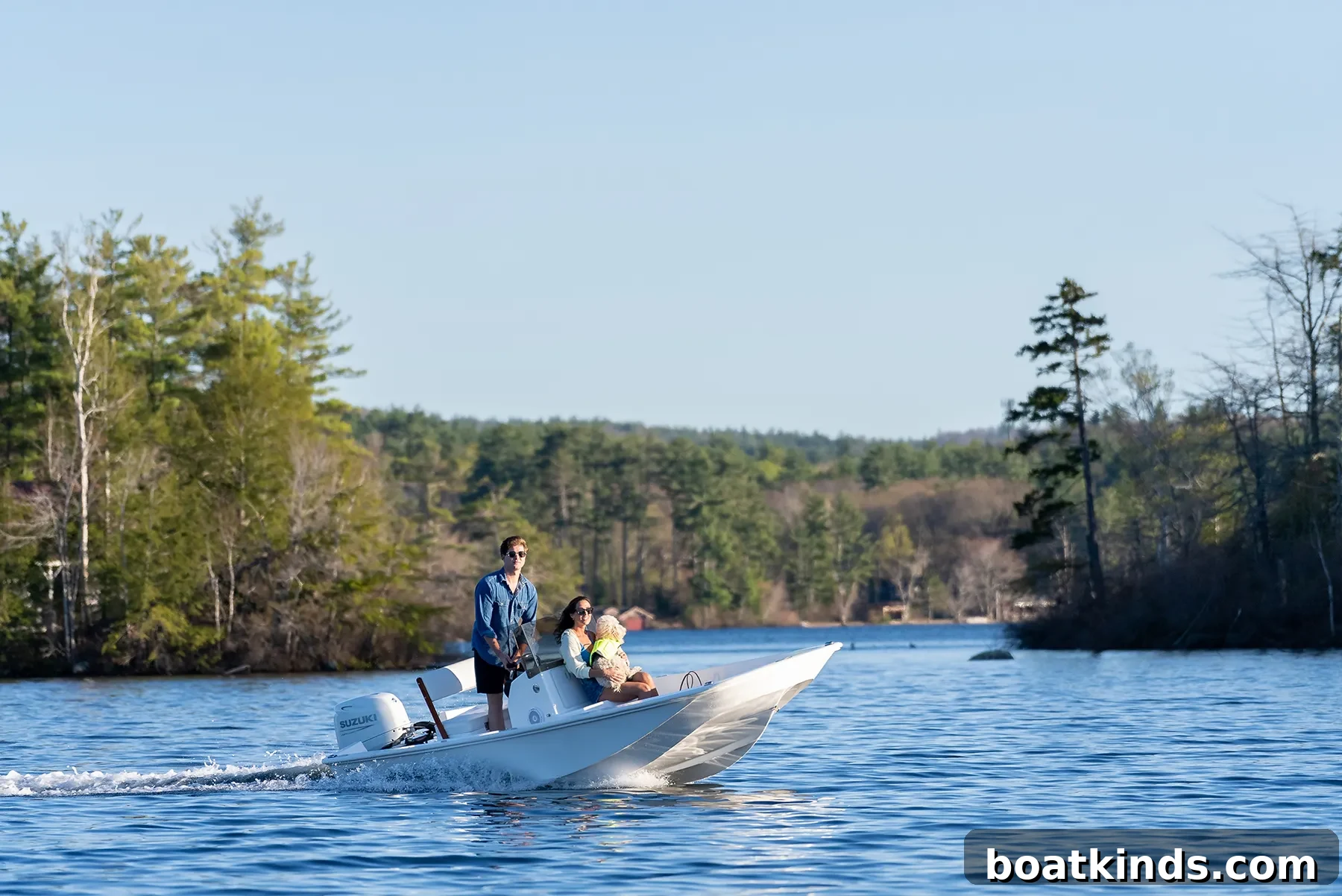
How a Chance Meeting in Daytona Sparked a New Line of Wolfeboro Boats
When Nate Drouin stopped into a West Marine store in Daytona Beach last year, he was looking for a simple answer about repair materials for the fiberglass on his rental water-scooters. As the owner of a marina and Jet Ski rental business on New Hampshire’s Lake Winnipesaukee, and operator of additional scooter-rental outlets in both Florida and New Hampshire, Drouin is hands-on with maintenance and wanted practical guidance on polyester versus epoxy resins.
What followed was an unexpected encounter that changed the course of his business. An older man approached while Drouin was comparing resins. “Can I help you?” the man asked. When Drouin mentioned polyester and epoxy, the man brightened and revealed he had built thousands of polyester boats during his career. That man was Harry Farmer, the founder of Seaway Boats, known for its Down East-style builders in the 1970s.
A short time later Farmer visited Drouin’s Daytona shop to advise on the Jet Ski repairs. The conversation shifted from patching hulls to a shared enthusiasm for boatbuilding. Drouin casually asked Farmer whether he might be interested in building another boat. Farmer’s response was immediate and enthusiastic. Within weeks he left his job at West Marine to become a consultant to Drouin and his partner, Trell Hartford.
From Repair Advice to a New Boat Line
Together, Drouin and Hartford—owners of Wolfeboro Boat Company—began developing two distinct models: a 15-foot center console called the Classic 15 and an all-new 27-foot Down East–style cruiser influenced by Farmer’s Seaway heritage. Both boats are built to order at the Daytona facility, where as of late May a small team of seven was producing the fourth Classic 15.
The Classic 15 and the forthcoming 27-footer are deliberately different in purpose and layout. The Classic 15 is a nimble center console with a functional top deck and modern conveniences, while the 27-foot model carries the traditional Down East hull lines that reflect Farmer’s background. What unites both designs is a focus on high-end interior finishing and practical, user-friendly systems.
Features, Construction, and Pricing
The Classic 15 starts at $29,900, rising to about $36,000 depending on options. Standard equipment includes a reliable 50-hp Suzuki outboard and a five-year warranty. Construction emphasizes safety and durability: the boats are built with a one-bond foam core sandwiched between hull and deck that provides more than 2,500 pounds of flotation. The Classic 15 also features hydraulic steering, an integrated 12-gallon fuel tank, Accon cleats, Perko LED navigation lights, Lumitec switches and interior lighting, a Todd Marine swingback integrated cooler seat, and a swim ladder.
Optional upgrades allow buyers to tailor their Classic 15 with modern electronics and entertainment, including a Garmin touchscreen chart plotter with lake charts and sound systems using Fusion and JL Audio components. The manufacturing approach blends traditional craftsmanship with contemporary components: “We’re building 100-percent composite boats the old-school way, by hand, and putting out a high-quality finish,” Drouin says. “We’re blending that old world and new world, and it’s kind of cool.”
For buyers seeking a larger cruiser, the 27-foot Down East–style model will carry a higher starting price—Drouin estimates around $120,000—and is positioned as a premium, fully finished cruiser with the same attention to craftsmanship that defines the Classic 15.
Small-Scale, Built-to-Order Craftsmanship
Wolfeboro Boat Company’s early production emphasizes customization and quality over mass-market volume. The Classic 15 was the company’s initial product offering, designed to be modern in operation—featuring push-button electrical systems and simplified operations—while maintaining the look and feel of a carefully finished, hand-built boat. Each hull is assembled by a compact team focused on detail work and integrity of construction.
The collaboration between a new-generation owner-operator and a seasoned builder illustrates how practical maintenance needs can spark broader creative ventures. What began as a question about fiberglass resins led to a partnership that revives traditional composite boatbuilding methods in a contemporary, market-ready package.
This article was originally published in the September 2023 issue.