
Nothing on the water is more dangerous than an unexpected person overboard. While medical emergencies and hull leaks are common, going over the side remains the deadliest boating accident. If the U.S. Coast Guard is called to search for a missing person, the odds are grim: there’s roughly a 40% chance the person will never be found, alive or dead.
Your chances of survival improve dramatically with the right gear and by wearing it. Equally important is the crew’s response when someone ends up in the water. Hitting the MOB (Man Overboard) button on your GPS or immediately calling over VHF before stabilizing the situation can create confusion and waste critical seconds. The correct response depends on one clear distinction: whether the person in the water is still in sight or not. Each situation demands a different, well-practiced procedure.
If the MOB is in Sight
When the person in the water remains visible, the single priority is to keep them in sight and bring the vessel to them safely. Start by throwing flotation: a life ring or any floatation device should be deployed immediately—even if the person is wearing a life jacket or is an accomplished swimmer. Flotation helps keep them in the exact location and provides something to grab while you approach.
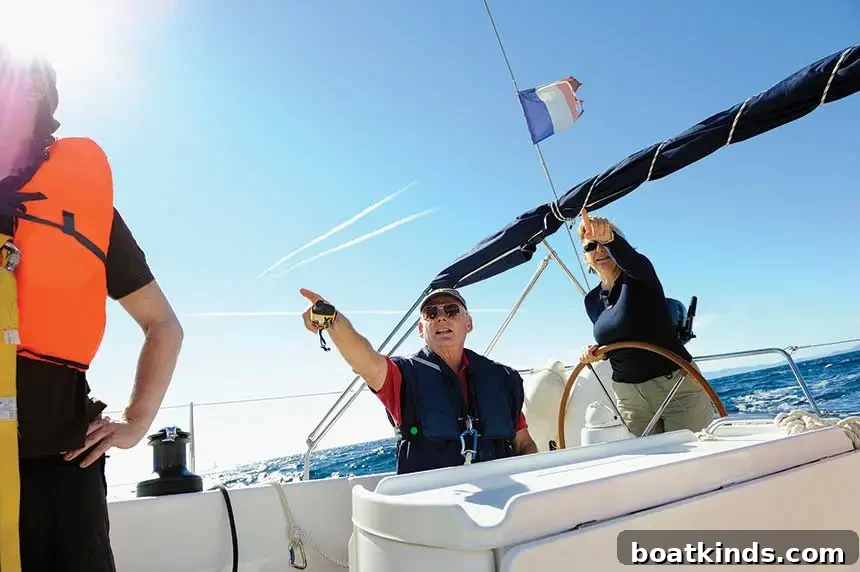
Assign a dedicated spotter whenever possible. If there are at least two people aboard, the non-driving crew member should maintain continuous visual contact, point toward the victim, and call out cues to the operator. The spotter must not become distracted looking for gear or lines; their job is solely to keep eyes on the MOB.
Approach slowly and deliberately, keeping the person in view at all times. Communicate with the person in the water to assess consciousness and condition. As you close in, prepare recovery equipment calmly: secure propellers if you can, have a reach device—boat hook, pole, or rope—ready, and position a throw line near the rail. Rushing the recovery increases the chance of injury to both the person in the water and the crew.
Complete the recovery only when the person has a solid hold on the line or a crewmember has a secure grip. Bring them aboard gently, being mindful of exhaust and prop wash if you’re recovering near the stern. Once aboard, resist the urge to immediately get underway. Conduct a focused medical assessment: check for hypothermia, bleeding, broken bones, and other injuries that may be masked by adrenaline. If the recovered person is wet, cold, or injured, get them warm and dry and return to shore or call for assistance as needed.
If You Lose Sight of the MOB
Losing sight of a person in the water turns the response into an urgent search-and-rescue situation. If the MOB disappears from view—especially at night, in waves, or in low visibility—begin with visible and audible markers. Throw lighted flotation if available; it becomes a reference point and improves the chance of relocation.
Next, call for help. Activate the MOB function on your GPS and the DSC (Digital Selective Calling) feature on your VHF, and transmit a distress call. This is a true emergency; issue a MAYDAY if the situation warrants it. If there are multiple crewmembers aboard, one person should operate the radio while the driver conducts the search.
Begin a slow, methodical search. Maneuver toward the last known position and periodically stop to call and listen for a response. Determine your drift by observing how the lighted flotation moves; this drift datum gives an estimate of how the person in the water may be moving. Report drift direction, drift rate, sea state, and wind conditions to the Coast Guard to help coordinate the search.
Consider initiating a sector or expanding search pattern from the last known position and the drift datum, moving slowly and maintaining a sharp lookout. Frequently stop to call out and listen for replies. Think about likely behavior: a person who fell overboard may try to swim to a nearby buoy, daymark, or the last visible reference. Use that insight to guide the search while awaiting instructions and assistance from responding authorities.
Losing sight of a crewmember can become the worst day imaginable. Recognize the two distinct MOB scenarios—person in sight and person out of sight—and practice separate, clear procedures for each. Tailor these steps to your vessel and crew size, rehearse them regularly, and make them part of every onboard safety briefing so everyone knows exactly what to do when seconds count.
This article originally appeared in the October 2019 issue.