
Solar panels offer a quiet, sustainable way to power systems on board. A well-planned marine solar installation keeps batteries charged, reduces dependence on noisy generators and shore power, and supports longer, more independent cruising. This guide outlines the essential components of a boat solar system so you can design a setup that meets your energy needs while remaining safe and reliable.
Understanding the roles of charge controllers, wiring layouts, mounting methods, and protective components will help you optimize performance and longevity. Whether you’re outfitting a small dayboat or a larger cruising yacht, these practical recommendations will steer you toward a more efficient and trouble-free marine solar installation.
Charge Controllers
A charge controller is a central element of any solar installation. It ensures solar panel output is properly regulated to match your battery bank’s charging profile and protects batteries from overcharging. There are two common types of charge controllers, and their performance differences are significant for marine use.
MPPT (Maximum Power Point Tracking) controllers are generally the best choice for boats, especially where roof or bimini space for panels is limited. MPPT units convert higher panel voltages down to battery voltage while increasing charging amperage, delivering overall efficiencies typically between 94% and 97%. Many MPPT controllers include features such as Bluetooth or remote monitoring, allowing you to track real-time solar production. Although MPPT controllers are more expensive than their simpler counterparts, the efficiency and safety benefits often justify the investment for boaters.
PWM (Pulse Width Modulation) controllers are simpler and cheaper but substantially less efficient. PWM units regulate charging by pulsing the panel output to approximate a stable charge voltage, which can result in considerable energy loss—sometimes delivering only half the potential output of the solar array. Besides lower efficiency, lower-quality PWM controllers may have reliability and voltage-regulation issues that risk battery damage. For most marine applications, MPPT is the recommended option.
Making Connections
How panels are connected—series, parallel, or individually regulated—affects system voltage, current, shading resilience, and connector or wiring limits. Choose the configuration that best matches your array size, expected shading, and controller or cable constraints.
Parallel connections: Parallel wiring ties all panel positives together and all negatives together. This approach keeps the system voltage the same as a single panel while increasing amperage with each addition. Parallel arrays perform better when one panel is shaded, since shading on one panel has a smaller impact on total output. However, higher amperage can exceed standard connector and 10-gauge wire ratings (commonly around 30 amps), requiring heavier cables or higher-rated connectors as you add panels.
Series connections: Series wiring adds each panel’s voltage while the current remains the same as a single panel. Series arrays allow higher total wattage on thinner wire but are more vulnerable to shading: any shaded or damaged panel reduces the entire string’s production. Series configurations are appropriate for larger, consistently sun-exposed arrays.
Individually regulated setups: Running a separate charge controller for each panel isolates panel performance and avoids overloading branch connectors. This offers redundancy and better handling of partial shading but requires more wiring (two conductors per panel) and the cost of multiple controllers.
Additional Components
Beyond panels and a charge controller, select durable, marine-grade components to ensure safety and reliability.
Solar wire: Use PV-rated stranded tinned copper conductors for solar runs; these are designed for UV exposure and outdoor conditions. USE-2 wire is an acceptable alternative with good UV and chafe resistance. Standard marine wire typically has thinner insulation and a higher risk of water intrusion and should not be used for exterior solar runs.
MC4 connectors: MC4s are the standard watertight connectors for solar arrays and must be crimped correctly using the appropriate tool. Improperly installed connectors add resistance and heat and can cause failures. Choose MC4 fittings sized for the wire gauge and current they will carry; many common types are limited to around 30 amps.
Solar fusing and disconnects: Proper fusing is essential on marine solar systems to protect against short circuits and potential fires. Fuses should be sized according to wire gauge and system short-circuit currents, with the primary fuse located at the battery connection. In parallel arrays where combined short-circuit current exceeds a panel’s series rating, branch fuses are required and should match maximum series fuse ratings. Even when not required, having a dual-pole disconnect or rotary switch for each run is a best practice for safe maintenance. High-quality rotary disconnects or DIN-mount fuse panels tend to be more reliable than inexpensive dual-pole switches.
Power optimizers: While power optimizers can improve performance in some residential or commercial applications, they have shown higher failure rates in aggressive marine environments. For most boats, optimizers are not recommended.
Mounting Options
Choosing how and where to mount panels depends on boat type, desired wattage, and aesthetics. Each method has trade-offs in durability, shading, and ease of installation.
Canvas integration: Semi-flexible panels mounted into dodgers or Biminis preserve the boat’s lines and are visually subtle. These installations require careful panel sizing and positioning to reach target wattage—often a puzzle of shapes and sizes. Secure panels with Velcro, zippers, or reinforced attachment points, and protect edges from chafe. Rare-earth magnets have been used occasionally, but they can fail in high winds.
Deck-mounted panels: Textured semi-flexible panels with underside diode boxes are good for walking-deck installations because they provide grip and reduce tripping hazards. These panels require routing for diode boxes and watertight sealing. Rigid panels are durable and cost-effective for large, unobstructed hardtops on powerboats but need mounting feet, cable glands for waterproof pass-throughs, and areas free of foot traffic.
Davits and arches: Davits, arches, and hardtops provide excellent locations for rigid panels on sailboats, offering high, less shaded exposure. This setup can also shade a dinghy and cockpit, but consider stern ladder clearance and reinforce stern pulpit or arch structures to bear the added load.
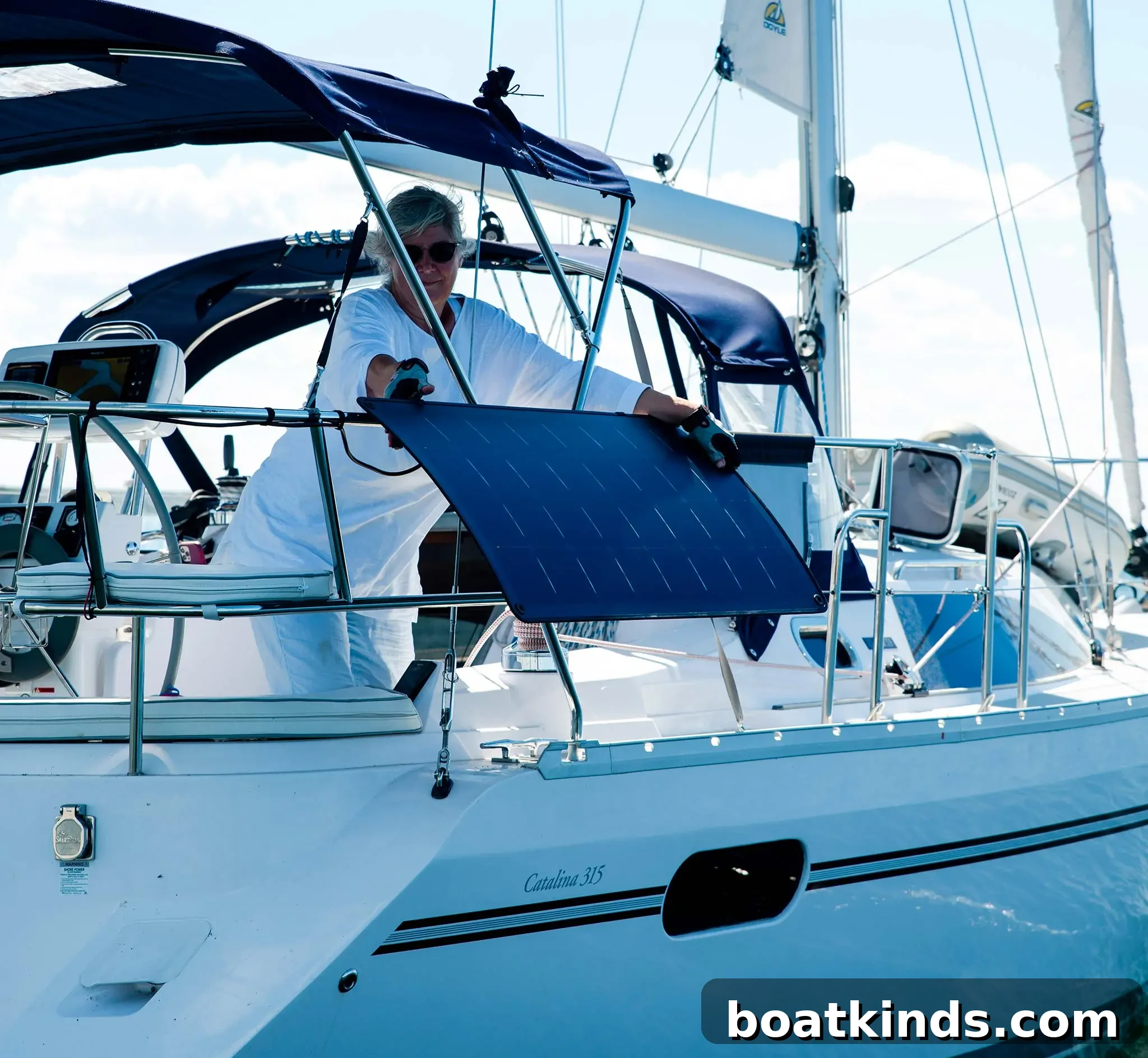
Lifeline and rail mounts: Installing panels on lifeline rails or custom stainless mounts can maximize solar area on smaller sailboats. There are also lightweight, adjustable carbon-stabilized panel solutions suitable for tight spaces; consider reputable marine-rated products and mounting methods when space is at a premium.
Mike Garretson owns Sea & Land Yacht Works in Wakefield, Rhode Island. This article originally appeared in the February 2025 issue of Soundings magazine.
February 2025