
F28 Center Console: An Elegant, Comfortable Coastal Cruiser
Center-console boats are especially appealing once their overall length reaches about 30 feet, but well-designed models around 28 feet can deliver many of the same benefits. These boats are typically lightweight, economical to operate and require modest horsepower to achieve satisfying speeds for most owners. Traditionally focused on utility and fishing, contemporary center consoles increasingly blend practicality with comfort to serve a wider range of cruising activities.
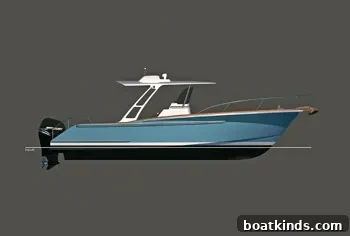
Many modern center consoles have evolved into something akin to the crossover SUVs of the boating world: versatile, comfortable and able to handle a variety of missions. Unlike bulkier road vehicles, center consoles retain a clean, purposeful elegance that highlights their functional strength. The F28 is a strong example of this design philosophy, combining the businesslike efficiency of a fishing boat with the livability expected of a small cruiser.
Designer Mark Fitzgerald drew the first F28 a few years ago, then brought on naval architect Wyatt Huggins—formerly chief designer at Fexas Yacht Design—to refine a hull form optimized for speed and efficiency. Fitzgerald also enlisted Hak Soo Ha, who worked on ergonomics and fabrication details while serving as a lead designer at Ford Motor Co. Their collaboration aimed to elevate onboard comfort without sacrificing the center console’s core capabilities, producing a boat meant to be equally at home on point-to-point coastal passages and island hops.
In late 2013 John Riddell contacted Fitzgerald with a specific brief. Planning a single-handed run of the Great Loop—roughly 6,000 nautical miles around the eastern United States—Riddell needed a boat that accommodated age and mobility limitations. His requirements were practical and direct: no climbing on cabin structures, no working on slippery foredecks, easy and secure handling of all vessel operations, and straightforward management of lock lines in narrow canal systems. The F28’s design responded to those constraints by simplifying deck access, improving ergonomics and ensuring controls could be handled safely by one person.
While a 28-foot center console may not match traditional ideas of a cruise boat, the F28 demonstrates how clever design can broaden that definition. A broken sheerline and a gently curved bow—details reminiscent of Carolina sportfishing boats—lend the F28 graceful proportions and visual balance. These stylistic choices are not merely cosmetic; they influence how the boat moves through the water and how it handles waves and spray.
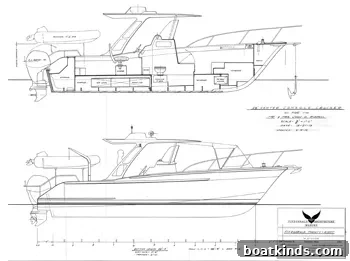
The boat’s confident stance comes from the forward thrust of several major design elements: the transom, stem, hardtop supports and the helm side of the console, as well as the rail that surrounds the foredeck. Even subtle elements, such as the leading edge of the rubrails, contribute to the impression of forward motion. Taken together, these details give the F28 a purposeful, athletic appearance without excess bulk.
Bulk can undermine good design, but in measured amounts it serves important functions. The F28 carries substantial freeboard in the forward sections, which increases buoyancy in the bow, reduces the tendency to bury in head seas and suppresses spray on deck. The hardtop is deliberately slim, supported by thin, spidery struts that make the structure appear to float above the cockpit. That approach reduces windage and weight high on the boat while still providing shelter and functional mounting points for electronics and lighting.
Beyond its looks and seaworthiness, the F28 is built for livability. A private head inside the console and flat areas in the bow provide sheltered sleeping options for overnight trips. With the addition of simple galley gear—such as a camp stove and an icebox—the boat becomes an effective small cruiser, able to support weekend escapes or extended coastal runs. Ergonomic considerations and fabrication details make routine tasks easier and safer, particularly for a single-handed skipper.
In short, the F28 shows how a center-console platform can be reinterpreted to emphasize comfort and coastal cruising capability without surrendering the utility and seaworthiness that made the design popular in the first place. Its combination of efficient hull design, careful ergonomics and tasteful styling creates a compact, capable boat suited to a variety of on-water missions.
This article originally appeared in the November 2015 issue.