
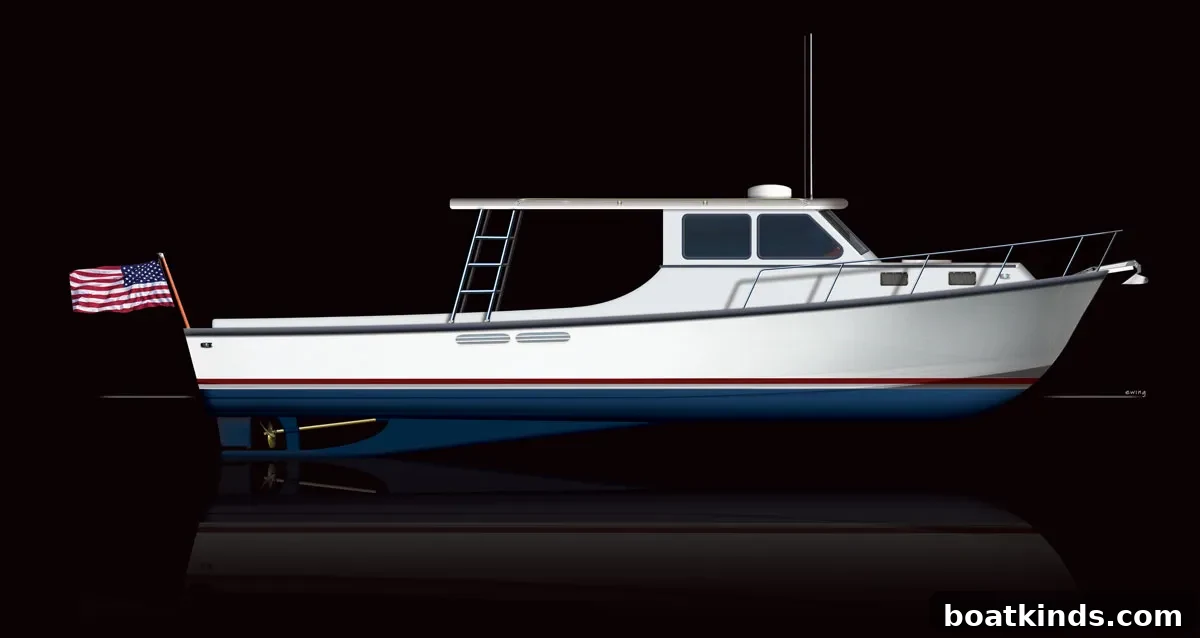
Markley 46: The Fiberglass Evolution of the Chesapeake Deadrise
The Chesapeake deadrise is a workboat tradition born on the tidal waters of the Chesapeake Bay, and the Markley 46 represents a key evolution of that lineage. Originally built by and for commercial watermen harvesting crabs, oysters and finfish, traditional deadrise boats were rugged, practical wooden vessels with a low profile, large open cockpit and modest transom deadrise. The Markley 46 kept the functional DNA of those boats while introducing fiberglass construction and modern systems that appealed to both commercial operators and recreational boaters.
Origins and Builders
Hull No. 1 of the Markley 46 began as a wooden prototype. Designer Robert Meekins of Golden Hill, Maryland, built that first hull for Ben Markley, a waterman and boatbuilder who wanted a larger, seaworthy commercial craft. The boat was constructed on Markley’s waterfront property near Baltimore from the plug used to make the production mold. That wooden origin preserved the traditional deadrise lines before the mold was used for fiberglass production.
Shortly after, Glenn Manning—often regarded as the Godfather of fiberglass on the Bay—laid up more than 100 Markley 46s, helping to establish the model’s reputation. Later, Composite Yachts of Trappe, Maryland, acquired the hull molds and has continued to produce variations of the Markley 46, keeping the classic deadrise silhouette in production for new buyers.
Design Driven by Function
The Markley 46 exemplifies “form follows function.” Its straight, unbroken sheer and generous bow flare control spray and improve seakeeping on windy Bay days. The wide 13’6″ beam runs most of the way aft, providing a spacious, stable platform for work and recreation. The cockpit, close to the water and spanning nearly half the boat’s length, reflects the vessel’s working-boat roots while offering ample room for crews or charter passengers.
Because of the boat’s low profile and shallow draft, engine boxes are located on deck and serve a dual purpose as seating. A fiberglass roof stretches over much of the cockpit, giving protection from sun, spray and rain. The aft bulkhead of the wheelhouse shelters the helm from noise and weather, and owners can equip the cabin with heating and air conditioning for true year-round use.
Interior Layout and Practical Features
Belowdecks, the Markley 46 provides practical accommodations suited to its mixed commercial and recreational roles. The cabin typically includes a galley and a settee that seats six, creating a comfortable social area for passengers or crew. Forward, the trunk leaves room for a head, a workbench, storage areas and a V-berth—useful for overnight trips or extended days on the water.
Many Markley 46s have received a yacht-style finish, featuring stainless-steel hardware and varnished interiors that enhance comfort and aesthetics without sacrificing durability. Builders have offered the model with single or twin diesel powerplants, depending on the owner’s preferences and intended use.
Performance and Use
The fiberglass Markley 46 allows operators to cover the Bay’s fishing grounds more efficiently than many traditional wooden workboats. One documented example fitted with a single Cummins QSM 635-horsepower diesel cruised at about 21 knots with a top end near 25 knots, demonstrating that the design can combine seaworthiness with useful speed for commercial runs or charter operations.
Versatility has made the Markley 46 popular in several roles. It is frequently used as a Chesapeake Bay charter fishing boat capable of carrying as many as 30 passengers, and it can also serve as a turnkey vessel for operators holding a six-pack license. At the same time, its workboat origins keep it rugged and functional for serious commercial use.
Community and Availability
Like many classic vessels, the Markley 46 has an enthusiastic following, and well-maintained examples can be hard to find. Current owners commonly praise the boat’s combination of traditional deadrise lines, commercial-minded practicality and lower-maintenance fiberglass construction. For buyers who find one, the consensus from owners is simple: if you capture a Markley 46, you will likely fall in love with it.
This article was originally published in the February 2022 issue.