
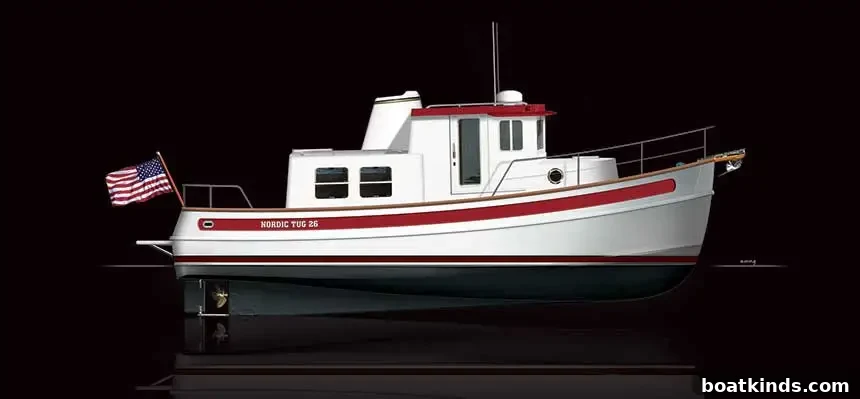
Nordic Tug 26: The Trailerable Pocket Trawler That Started a Trend
The Nordic Tug 26 is one of the most recognizable small trawlers on the water. With its pronounced hull, upright wheelhouse and distinctive “smoke stack,” the 26-foot Nordic Tug introduced the concept of a trailerable, pocket trawler and helped create a new niche in recreational boating that continues to attract enthusiasts today.
Design Origins and Purpose
The concept behind the Nordic Tug 26 began in the 1970s with designer Lynn Senour of Seattle. In the wake of the fuel crisis, Senour — a former wooden boat designer trained at the Westlawn School of Yacht Design — set out to develop an economical, comfortable cruising powerboat for a small family or a retired couple. The brief called for efficient fuel use, easy handling, comfortable accommodations and an aesthetic appropriate to slow-speed cruising.
Senour drew inspiration from the rugged commercial fishing and workboats of the Pacific Northwest, translating their practical, seaworthy lines into a recreational craft. The resulting profile combines the charm of a traditional tug with modern small-boat sensibilities, giving the Nordic Tug 26 its instantly identifiable appearance.
Hull, Keel and Handling
The Nordic Tug 26 uses a semi-displacement hull with hard chines. This hull form offers a compromise between the calm, steady ride and fuel economy of displacement hulls and the ability to achieve higher speeds when required. Hard chines contribute to predictable handling and help the boat track steadily under power.
A full keel was incorporated into the design to enhance directional stability and protect underwater gear such as the propeller and rudder. The combination of hull shape and keel gives the 26 solid, confidence-inspiring handling both underway and at anchor, which contributed to the model’s appeal among cruisers who valued safe, uncomplicated operation.
Wheelhouse and Onboard Ergonomics
The wheelhouse of the Nordic Tug 26 is notable for its large, triple-pane windows and a sliding door adjacent to the helm, providing excellent visibility and comfortable access between helm and cockpit. The upright wheelhouse design keeps visibility high and helps create a roomy, protected helm environment — important for comfort during long passages or in inclement weather.
Interior and Accommodation
The main cabin layout is practical and efficient, designed to serve the needs of a small cruising party. The galley includes essentials such as a two-burner stove, refrigerator and sink, with a dinette that converts into an additional berth when needed. The private forward master cabin and berths are located down below, offering separation and privacy from the main salon.
Power, Economy and Equipment Options
Standard propulsion was a single 110-hp diesel engine, chosen to balance trawler-style performance with fuel economy. The 26 was reported to burn less than 2 gallons per hour at an economical cruising speed of about 7 knots, underscoring the design’s emphasis on efficiency for coastal cruising and longer, slow-speed passages.
Factory and owner options allowed buyers to tailor the 26 to their cruising style. Typical options included a bow thruster to improve close-quarters maneuvering, an inverter to support household-style electrical loads, and a genset for extended off-grid capability. These options made the 26 adaptable to a range of cruising scenarios, from weekend outings to longer coastal adventures.
Market Reception and Legacy
Lynn Senour and his partner Jerry Husted formed Nordic Tugs, Inc. and introduced two versions of the original 26-foot prototype at the 1980 Seattle Boat Show: an open-deck model called the Cricket and a cruising-oriented model named Red Apple, with an introductory price around $29,000. The model was an immediate success, helping to define the “pocket trawler” category by offering full-featured cruising capability in a compact, trailer-friendly package.
The original Nordic Tug 26 remained in production until 1997, with 174 hulls built during that period. The model was later brought back into production in 2009 and remains available to buyers who appreciate its combination of classic tug styling, sensible systems and efficient cruising performance.
Why the Nordic Tug 26 Endures
The Nordic Tug 26 endures because it answers a clear set of owner priorities: economical operation, comfortable accommodations for two to four people, robust handling and unmistakable style. Its design speaks to boaters who value seaworthiness, simplicity and a timeless aesthetic — characteristics that helped establish the pocket trawler market and continue to attract new owners decades after the model first appeared.
This article originally appeared in the July 2020 issue.