
The Famous Jibe: Livonia vs Columbia — America’s Cup, 1871
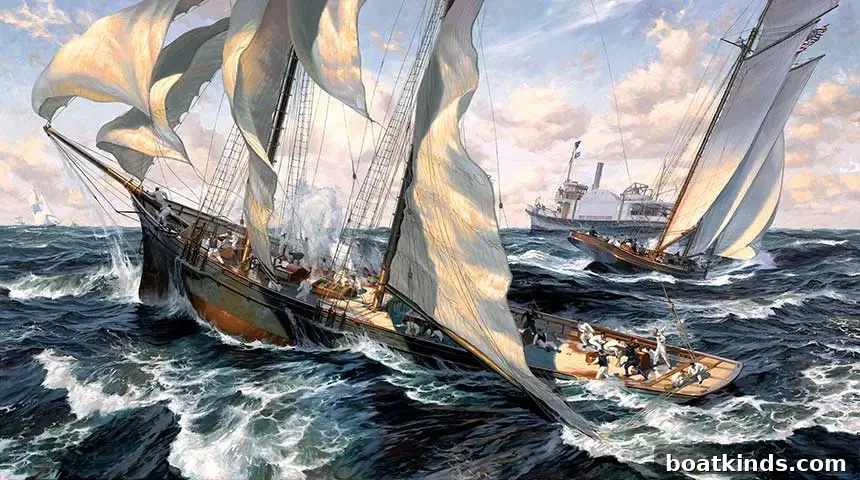
One of the most talked-about moments in early America’s Cup history is the dramatic jibe that cost the British entry the lead in the 1871 race. Marine artist Russ Kramer captures that instant in a vivid painting, focusing on the human drama as much as the vessels themselves. In Kramer’s scene, the British schooner Livonia, owned and campaigned by J.L. Ashbury, arrives at the stake boat ahead of the New York Yacht Club defender Columbia. As the two ships prepare to round the mark, Livonia’s captain, J.R. Woods, chooses to leave the stake boat to starboard and executes a jibe in what an eyewitness described as “a gale of wind.”
The jibe immediately upset Livonia’s balance. According to contemporary accounts, the maneuver “made her stagger to leeward of the mark.” The crew struggled to regain control of the near-100-foot schooner as it reeled in the heavy conditions. Seizing that moment, Columbia came up from leeward, passed Livonia, and rounded the stake boat to port. After rounding, Columbia reportedly stowed her topsails, reefed her foresail and then ran home on a reach to take the lead decisively, ultimately winning the 30-mile race by about ten minutes.
Kramer’s painting zeroes in on the human response to sudden crisis at sea. “This is the moment when Captain Woods and his crew are desperately trying to sheet in her sails after crashing around,” Kramer explains, describing how he imagines the scene: Ashbury in a dark jacket on the aft deck watching Columbia complete the tack and feeling furious at the loss of the lead. The artwork invites the viewer to consider not only the technical skill required to handle large sailing yachts in extreme conditions, but also the pressure, quick decisions and emotions experienced by the men on board.
The aftermath of the race was contentious. Ashbury protested, claiming Columbia had rounded the stake boat on the wrong side and that the maneuver had affected the result. The race committee rejected the protest, noting that the sailing regulations of the event left the method of turning the stake boat optional. Members of Columbia’s crew recalled that their captain had checked with the race committee about turning the stake and had been told, “Turn as you please.” With the protest denied, the victory stood, and the New York Yacht Club went on to retain the America’s Cup.
The 1871 contest remains a notable chapter in early competitive yachting because it highlights how a single tactical decision can change the outcome of a race. A jibe—an intentional change of course by swinging the stern through the wind so the sails pass from one side to the other—is a standard sailing maneuver, but in strong winds and with large, heavy rigs it carries risk. A poorly timed or mishandled jibe can cause a vessel to lose momentum, heel excessively, or even fail to respond to the helm, all of which create an opening for an opponent to seize the advantage.
Kramer’s interpretation emphasizes those stakes. His painting doesn’t merely document a sailing incident; it tells a story of competition, human error, and the fine margins that decide important races. By focusing on expressions, posture and the frantic activity on deck, the artist brings to life the tension of a moment when leaders can become challengers in the space of a single, misjudged maneuver.
For modern readers and sailing enthusiasts, the Livonia–Columbia episode remains instructive: it demonstrates the combination of seamanship, rules interpretation and split-second judgment that defines competitive sailing. It also explains why the America’s Cup, even in its early years, produced moments that have endured in maritime lore. Kramer’s work preserves one of those moments, casting it in a frame that reminds viewers of both the technical complexity of sailing large yachts and the very human reactions that follow when a race turns on a single, decisive event.
This article originally appeared in the September 2019 issue.