
History of the U.S. Coast Guard and the Evolution of Station Menemsha
The origins of the U.S. Coast Guard date back to Aug. 4, 1790, when the first Congress authorized the construction of ten vessels to enforce tariff and trade laws and to deter smuggling along American shores. In the 19th and early 20th centuries, this maritime enforcement role was carried out by organizations known as the Revenue Marine and later the Revenue Cutter Service.
Separately, in 1878 a Life Saving Service was established to organize and improve a largely volunteer network of rescue stations along busy coastlines. That service focused on rescuing mariners in distress, providing boat crews and shore-based rescue operations where hazardous shoals, storms and heavy traffic made navigation perilous.
The U.S. Life Saving Service constructed a station and boathouse in 1895 that later became known as Coast Guard Station Gay Head. Situated near Gay Head Light, the boathouse stood on the shore west of Dogfish Bar. The first keeper, Nehemiah C. Hayman, was appointed Oct. 4, 1895, according to Coast Guard records associated with the station.
Keepers of the life-saving stations were expected to meet strict standards: they needed to be physically capable, of good character and habits, literate, under 45 years of age, and highly skilled at handling boats—especially in rough weather. These qualities reflected the demanding nature of coastal rescue work, where courage and seamanship often determined mission outcomes.
A major organizational change came in 1915 when Congress merged the Revenue Cutter Service and the Life Saving Service into a single maritime service officially designated the Coast Guard. This unified organization was charged with both saving lives at sea and enforcing the nation’s maritime laws. In 1939, President Franklin Roosevelt ordered the transfer of the Lighthouse Service to the Coast Guard, further expanding its responsibilities for aids to navigation and coastal safety.
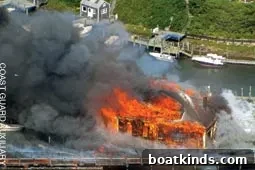
Local personnel played key roles in the station’s continuing history. Robert E. Kinnecom of Oak Bluffs served at what became Station Menemsha when it was still located beside the lighthouse on the cliffs. Kinnecom recalled that the Great Hurricane of 1938 destroyed the original Gay Head boathouse. A new boathouse was rebuilt in Menemsha in 1939, and Kinnecom remembered applying the stain that gave the structure its trademark red roof.
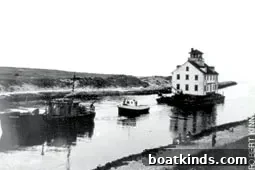
Later changes in structure and location continued. In 1952, the Coast Guard moved the Cuttyhunk station building to Menemsha by barge. The facility was commissioned in its new location on March 12, 1954, and in January 1974 the Coast Guard officially renamed the site to reflect its actual location as Station Menemsha.
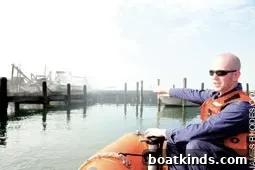
Today, Station Menemsha operates with a modest complement of roughly 22 Coast Guard men and women. Those crewmembers patrol an area that includes waters south and west of Gay Head at the western end of Vineyard Sound, maintaining readiness for search and rescue, law enforcement, and maritime assistance. The station’s primary response assets include a 47-foot motor lifeboat and a rigid-hull inflatable, vessels well suited to operating in heavy seas, nearshore shoals, and the variable weather of the region.
Station Menemsha’s history illustrates how local stations grew out of separate federal services and evolved through storms, relocations and agency consolidation into the modern Coast Guard. The combined missions of life-saving, law enforcement and navigational aid stewardship remain central to the service’s work along America’s coasts.
This column was first published in The Martha’s Vineyard Times.
This article originally appeared in the September 2010 issue