
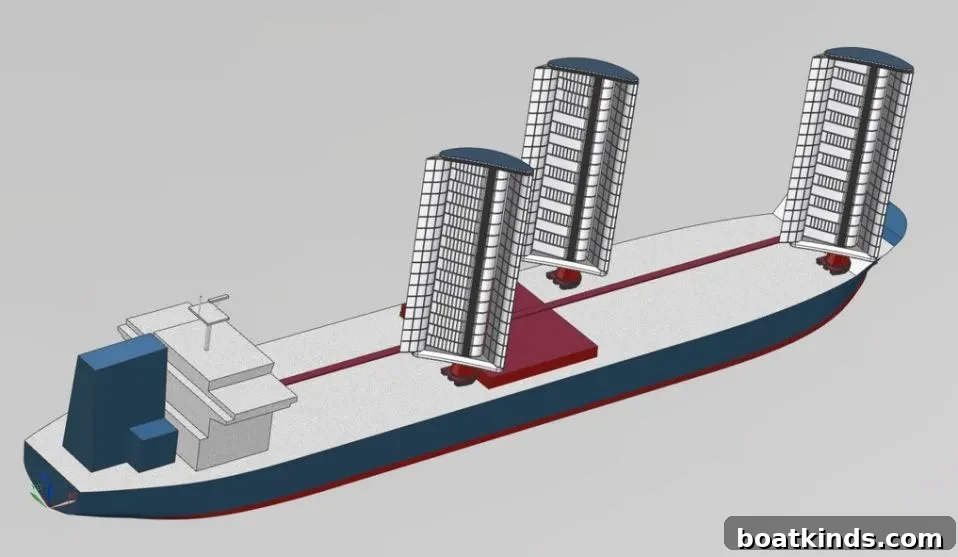
Cargill to Fit Giant Wing Sails on Cargo Ships to Cut Fuel Use and Emissions
Minnesota-based Cargill Inc., one of the world’s largest agricultural commodities traders, is moving forward with plans to equip some of its chartered cargo fleet with large rigid wing sails. The company, which typically charters around 600 vessels at any given time, says the sails could reduce fuel consumption by as much as 30 percent on selected voyages, a change that would lower carbon dioxide emissions and operating costs for its shipping operations.
Shipping is a major component of global trade and a measurable source of greenhouse gas emissions. Worldwide maritime transport is responsible for nearly 3 percent of man-made carbon dioxide emissions, so fuel savings on the order of 30 percent for ships that adopt wind-assisted technologies would represent a meaningful contribution to decarbonizing the sector. Reduced fuel use also translates into direct cost savings for ship operators, making wind-assist investments attractive from both environmental and financial perspectives.
The plan under consideration would see ships fitted with three large wing sails as early as 2022. These are not traditional fabric sails but rigid, aerofoil-style wings that generate lift and forward thrust when oriented correctly relative to the wind. The technology is designed to work alongside conventional engines and can reduce the load on engines during favorable wind conditions, improving overall fuel efficiency without relying entirely on wind power.
Cargill is pursuing the project in partnership with BAR Technologies, a British engineering and design firm that originated as a spin-off from the Ben Ainslie Racing (BAR) team. Ben Ainslie is one of the world’s most successful Olympic sailors and an America’s Cup winner; his background in high-performance sailing has informed BAR Technologies’ focus on advanced hydrodynamics and novel wind-assist solutions for commercial shipping.
Adopting wing sails on commercial cargo ships involves several operational and technical considerations. Retrofitting existing vessels requires careful structural assessment, because the sails apply new forces to the ship’s deck and hull. The sails must be stowed or folded safely for maintenance, port maneuvers, and when wind conditions are unfavorable. Ship crews need training to operate and maintain the systems, and shipping companies must assess route profiles to determine which voyages will benefit most from wind assistance.
Despite these challenges, a growing number of shipowners and operators are exploring wind-assist technologies as part of broader strategies to reduce fuel use and prepare for tightening emissions regulations. Technologies range from traditional sails to modern hard wing sails, rotor sails, and towing kites. Each approach offers different advantages depending on vessel type, trade route, and cargo profile. For bulk carriers and certain liner services, wind assistance can be an effective complement to other efficiency measures such as slow steaming, hull improvements, and cleaner fuels.
For a large charterer such as Cargill, the economics are compelling when fuel cost savings are multiplied across dozens or hundreds of voyages annually. If wing sails deliver the projected reductions in fuel burn, the investment could reduce both fuel expenditure and the company’s scope 3 emissions associated with chartered transport. That potential makes wind-assist retrofits an attractive option for companies aiming to meet sustainability targets while keeping an eye on operational costs.
The Cargill–BAR Technologies collaboration is one example of how maritime innovation is moving from racing yacht technology to commercial shipping applications. Drawing on expertise from competitive sailing—where aerodynamics, weight distribution, and responsive control systems are essential—engineers are adapting those lessons for the heavy-duty, long-duration demands of cargo shipping.
As shipping companies test and deploy these systems, industry observers will be watching for real-world performance data, retrofit costs, and impacts on voyage schedules. If the trials meet or exceed expectations, wind-assist technologies could become a common feature on a new generation of more fuel-efficient, lower-emission merchant ships, contributing to the shipping sector’s gradual transition toward lower-carbon operations.