
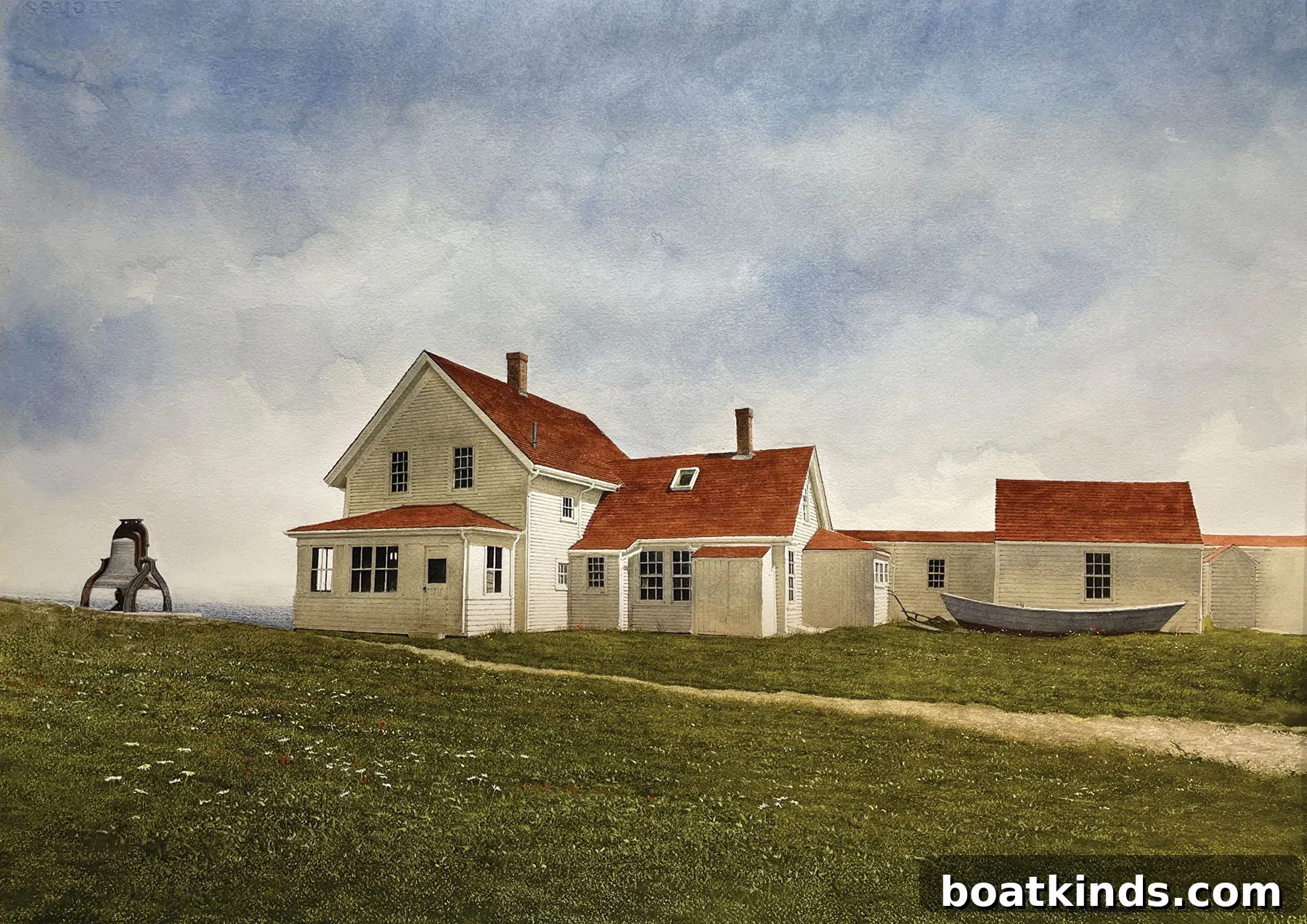
Monhegan Light — A Watercolor by Doug Brega
Against a crisp Maine sky of whites and blues, white clapboard houses and weathered red roofs stand in quiet contrast, their silhouettes punctuated by the bell of the Monhegan lighthouse. In his painting Monhegan Light, contemporary American realist Doug Brega captures not only the physical details of this iconic New England scene but also the mood that makes coastal landscapes so compelling.
Evoking Place: Light, Air and Architecture
The composition conveys what many viewers long for when they think of the New England coast: the brisk sea breeze, the tang of salt in the air and a sense of solitude that invites reflection. Brega’s focus is on clean forms and the functional integrity of architectural elements. The clapboards, rooflines and lighthouse bell are rendered with an economy of means that nonetheless communicates solidity and presence. Rather than a photographic reproduction, the work offers a considered interpretation—an image that feels both accurate and expressive.
Artist Background
Doug Brega, now in his seventies, grew up in western Massachusetts surrounded by the buildings, villages and rural landscapes that would become recurring subjects in his art. He developed an early interest in drawing—alongside his twin and older brother, Brega drew cartoons and later contributed to sports signage in high school. He went on to study at Paier College of Art in Connecticut and began his professional life as a commercial artist, designing packaging such as cottage cheese and sour cream containers for a dairy company.
Along the way he studied the life and work of Andrew Wyeth, an influence in terms of observing regional life and natural light. A turning point came when he secured support to spend time painting on Martha’s Vineyard. That period led to a successful exhibition at the Silvermine Guild in New Canaan and a subsequent one-man show in New York City—both key moments that helped establish his career as a painter of New England subjects.
Watercolor Technique and Artistic Intent
Monhegan Light showcases Brega’s watercolor method. He begins with very loose washes, laying in broad areas of color and tone to establish atmosphere and spatial relationships. Into that foundation he gradually introduces detail, refining edges and accentuating the elements that give the scene its character. This layered process allows the work to retain a sense of immediacy while also delivering clarity where it matters—the precise tilt of a roof, the shadow along a clapboard, the geometry of a lighthouse tower.
Brega speaks of striving for a precise and honest interpretation rather than a literal mirror of reality or a heavily subjective commentary. In both his portraits and landscapes, his approach is consistent: he looks to capture an expression—whether of a human face or of an architectural ensemble. In that sense Monhegan Light reads as a portrait of place, an image that suggests something about who lived there and how the built environment shapes daily life on an island coast.
Why This Scene Resonates
What makes this painting resonate is its balance of familiarity and restraint. The scene is instantly recognizable to anyone who knows New England’s coastal vernacular, yet Brega’s selective detailing invites the viewer to linger and imagine the lived-in stories behind the structures. The lighthouse bell, a small but evocative element, carries with it associations of guidance and endurance—qualities often linked to maritime communities. The overall effect is contemplative rather than nostalgic, honest in its observation and deliberate in its execution.
Monhegan Light exemplifies the qualities that define much of Doug Brega’s work: a respect for regional architecture, an emphasis on clear, functional form, and a watercolor technique that balances loose, atmospheric washes with careful, telling detail.
This article was originally published in the April 2021 issue.