
Investigators: Careless Operation Caused Fatal Charter-Boat Accident at Jupiter Inlet
Florida authorities say a charter captain’s careless maneuver led to a fatal accident last September at Jupiter Inlet.
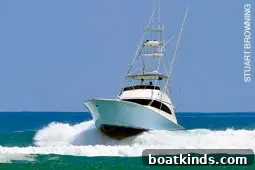
According to a Florida Fish and Wildlife Conservation Commission (FWC) report, 59-year-old Thomas Henry suffered head and neck injuries that caused him to drown on Sept. 3 after falling from the flybridge of his 48-foot 1986 Garlington, Waterdog. Henry and his first mate had been returning from a morning offshore fishing trip with five paying clients when the boat broached in 6- to 8-foot breaking waves.
“Mr. Henry operated the vessel in a careless manner by attempting to drive over the backside of the wave as he approached the inlet,” FWC investigator Jon Garzaniti wrote in the 73-page investigation. The maneuver caused the vessel to capsize and ejected Henry into the water. He was not wearing a life jacket.
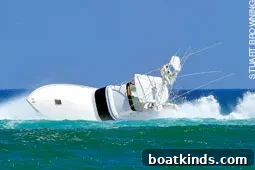
The commission’s report places the accident about 350 yards east and 100 yards south of the inlet. Freelance photographer Stuart Browning photographed the sequence; those images are included in the report and show the boat coming down the back of a breaking wave, broaching as it descended into the trough, the bow plunging and the cockpit flooding as the vessel rolled onto its port side. As the boat began to right to starboard, Henry was thrown from the flybridge. His head and upper body struck the port gunwale before he fell into the water.
With no one at the helm, Waterdog drifted north, parallel to the surf, then completed a 360-degree turn and headed back out to sea. First mate Tim Sperling, 55, who had been in the cockpit and was knocked down when the boat broached, got back up, checked on the passengers in the cabin and climbed to the flybridge to take the helm.
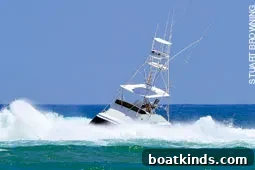
“He definitely did a great job of getting control of the vessel and preventing the situation from being worse than it could have been if it continued unpiloted,” Garzaniti said. The report notes the boat could have struck the jetty, which is open to the public, or run aground onshore if it had remained unmanned.
All five clients—Jeremy Smith, 38; his wife Diane, 40; their sons Jacob, 5, and Ethan, 8; and Diane Smith’s 73-year-old mother, Dorthy Maughon—were seated in the saloon when the boat broached. They were vacationing from Carrollton, Texas. As the vessel rolled, Diane Smith and the children were flung from the starboard bench across the cabin to the port side, where Jeremy Smith and Maughon were seated.
“My grandsons were scared to death,” Maughon recalled. “The oldest kept saying, ‘We’re going to die. We’re going to die.’ The little one was too scared to say anything. [My daughter] had a death grip on him. I kept hoping we weren’t going to fly out of the cabin because the door broke and was swinging open. It was quite an experience.”
A laptop also flew across the saloon and struck Maughon in the head, but she did not require medical attention. The report states no other passengers were injured.
Several other charter captains had left their boats tied to the dock that morning because of the rough conditions. Jason Cardinale, another charter operator who keeps vessels at the same marina Henry used, said he chose not to go out. “I just didn’t want to take a chance,” Cardinale said. “Some boats went out that day. We didn’t.”
The FWC report does not address Henry’s decision to leave the dock. “Obviously, the seas did play a factor in the accident,” Garzaniti said. “But there’s nothing to say he could not have gone out. That was a personal choice on his part.” The investigation also did not list excessive speed as a contributing factor; the report notes the boat, powered by twin 540-hp diesel engines, was traveling between 10 and 20 mph.
Palm Beach County Ocean Rescue lifeguards witnessed the incident from a beach post and responded in a 15-foot Avon RIB. Ocean Rescue Captain Julia Leo said it took the lifeguards about eight minutes to reach Henry, who was found face down in the water without a pulse. Medics on shore were able to resuscitate him, and he was transported to a hospital, but he died three days later.
Henry was a well-known captain with more than 20 years of experience. “He was very meticulous and was always paying attention to what was going on,” Sperling told The Palm Beach Post. “Things happen so fast on the water; a moment of carelessness might be one second.” Efforts to reach Sperling for an interview for this story were unsuccessful.
Online forums among local captains speculated the boat may have been forced off course to avoid a personal watercraft rider, but Garzaniti said Sperling made no mention of a PWC in his interviews and the investigation found no evidence of one contributing to the accident.
Before becoming a charter captain in Palm Beach County, Henry had worked as a lawyer in Maryland. He moved to Palm Beach County roughly 20 years ago and built a reputation in the local charter community.
“It’s sad he’s gone,” Cardinale said. “Boating is dangerous. Even a professional can get hurt, whether it’s in the inlet or offshore.”
This article originally appeared in the March 2011 issue.