
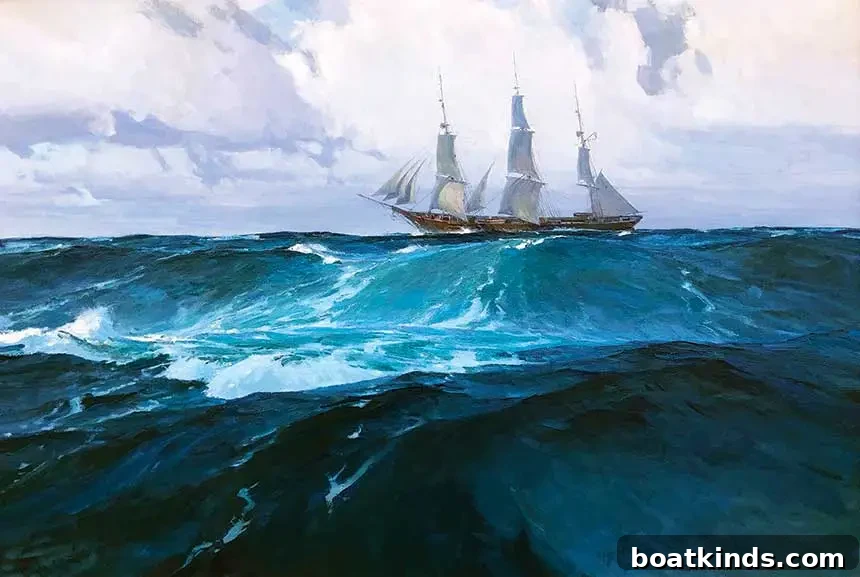
Clipper Ship Seascape by Christopher Blossom: Oil on Canvas
A lone clipper sails before the wind across a vast, open ocean in this striking oil-on-canvas seascape. The composition captures the raw, unbroken voice of the sea — the relentless roll of water, the whisper of wind, and the occasional thunder of a collapsing wave crest. As artist Christopher Blossom describes it, the painting expresses “the constant movement of thousands of tons of water relentlessly rolling on with only the sound of the wind and the occasional rushing tumble of a collapsing wave crest.”
Blossom brings both artistic lineage and technical training to his maritime work. His grandfather Earl and his father David were commercial artists, and Blossom himself has been painting for most of his 63 years. Informal lessons from his father led him to study at New York’s Parsons School of Design, and later to Robert Bourke’s industrial design studio, where he learned to read and interpret ship blueprints. This combination of aesthetic sensibility and technical knowledge allows Blossom to render seafaring scenes that feel authentic while remaining deeply expressive.
Although a ship appears in the painting, it is deliberately not the focal point. Placed at a distance, the clipper serves as a scale marker and a human element rather than the primary subject. The viewer’s perspective is close to the waterline, confronting the sea itself: great rolling waves occupy the foreground and middle ground, separating the observer from the tiny silhouette of the sailing vessel. Blossom has said that this arrangement “suggests that this is not where the viewer belongs, so far from the safety of the ship.” The effect is an immersive reminder of human smallness against the ocean’s immensity.
Blossom’s interest in the dynamics of water is evident throughout the work. “I enjoy the process of painting water,” he notes, and the painting demonstrates why: water offers a wide range of compositional possibilities, from reflective surfaces to turbulent motion, from subtle tonal shifts to dramatic highlights. In this piece, the artist balances the bulk and movement of the waves with atmospheric space, using brushwork and color to convey depth, motion, and scale. The distant clipper functions as both a narrative anchor and a compositional device, giving the eye a destination amid the energy of the sea.
For reference and accuracy while working on this painting, Blossom consulted historical plans. He mentions that he was looking at the plans for the Challenge, a clipper ship of 1851 built by William Webb of New York, although he emphasizes that the specific identity of the vessel is secondary to its role in the picture. “The boat is really there to establish scale and introduce the human element, our insignificance in the face of such power and immensity,” he explains. That insight informs the painting’s emotional tenor: the human story is implied rather than explicit.
Technically, the painting demonstrates Blossom’s command of maritime detail and atmospheric effects. His training in interpreting ship blueprints enables him to suggest authentic rigging and hull lines even when those details are viewed at a distance. At the same time, his painterly approach to the ocean—layering color, modulating light, and varying brushmarks—makes the water feel alive and immediate. The result is a seascape that reads as both documentary and poetic, combining fidelity to nautical form with an expressive evocation of nature’s power.
Viewed as a whole, the work invites contemplation: it is a study in scale, motion, and perspective that emphasizes the sea’s capacity to dwarf human endeavor. The careful balance between technical accuracy and expressive atmosphere is a hallmark of Blossom’s maritime paintings. This particular canvas, where the waves command the foreground and the clipper recedes into the horizon, captures a timeless maritime theme—man confronting the vastness and force of the ocean.
This article originally appeared in the April 2019 issue.