
Passing Squall: Thomas Hoyne’s Portrait of the Albert J. Lutz
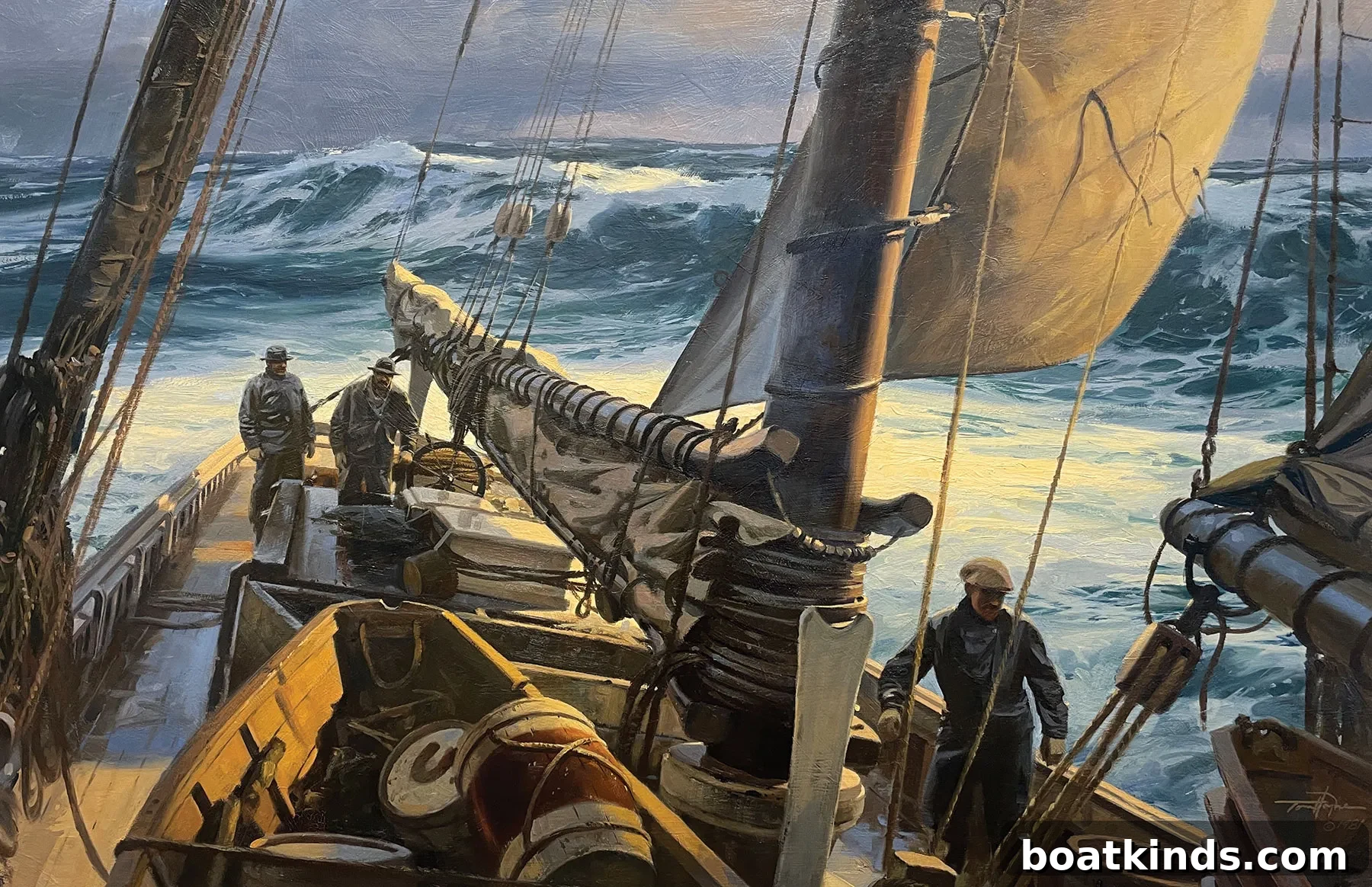
The sea rolls without mercy in Thomas Hoyne’s oil painting Passing Squall, where the Canadian halibuter Albert J. Lutz fights through a storm-tossed horizon. Hoyne captures the moment with a dramatic indigo sky and restless water, the vessel yielding to the ocean with a storm trysail set and a reefed foresail. The composition conveys the raw tension of seamanship: the crew’s cautious navigation, the strain on spars and rigging, and the fragile balance between a fast fishing craft and the Atlantic’s wide moods.
The subject, the Albert J. Lutz, was a halibut fishing schooner from Digby, Nova Scotia, launched in 1908. Known for its speed, the vessel earned distinction in 1912 by winning the Britain trophy under Captain John Apt. Like many working boats of its era, the Lutz’s active life passed into history after World War I, and the ship eventually disappeared from the record. Hoyne’s painting preserves the memory of that working craft, turning archival research and nautical detail into a vivid, almost tactile portrait.
Hoyne’s Method: Research, Models, and Hyper-Real Detail
Thomas Hoyne approached each ship painting as both a historical exercise and a visual study. He researched ship records and contemporary articles to ensure accuracy, and he consulted experts when possible. To reproduce the way a hull cuts through waves, he commissioned scale models from renowned ship modeler Erik A. R. Ronnberg. Hoyne would place those models in a box of kitty litter to simulate how water would rake and splash, then sketch and photograph the staged scenes as references for the final canvas. These studio techniques contributed to the striking realism in his marine work—the quality viewers often describe as “wet,” as if the paint itself reflects seawater.
The artist’s process was deliberate and intensive. According to his son, Scott Hoyne, each ship painting could take up to a month to complete. The deliberate timeline allowed Hoyne to refine lighting, rigging detail, and the subtleties of weather, so that every rope, rail and swell supports the overall narrative of the scene rather than serving as mere ornamentation.
Life and Career: From Illustrator to Marine Artist
Hoyne’s route to marine painting combined personal experience and professional change. Raised in the Midwest, he spent summers in Maine where exposure to coastal life introduced him to maritime subjects and artists. After serving in the U.S. Navy during World War II, he built a career as a commercial illustrator. When photographic techniques began to dominate advertising in the mid-1970s, and after receiving a cancer diagnosis, Hoyne shifted his focus from illustration to fine-art marine painting.
That transition produced a body of work respected for both historical fidelity and painterly atmosphere. Over the course of his career he completed approximately 100 marine paintings. Hoyne died in 1989, and by then he had earned a reputation as one of the most accomplished contemporary marine artists of his generation, notable for his ability to conjure the lived experience of life at sea without always stepping aboard the vessels he painted.
Legacy of Passing Squall and the Albert J. Lutz
Passing Squall is more than an evocative seascape; it is a historical portrait that restores presence to a vanished working boat. The Albert J. Lutz represents a class of coastal fishing schooners that combined speed and seaworthiness for the demanding halibut grounds off Nova Scotia. Hoyne’s commitment to detail—rigging, hull shape, sail configuration, and the behavior of waves—turns that specific vessel into a broader testament to the hazards and craftsmanship of early 20th-century coastal fishing.
For contemporary viewers, the painting offers both spectacle and tribute. It celebrates the technical skill of the ship and the dexterity of the crew while honoring the memory of vessels that no longer sail. Hoyne’s studio techniques and painstaking research give the work documentary weight as well as aesthetic power, so Passing Squall stands as a lasting record of a ship, a seafaring tradition, and an artist’s devotion to maritime realism.
This article was originally published in the October 2021 issue.