
Coast Guard Expedition Locates Wreck of 1942 Grumman Duck on Greenland Ice Cap
An air-sea rescue mission that became one of World War II’s most dramatic and tragic episodes appears to have a long-awaited resolution. Researchers now say they have identified the crash site of a Coast Guard J2F-4 Grumman Duck that went down on the remote Greenland ice cap in late 1942.
The Duck had been part of a daring rescue operation to recover members of a U.S. Army Air Forces B-17 crew stranded on the ice. After successfully rescuing two men, the Duck — piloted by Coast Guard Lt. John Pritchard with Petty Officer 1st Class Benjamin Bottoms as radioman — returned to the ice cap to retrieve additional survivors. Encountering whiteout conditions, the aircraft crashed and did not return.
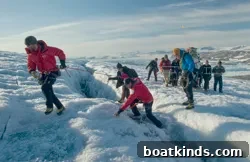
Seventy years after the crash, an expedition led by members of the Defense Department’s Joint POW/MIA Accounting Command, Coast Guard personnel, and scientists and explorers from North South Polar Inc. conducted a focused search in the area near Koge Bay, Greenland. That search has produced compelling evidence that the site they investigated is the final resting place of the J2F-4 Grumman Duck.
Cmdr. Jim Blow of the Coast Guard Office of Aviation Forces described the discovery as “a monumental success,” saying the joint effort fulfilled the Coast Guard’s long-standing goal, which began in earnest in 2008, to locate the aircraft. The recovered evidence is now part of a careful process to document the site and honor the service members who were lost.
The Duck’s last mission centered on a B-17 that had crashed on Nov. 9, 1942, during a search mission. On Nov. 28, 1942, Pritchard and Bottoms used the amphibious J2F-4 to land on the Greenland ice cap and successfully evacuate two members of the B-17 crew — an unprecedented and risky operation given the terrain and weather. The following day, the Duck returned to the scene, picked up Army Air Forces Cpl. Loren Howarth, and set out to reach the Coast Guard cutter Northland. They never arrived.
Contemporary accounts from Army aircrews recorded that the wrecked Duck was sighted a week later and that no survivors were found in the wreckage. The remaining members of the B-17 crew were kept alive by air drops and were rescued roughly six months after the initial crash. The three men aboard the Duck — Pritchard, Bottoms, and Howarth — were later recognized for their bravery and sacrifice.
The modern expedition combined historical research with targeted geophysical methods. Investigators reviewed wartime records and mapped probable drift patterns and flight paths to narrow the search area. On the ground and ice, the team used ground-penetrating radar, magnetometer surveys, and metal detection equipment to isolate anomalous targets consistent with an aircraft wreck beneath the ice.
Once a likely location was established, the team melted a series of five vertical access holes, each approximately six inches in diameter, into the ice to allow visual inspection. In the second hole, roughly 38 feet below the ice surface, the team lowered a specially designed camera scope and observed black cables and wiring consistent with materials used on World War II-era J2F-4 Grumman Ducks. Video footage and still photographs captured through the scope showed additional metallic components and structures that match features typically found near the engine compartment of that aircraft model.
Those visual confirmations, together with the geophysical survey data and historical documentation, provided the evidence the Joint POW/MIA Accounting Command and partnering organizations needed to identify the site as the Duck wreck. Officials emphasized that locating the aircraft honors the memory of the three servicemen who lost their lives and helps bring closure to a decades-long chapter of wartime history.
Finding the Duck is significant not only for its historical value but also for the methods it demonstrates: combining archival research with modern remote-sensing technology and careful on-site investigation can yield reliable results even in harsh polar conditions. The Coast Guard, North South Polar, and the Defense Department’s accounting command will continue to analyze the collected imagery and artifacts following established protocols before any further actions are taken.
The full official report of the expedition and its findings has been prepared by the Joint POW/MIA Accounting Command and the Coast Guard. The teams described the discovery as a meaningful step toward honoring the sacrifice of Lt. John Pritchard, Petty Officer 1st Class Benjamin Bottoms, and Cpl. Loren Howarth, and toward resolving a long-standing wartime mystery on the Greenland ice cap.