
Your neighbor has a new Tesla that parallel parks itself with a tap. Another neighbor plants corn hands-free with a GPS-guided John Deere that turns at the row end, self-aligns within three inches and continues while he checks futures on a tablet.
So when will boats be that smart? When will you be able to tap a screen and relax—apply sunscreen or hand your partner a line—while the boat backs itself into a slip?
The technological cure for docking anxiety may be closer than you think. Later this year, docking‑assist systems from Volvo Penta and Raymarine will reach the recreational-boating market. Neither delivers full autonomy yet, but both move the industry toward safer, easier docking. Below are two available approaches and what they do.
Volvo Penta assisted docking
Experienced skippers already compensate for wind and current by observing flags, pilings and water flow, then mentally aiming the boat “off target” so it drifts to the desired position. Volvo Penta’s Assisted Docking automates that mental calculation to reduce stress during close-quarters maneuvers.
Introduced at the Consumer Electronics Show, Assisted Docking is a software layer for Volvo Penta’s Electronic Vessel Control (EVC) and Dynamic Positioning System (DPS). The captain uses the joystick to indicate desired speed and heading. If wind or current pushes the vessel off course, Assisted Docking intervenes, subtly modulating thrust (including bow thruster) and steering to keep the intended track. Volvo Penta recommends integrating a bow thruster with IPS EVC controls, since that reduces the load on IPS drives when holding heading.
The system also helps during low‑speed transits and marina maneuvers by continuously fine‑tuning control to maintain the course the captain intends. Release the joystick and Assisted Docking assumes you want the boat to hold position, making the corrections necessary to keep station against wind and current.
“Assisted Docking is a hybrid between automated docking and manual control,” says Ida Sparrefors, director of autonomous solutions and new business models at Volvo Penta. “It gives the captain enhanced control while behaving intuitively so anyone can feel confident in close quarters.”
Volvo Penta plans to offer Assisted Docking as an option for IPS installations on motor yachts from roughly 35 to 120 feet. Tiara Yachts will include it as standard equipment on certain 2022 IPS‑powered models, and a retrofit package—requiring a software update, a new antenna and professional installation—will be available for existing IPS boats in late 2021. Volvo Penta previously demonstrated a fully autonomous docking prototype on a 68‑foot yacht in 2018 using GPS and distributed sensors, indicating the company is testing more advanced features.
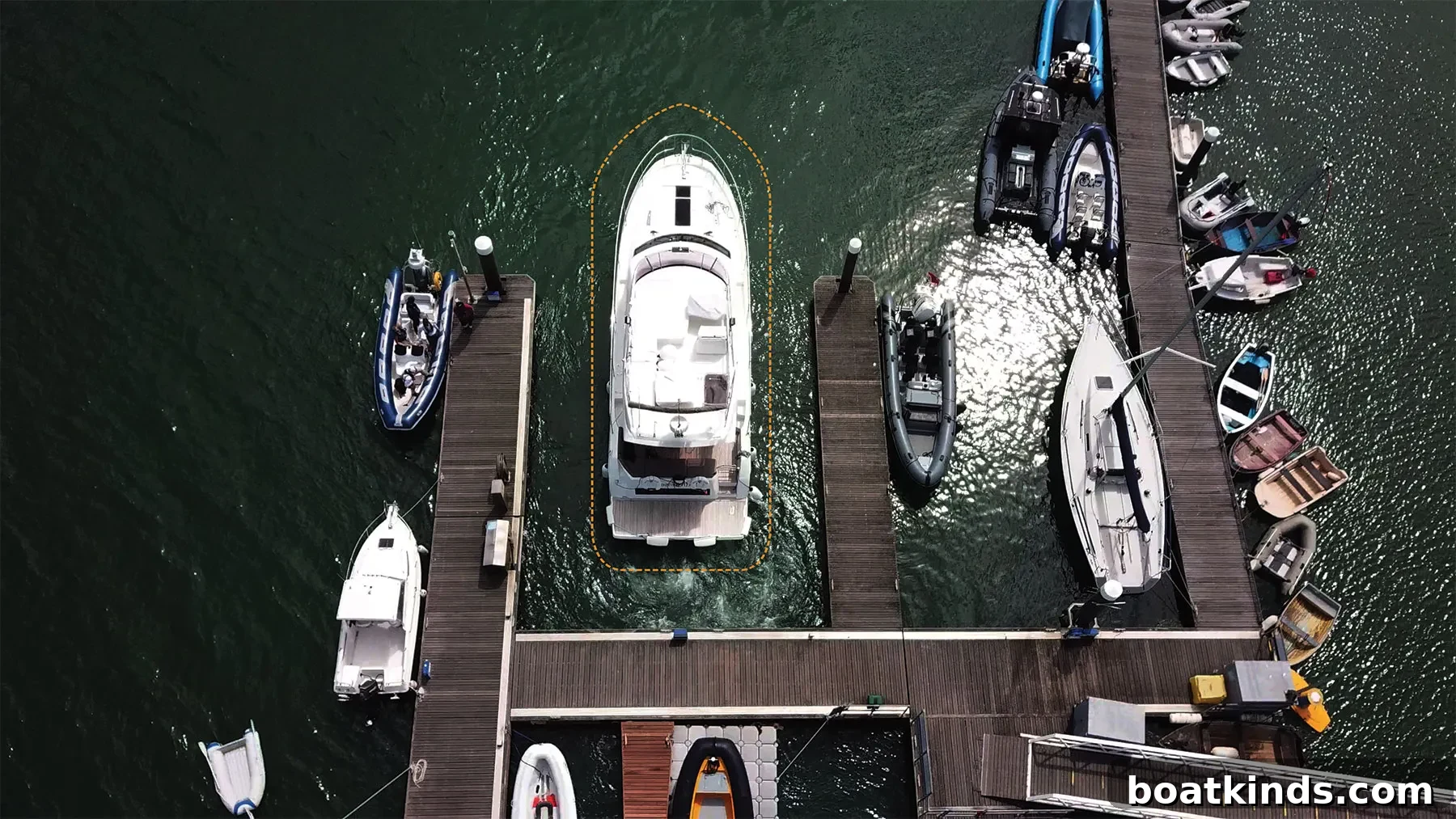
Raymarine DockSense Control
Raymarine’s DockSense Control builds on an earlier prototype we called a “force field” around the boat. Developed with Mercury Marine and tested with Boston Whaler, DockSense combines intelligent object recognition and motion sensing with joystick piloting. The system anticipates movement and intervenes through the joystick to keep the boat a programmed distance—typically around three feet—from obstacles. In prototype tests it was virtually impossible to strike the dock.
DockSense Control has been installed on a Monte Carlo 76 Skylounge with Volvo Penta IPS drives, and Brunswick plans to offer it on the Boston Whaler 380 Realm. Mercury Marine and Prestige Yachts have played key roles in DockSense development and validation.
The system uses five FLIR 3‑D stereo‑vision cameras to create a full 360‑degree view and detect any object projecting more than roughly 40 centimeters above the water. Camera imagery appears on a Raymarine Axiom multifunction display as graphics and video, and an audible alert warns the captain when objects are close. The Virtual Bumper can be adjusted to match slip widths; the captain can temporarily disable the bumper on one side to snug up to a dock manually.
DockSense also includes an automated alignment feature that, on command, aligns the boat with the dock, snugs it up and holds that position—against an offshore wind, for example—while lines are secured. According to developers, DockSense offers much finer heading and position control than virtual‑anchor systems like Mercury Skyhook and can hold a vessel close to a dock for extended periods.
For now, DockSense Control is intended as an OEM installation and requires detailed setup. Manufacturers need accurate 3‑D models, stability and trim data, and precise centers of gravity and rotation. Once configured for a model, however, the setup is repeatable for production boats.
Raymarine also offers DockSense Alert, which uses the same imaging and sensing tools but does not interface with the propulsion system. It provides the visual display and audible Virtual Bumper warnings so the captain can make manual corrections.
Will fully autonomous docking arrive for pleasure boats? “I can totally see autonomous docking in the future,” says a Raymarine spokesperson. “We have much of the hardware capability; software must evolve to handle anomalies—like a kayak suddenly crossing a slip.”
Brunswick’s 2021 investor presentation highlighted progress on its Autonomous Connected Electrified Shared (ACES) strategy, noting hundreds of employees focused on commercialization and partnerships to advance marine ADAS and autonomy. Collaborations with Carnegie Robotics and Sea Machines Robotics further accelerate development of autonomy and remote control solutions for marine applications.
Taken together, these developments suggest that self‑docking pleasure boats are no longer science fiction but a near‑term possibility as manufacturers refine sensing, control and software integration.
This article was originally published in the August 2021 issue.