
Monet’s Studio Boat and the Joys of Seeing the Water Differently
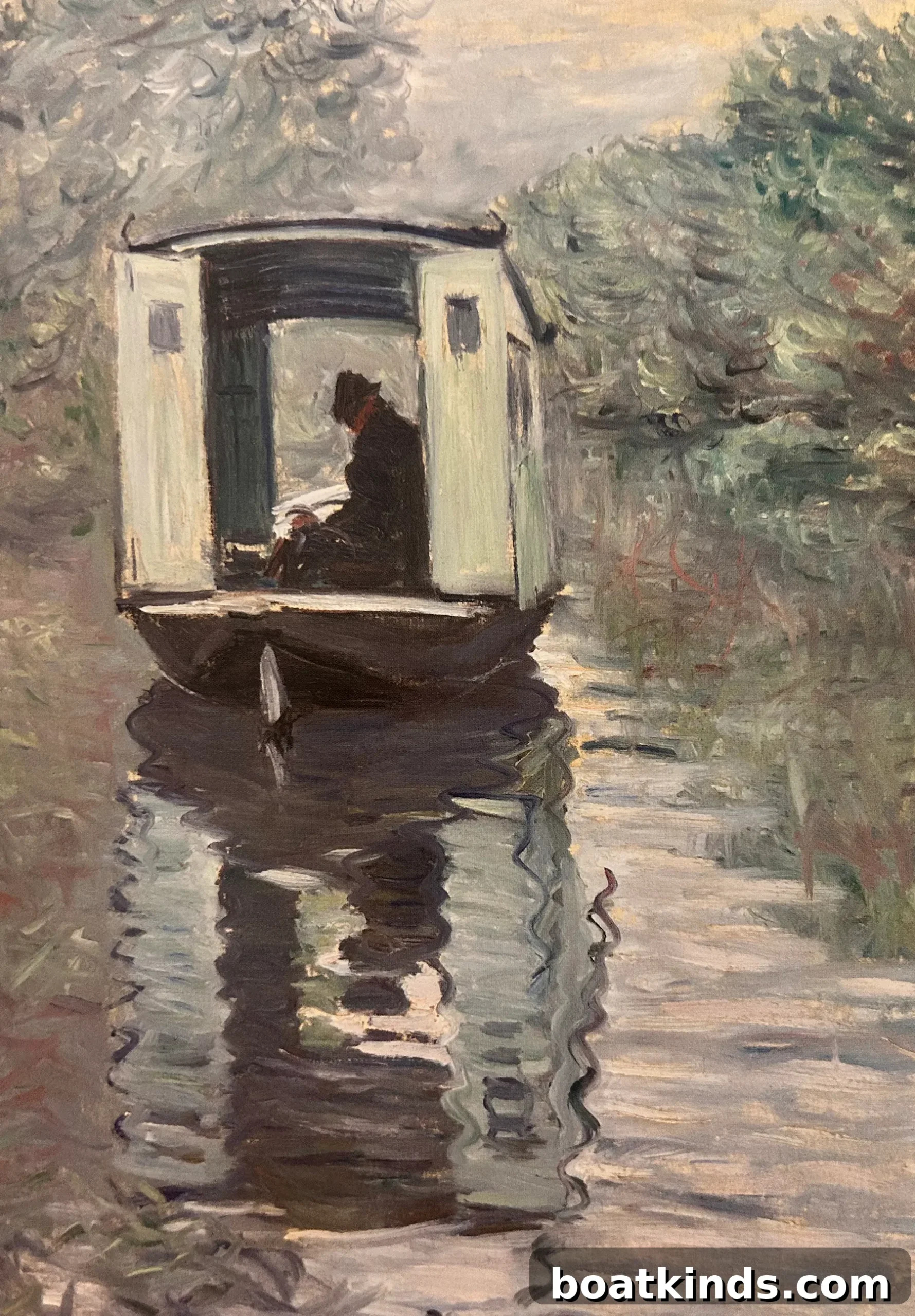
The Barnes Foundation in Philadelphia houses roughly 4,000 works of art, including about 900 paintings, and its collection is often valued at around $25 billion. On a cold January afternoon, moving quickly through the galleries before closing, I paused when a small, odd-looking boat in an oil painting caught my eye. It was a quiet reminder of how a modest craft can shape an artist’s vision—and of how boats open access to different points of view.
The painting, “The Studio Boat” (Le Bateau-atelier), was painted in 1876 by Claude Monet. It shows the artist working aboard his own vessel on the Seine. Monet bought the boat around 1873 after moving to Argenteuil, a Paris suburb. He described it as a “cabin made out of planks,” with just enough deck space to set up an easel. The boat itself was simple and utilitarian, yet it enabled Monet to reach scenes and angles on the water that would otherwise have been out of reach—and those scenes became central to some of his most famous works, including his series “Boats at Argenteuil.”
Standing there, watching how the light in the painting suggested a different perspective on a familiar landscape, I was reminded of one of the great pleasures of boat ownership: the chance to encounter the world from a new vantage point. Whether you’re painting from a small studio boat or heading offshore for days at a time, watercraft can transform how you experience place, light and motion.
That idea—boats as portals to fresh experiences—runs through the stories in this issue. In “Worth the Wait,” David Szewczul of Connecticut describes how his passion for tuna fishing led him to trade a runabout production center console for a semi-custom 46-foot boat that resembles a commercial fishing vessel. Building that boat required time, money and problem-solving from a busy full-time executive, but the result is a platform that expands where and how he fishes. The larger, more capable boat allows multi-day trips offshore and access to fisheries he couldn’t reach before, turning extended outings into memorable, perspective-shifting experiences.
Another piece, “Ivy League Effort,” follows a team of Princeton students who applied creative engineering to marine propulsion. They modified a power train for a hydroplane that set a record for electric propulsion with a top speed of 114.2 mph. The students’ achievement is noteworthy not only as a technical milestone but also as an indicator of where marine technology is heading: electric power continues to improve, and innovative applications—driven by fresh thinking from students and young engineers—are accelerating that progress.
My inbox also offers glimpses of how readers are shaping their own time on the water. John Torelli recently wrote to describe his plan to commission a Venetian-style tender as a day boat for coastal trips out of his home port in San Diego. A lifelong boater who has owned four trawlers and logged many offshore miles, he’s now seeking a different kind of experience—shorter coastal runs and the chance to take in unfamiliar views from a new helm. That desire to change perspective, to see places differently from a boat, is a common thread among boaters of all backgrounds.
Monet’s small studio boat may have been a modest “cabin made out of planks,” but its story illustrates a larger truth: a vessel, whether simple or sophisticated, can reshape what you notice and how you spend your time. Boats offer access, perspective and the possibility of slow, sustained attention to light, weather and landscape. For artists and anglers, students and seasoned captains alike, the water presents opportunities to reframe familiar places and to discover new ones.
Jeanne Craig, [email protected]
This article was originally published in the March 2024 issue.