

When someone falls overboard, every second matters. Early detection dramatically improves the chance of a successful rescue, so many boat owners now equip their vessels with wireless man-overboard (MOB) systems. These solutions range from inexpensive Bluetooth beacons you monitor with a smartphone to more advanced systems that manage dozens of tags and interface with onboard electronics. Below is an overview of several current options, how they work, and which situations they best suit.
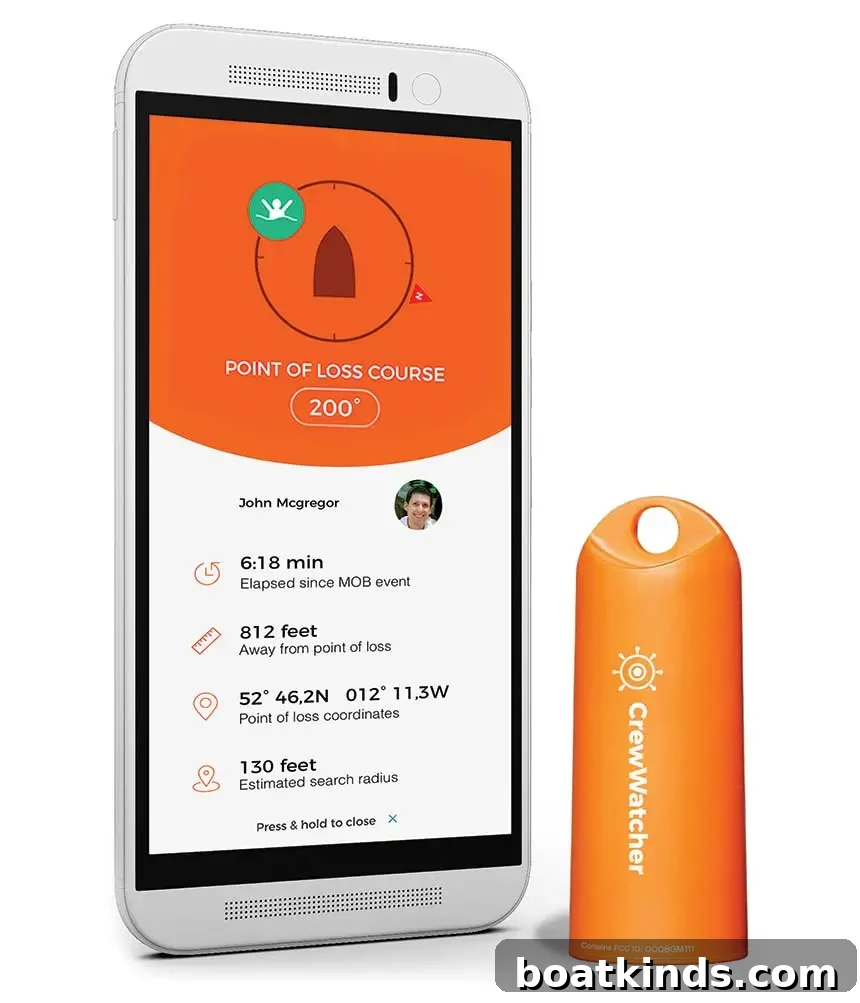
Weems & Plath’s CrewWatcher
CrewWatcher is a compact cylindrical Bluetooth beacon—about 3 inches tall and 1.5 inches in diameter—designed to clip or attach to a PFD, clothing, or gear. When the beacon goes out of Bluetooth range or a built-in sensor detects water, the CrewWatcher app (iOS and Android) triggers an alarm on an onboard smartphone.
The app can track up to five beacons, making it suitable for small crews, pets, or even key items like a towed dinghy. If a tag drops out of range, the app displays the last known location and, when the beacon is rediscovered, updates the distance to that beacon. Typical Bluetooth range in open conditions is roughly 98 feet, though metal structures and other obstacles aboard the vessel can reduce that distance. Each beacon uses a non-replaceable battery rated for roughly three to five years depending on use. Individual beacons are priced at $89.
ACR OLAS
ACR’s OLAS system combines a watch-style tag (about $85) or a Float-On unit ($139) — the latter doubles as a floating flashlight, beacon, and water-activated strobe rechargeable via USB — with the free ACR OLAS app. Like CrewWatcher, the app provides onboard alerts when tags go out of range, but OLAS also includes a solo mode for single-handed sailors.
A key feature of OLAS is automated shore notification: if a tag leaves range and the alarm isn’t canceled within a brief delay, the app can send an SMS with the time and location to a predefined emergency contact. This is especially useful for letting someone on land know about a MOB event, provided the boat’s phone remains onboard and has cellular reception.
ACR also offers modular expansions to extend functionality. The Core module (USB powered and portable) increases the supported device count from six to 15 and adds an 85 dB siren and a red visual alarm. The 12-volt Guardian module adds those features plus an engine kill switch to shut down propulsion during a MOB event. An Extender module can broaden the monitoring range to cover boats up to 100 feet long. These modules expand the system’s reach and onboard integration.
Fell MOB+
Fell MOB+ is a dash-mounted system rather than a phone-dependent solution. The central module pairs with up to 20 tags and actively monitors four at a time. One of those tags is designated as the operator’s; if that tag goes overboard, the system sounds an alarm and activates an engine kill switch. If any of the other monitored tags fall into the water, the system triggers an alarm only. The engine kill can be manually overridden by pressing and holding a button on the dash module.
Fell offers a bundle with the dash module and one tag for $199; additional tags cost about $40 each. Tags can be worn in a watch-band strap, attached by lanyard to a PFD or clothing, or clipped to a strap or pet collar. Tags use replaceable batteries with roughly 300 hours of life. Fell is also collaborating with Mercury Marine to integrate MOB functionality into Mercury’s SmartCraft digital suite, including SmartIgnition, a keyless ignition that incorporates MOB protection.
For More Serious Cruising Boats
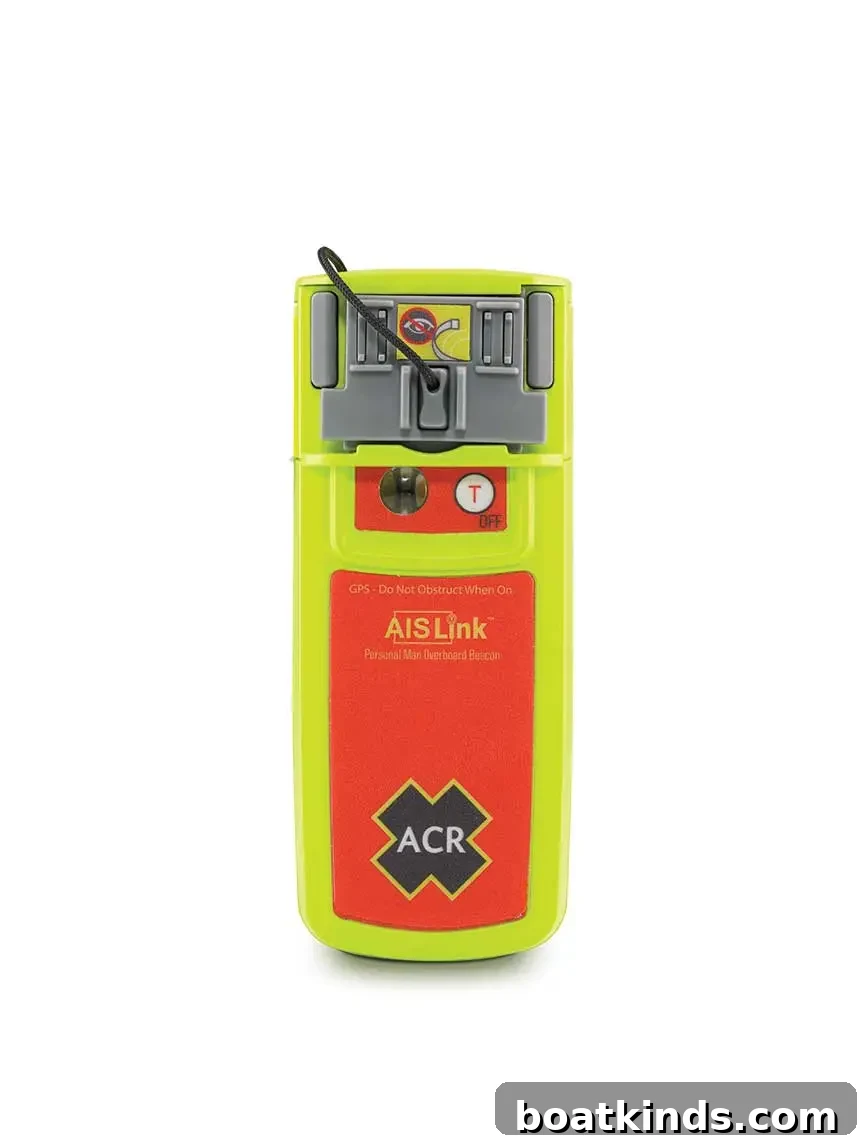
For offshore passages or open-water cruising, consider AIS MOB beacons or 406 MHz personal locator beacons (PLBs). Unlike short-range Bluetooth devices, these units provide precise position reporting that can be received by AIS-equipped vessels, shore stations, and search-and-rescue organizations.
AIS MOB beacons, typically priced between $225 and $300, transmit a continuous MOB signal and position to all AIS receivers in range. Their location updates are ongoing rather than limited to the point of loss, and some models also transmit a DSC distress alert on VHF so nearby vessels with radios receive the warning.
PLBs operate on the 406 MHz emergency frequency used by EPIRBs and communicate with the COSPAS-SARSAT satellite system to alert rescue coordination centers. PLBs with integrated GPS (usually $300–$400) send both the device identifier and precise coordinates, allowing search-and-rescue teams to locate the individual and access any registered owner information. Note that AIS MOB beacons and PLBs require manual activation, which makes them unsuitable for unsupervised children.
Choosing the right man-overboard system depends on your boat type, cruising range, crew size, and whether you need automatic shore notifications or integration with onboard systems. For nearshore and recreational use, Bluetooth beacons tied to smartphone apps are affordable and convenient. For offshore or solo voyaging, AIS MOB or PLB units offer the best chance of timely, accurate location reporting and coordinated rescue.
This article originally appeared in the November 2019 issue.