
Upgrading Boat Refrigeration: From Block Ice to Solar-Powered 12V Systems
Providing reliable refrigeration aboard a cruising boat is a common challenge. Early on, my family made do with a 25-pound block of ice, but over the years I gradually moved toward a dependable, solar-powered 12‑volt refrigerator system that would support long cruising days without constant reliance on shore power or running the engine.
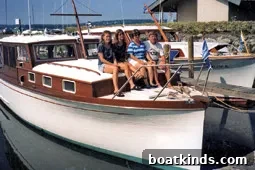
In 1971 my wife Nancy and I bought Sandstorm, a 1928 Richardson 28-foot sedan cruiser. The oak-framed, cedar-planked hull with its mahogany cabin and a single 1937 Kermath 6-cylinder engine pushed her along at about 7 knots on a good day. The layout included a forward head and sink, a trunk cabin with settees that converted to bunks, a small galley with a propane stove, and gravity-fed water from a bow tank. The cockpit had another fold-out bunk arrangement. With three growing kids, Sandstorm felt like a spacious family boat.
The icebox had been removed before we bought her, leaving a mahogany countertop with the original top-loading door. That presented an opportunity: I built a new insulated box lined with polyethylene and retained the top-loading design. It efficiently held a 25-pound block of ice. Later I added a 12‑volt thermoelectric cooling unit to help the ice last longer, but on hot nights the unit could still drain the house battery.
After cruising the lakes and canals of upstate New York, Lake Ontario and the Rideau Canal, we decided to test our systems on a longer run down the Intracoastal Waterway to Florida. The trip exposed the thermoelectric unit’s limitations—the cooling fan began to fail and eventually quit. Between ice stops we ate the contents of the box before it spoiled, and we resolved that future boats would have a reliable refrigeration system.
In spring 1977 we bought another Richardson, White Cap, a 1940 33-foot sedan cruiser. It had a sizeable side-loading icebox and an old 1950s 110‑volt refrigeration setup powered by a large GE compressor. The system worked well at the dock, but relying on shore power or a generator ran counter to our cruising style: we didn’t want to listen to someone else’s generator all night. So we kept buying ice and logging miles.
By 1986 we were planning extended cruising and I installed a 70‑hp Westerbeke diesel in place of the original Gray Marine engine and built a homemade engine-driven refrigeration system. I adapted an automotive air-conditioner compressor and salvaged a heat exchanger and evaporator from a 1950 Chris‑Craft. I added two inches of polyurethane foam and a new liner to the icebox. To create “cold plates,” I placed 5‑liter wine bladders filled with a water/antifreeze eutectic mix that froze at about 20°F inside the evaporator compartment at the top of the box.
That engine-driven arrangement served us well for nearly twenty years, but it required running the engine to keep things frozen. In spring 2006, inspired by our daughter Karen’s recent work modernizing the refrigeration on her 25-foot Albin trawler—she installed a built-in box, an efficient 12‑volt keel-cooled system and solar panels—we decided to switch to a dedicated 12‑volt marine refrigeration system paired with solar charging.
I removed the old GE shore-power compressor and the homemade engine-driven gear and installed a Frigoboat 12‑volt compressor with a keel-cooled condenser and a new evaporator inside the icebox. Keel cooling eliminates the need for a seawater pump or fan to cool the condenser, reducing maintenance and electrical load. I also added an optional “Smart Control” to regulate compressor speed for more efficient operation and longer compressor life.
For battery capacity, we retired the single old 4D house battery and installed four 6‑volt deep-cycle golf cart batteries wired to give more than 400 ampere‑hours. The original 4D was rated near 200 ampere‑hours when new, so this was a major increase. Normally the engine’s 55‑amp alternator can maintain the batteries during a few hours of daily travel, but we wanted to be able to anchor or moor for days or weeks without running the engine.
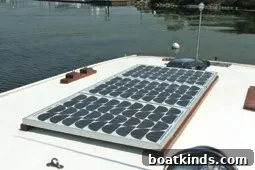
To support extended stays off-grid, I mounted three Siemens 50‑watt RV solar panels on the cabin top and added a Solar Boost 2000E charge controller from Blue Sky Energy. The panels provide steady charging—often enough even on overcast days—to keep the battery bank topped off. With this setup we can run the refrigeration continuously and still power lights, stereo, water pumps, two VHF radios, GPS, a depth sounder and a small inverter for a laptop and printer. In practice, refrigeration is the constant draw, and the solar array supplies the sustained charge needed for that load.
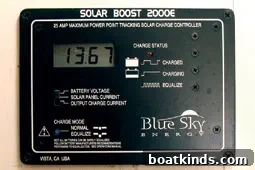
After two seasons living aboard and cruising New York’s lakes, rivers and canals, we found no need for shore power or routine engine charging. The trade-off is that the cabin top space once used to stow a dinghy now holds solar panels—a small price for making ice on board instead of buying it. The switch to a modern 12‑volt keel‑cooled refrigerator and a solar-charged battery bank transformed our cruising experience, giving reliable cold storage and the freedom to stay at anchor without noisy generators or frequent ice runs.
Don Pakkala has cruised for more than 30 years and logged over 25,000 miles. When ashore, he works on classic and antique restorations as well as marine system design and installations. This article originally appeared in the New England Home Waters section of the July 2009 issue.