
Discovery of a Giant Coral Colony in the Solomon Islands
Eric Brown was aboard the 130-foot Argo, finishing the day’s work with the rest of the crew, when Manu San Félix asked to talk. “It was a classic day,” Brown told Soundings. “But when we came back that night, Manu came up to me—I’m the coral reef scientist on board the boat—and he says, ‘Eric, I found something here.’”
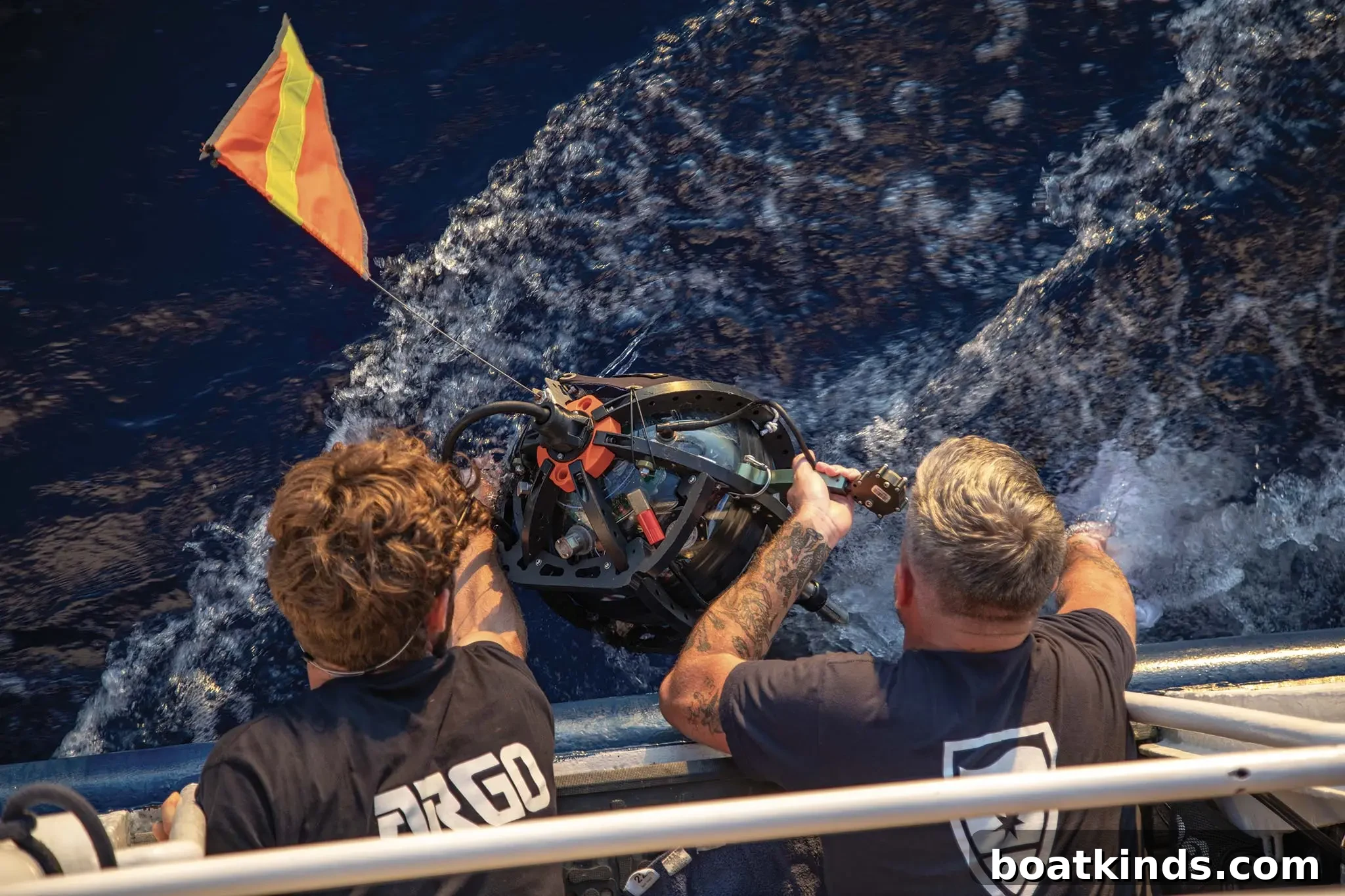
Both men are part of the National Geographic Society’s Pristine Seas project, a marine expedition program focused on exploring remote tropical Pacific waters to support conservation. The Argo operates like a modern exploration vessel, reaching places few humans visit. San Félix, a marine biologist and underwater imaging director, had been shooting photos and video all day when he noticed a large, dark form on the seafloor.
“They actually thought it was a shipwreck because there are a lot of shipwrecks in the Solomon Islands dating back to World War II or even before,” Brown says. “We’re talking and I said, ‘Ooh, this is quite massive. This is unusual. We should go back and explore this guy a little bit more.’”
The expedition team is careful about altering its schedule. The Argo serves many remote island communities and lingering in one spot can reduce time available for other locations where people are counting on scientific and conservation support. Still, the leader agreed to return the next morning for an extended survey.
Brown used his experience mapping and measuring giant corals to organize the dozen divers who assembled aboard the Argo. At dawn they split into six teams with different roles: some teams focused on width and circumference, others on height and slope, and some went deeper than the standard recreational limits—all to document and measure what would become the largest single coral colony ever recorded.
“It’s a big production,” Brown says. “When you’ve got a circumference of 183 meters, that takes a little while to swim around. It’s like two football field lengths.”
Beyond its sheer size, the formation appears to be unusual in its structure. Rather than a patchwork reef built from many separate colonies and species, this appears to be a single, massive colony of the coral species Pavona clavus. Brown explains that if tissue samples taken from different parts of the mound show the same genetic signature, they will have confirmed it is one genetically distinct organism rather than many individuals clustered together. The team plans to return next year to complete those tests.
The top of the coral mound begins roughly 45 to 50 feet below the water’s surface and slopes down to about 130 feet. That depth range places much of the structure beyond typical recreational dive limits, which helps explain why recreational divers and passing boats had not previously identified its full extent in this part of the Solomon Islands.
What makes this discovery even more remarkable is that the colony is thriving while much nearby reef shows signs of severe disturbance. “Nearby this one mega coral, we found large stands of dead coral and sections of reef that had been decimated by a coral bleaching event or a cyclone that had come through and left a lot of reef rubble,” Brown says. “There were some sections of the Solomon Islands that didn’t look so good, and I would say the disturbance event had taken place in the past five years.”
A resilient, centuries-old coral like this one offers a rare beacon of hope. Projections that predict dramatic losses for coral ecosystems by mid- to late-century underscore the importance of identifying and protecting surviving colonies. Although reefs cover only about 0.2 percent of the ocean’s area, they support more than a quarter of marine species, so protecting large, reproductive individuals can have outsized benefits for biodiversity and reef recovery.
Brown and his colleagues estimate that this giant colony may have been growing for more than 300 years. The discovery occurred in late October, and the team withheld public announcement until after the U.S. presidential election in November to ensure broader attention and to give context to its conservation importance.
Brown points out how protecting large organisms provides exponential benefits. “Let’s say you have a fish that’s 1 meter in size,” he explains. “That’s a good-size fish. It produces X number of eggs and sperm. The fish that’s 2 meters doesn’t produce twice the number; it can produce eight times the number. Once something achieves a certain size, the amount of reproductive material increases exponentially. The goal is that when you can protect the really big individuals, that’s when you get the most bang for the buck—and coral will be the same because they have so much more surface area.”
Finding this survivor has energized the team. They are optimistic that further surveys in remote Pacific sites will reveal more exceptional corals—possibly even larger colonies—whose protection could be critical to reef resilience and marine conservation efforts in the Solomon Islands and beyond.
“The bigger hope is that we find ones that are even bigger,” Brown says. “Just wait.”
February 2025